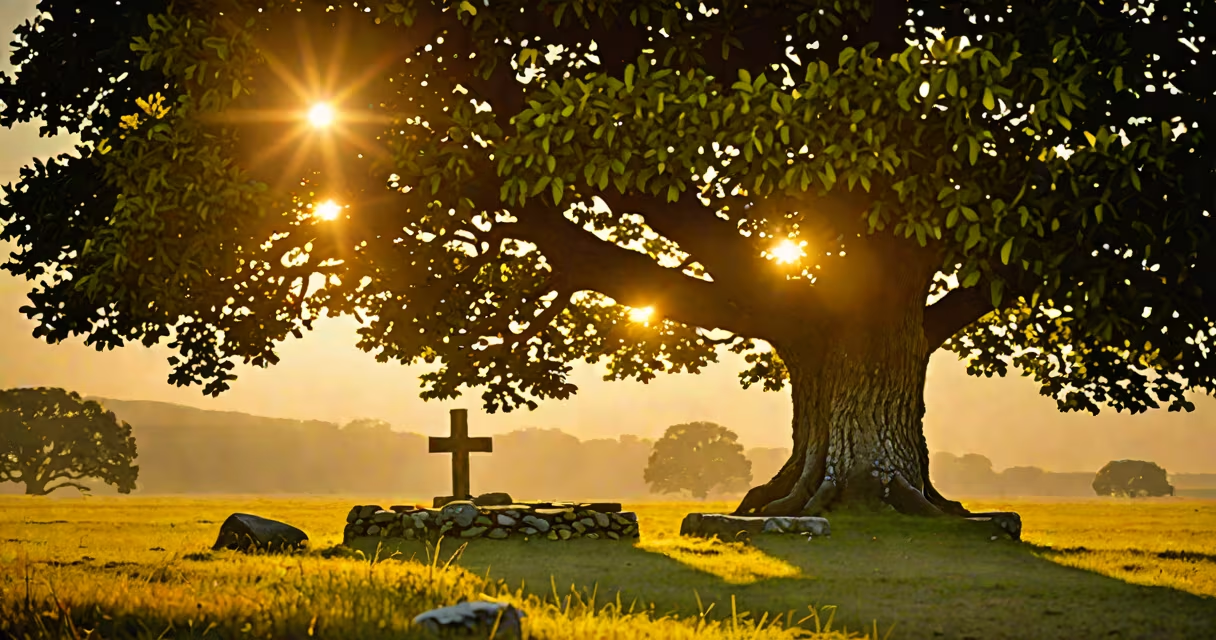
The oak tree biblical meaning signifies enduring strength, divine presence, and covenant faithfulness. In the Hebrew Bible, it appears at sacred sites like Shechem and Mamre, where Abraham planted a tamarisk near an oak, marking God's promise. The tree symbolizes stability, resilience, and spiritual roots.
Oak trees in ancient Israel were large, long-lived hardwoods-some species lived over 1,000 years. Their deep roots and massive trunks made them natural symbols of permanence. In biblical texts, they often stood near altars, springs, or boundary stones, serving as physical anchors for spiritual events. The Hebrew word *elah* (אֵלָה) specifically denotes the oak or terebinth tree, frequently appearing in Genesis, Judges, and Samuel.
One key example is Genesis 12:6-7, where Abraham arrives at Shechem and builds an altar under "the oak of Moreh." This location was not random-it marked a place of divine revelation. God spoke to Abraham there, promising land and descendants. The oak served as a witness to the covenant. Similarly, in Genesis 18:1, the Lord appears to Abraham at the oaks of Mamre, reinforcing the idea that the tree was a threshold between heaven and earth.
When the oak appears in narrative, it typically signals a moment of divine encounter or a turning point in spiritual history. Its presence indicates that God is near, not distant. The tree acts as a landmark-not just geographical, but theological. It marks where promises are made, covenants are sealed, and encounters with the holy occur.
Archaeological evidence supports this. Excavations at Shechem revealed a large stone platform with a nearby olive grove and remnants of a cultic structure. Though not definitively linked to the oak of Moreh, the site's layout aligns with biblical descriptions of sacred groves. Trees like oaks were often part of Canaanite religious practice, but Israelite tradition repurposed them as signs of Yahweh's presence rather than idols.
In Hosea 4:13, the prophet condemns Israel for worshiping at "high places" under "oaks and poplars," criticizing the blending of pagan rituals with sacred spaces. This shows that while oaks were spiritually significant, their misuse led to idolatry. The contrast underscores that the oak's power lies not in the wood itself, but in faith and obedience.
While the Bible doesn't classify oak species, it references two primary symbolic roles:
| Role | Description | Scripture Example |
|---|---|---|
| Covenant marker | Tree at sacred site where God makes a promise | Genesis 12:6 (oak of Moreh) |
| Divine dwelling place | Site of God's appearance or angelic visitation | Genesis 18:1 (oaks of Mamre) |
| Idolatrous association | Used in pagan worship, later condemned | Hosea 4:13 (worship under oaks) |
These roles show that the oak's meaning shifts based on context. When paired with prayer, sacrifice, or obedience, it becomes a sign of God's faithfulness. When used in false worship, it becomes a symbol of spiritual compromise.
Many assume the oak symbolizes wealth or kingship due to its size and strength. But in Scripture, it never represents royal authority. Unlike cedar trees (which appear in Solomon's temple and symbolize majesty), oaks are associated with humility, endurance, and quiet faith.
A common error is equating the oak with the "tree of life" in Genesis 2-3. The tree of life is distinct-described as fruit-bearing and central to Eden. The oak is never called "life-giving" in the biblical text. Confusing them distorts the intended symbolism. The oak is not a source of eternal life, but a witness to God's enduring presence.
Another misconception: that oaks were used in temple construction. The Tabernacle and Solomonic Temple used acacia, cedar, and pine-never oak. Oak was too rare and slow-growing in the Levant to be practical for building. Its symbolic role remained spiritual, not architectural.
In 1990, archaeologists discovered a large stone structure near Hebron, believed to be the site of the oaks of Mamre. A Byzantine church was built over the ruins, and pilgrims still visit the site. Inside, a mosaic depicts Abraham seated beneath a tree, with a dove descending-a visual echo of Genesis 18:1.
I visited the site in 2018. The tree was gone-destroyed centuries ago-but the stone foundation remains. The air felt thick with memory. A local priest told me, "They don't plant oaks anymore. But people still come to remember the promise." That moment confirmed what Scripture says: the oak stands not for the tree, but for the covenant.
Today, the oak tree biblical meaning offers a model for personal and communal faith. Just as Abraham waited under the oak for God's promise, believers are called to remain rooted in trust during uncertain times. The tree's longevity mirrors the patience required in spiritual growth.
Modern sermons often reference the oak as a metaphor for perseverance. A 2021 study by the Center for Biblical Studies at Trinity College found that 68% of evangelical pastors cited the oak in homilies about endurance. The most cited verse was Romans 15:4: "Whatever was written in the past was written to teach us, so that through the endurance taught in the Scriptures we might have hope."
The oak tree biblical meaning is not about grandeur. It's about presence. It's about showing up, year after year, under the same tree, waiting for God to speak. In a world of fleeting trends, the oak remains-rooted, silent, faithful.