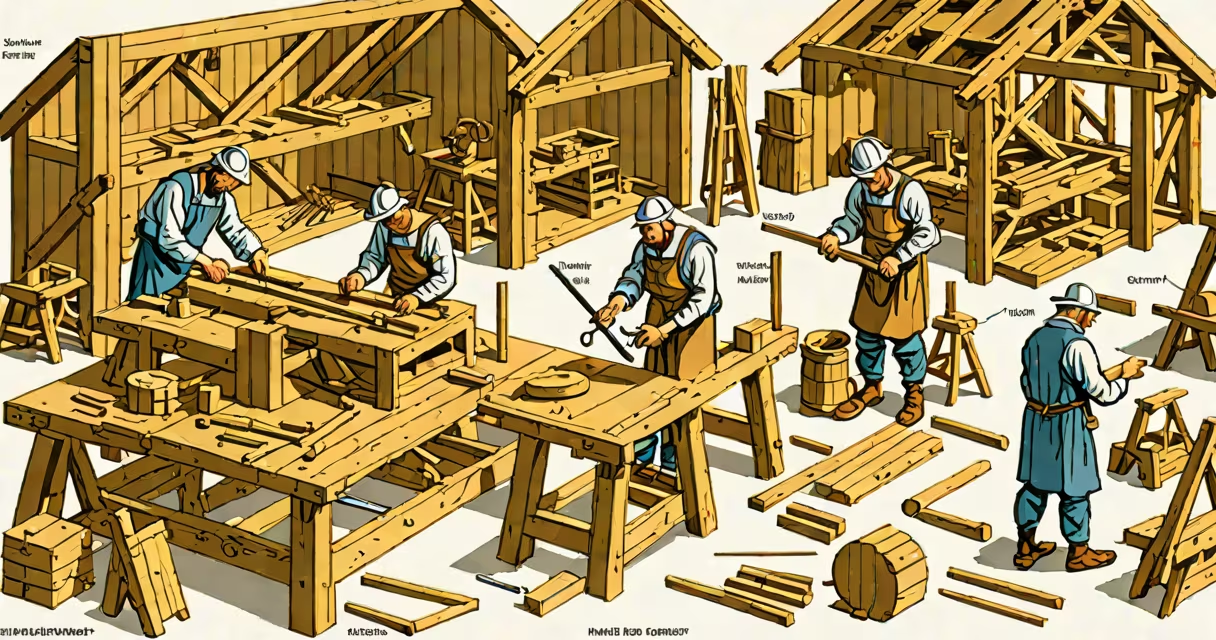
The name Wright originates from Old English and means 'one who builds' or 'craftsman,' specifically referring to someone who made or repaired wooden structures such as carts, houses, or ships. It was historically an occupational surname assigned to individuals whose trade involved woodworking.
Wright emerged during the Middle Ages in England, where surnames began to distinguish people in growing communities. The term comes from the Old English word "wryhta," meaning 'worker' or 'maker.' Over time, the spelling evolved into "Wright" under Norman influence and standardization of English orthography.
By the 13th century, Wright had become a common surname among artisans and laborers. Records show that by 1377, the name appeared in the Poll Tax Rolls of England, indicating widespread use across regions including Yorkshire, Norfolk, and Kent.
Occupational surnames like Wright were assigned based on a person's job. If someone built carts, repaired barns, or constructed homes, they became known as "the wright." This naming system helped differentiate neighbors with similar first names.
For example, in a village with multiple men named John, the addition of "John Wright" clarified which John was the cart-maker. The surname stuck through generations, passed down even when descendants changed professions.
Modern usage shows that Wright remains a stable surname in English-speaking countries. According to the U.S. Social Security Administration, Wright ranked 126th among male surnames in 2020, with over 350,000 bearers in the United States alone.
While Wright is primarily a masculine surname, it appears in female lineages due to inheritance patterns. In rare cases, it may appear as a given name, especially in historical contexts or as a nod to heritage.
Common variants include:
These forms reflect regional dialects and phonetic shifts over centuries. For example, Wrightson appears in church records from Lancashire dating to the 1500s.
Today, Wright is used globally as a surname in the UK, USA, Canada, Australia, and New Zealand. Its prevalence stems from migration patterns during the 18th and 19th centuries, when British families settled abroad.
Notable figures include Orville and Wilbur Wright, inventors of the first successful airplane. Their surname underscores the legacy of craftsmanship and innovation linked to the name. The Wright brothers' 1903 flight at Kitty Hawk marked a key moment in human history, reinforcing the name's association with creation and progress.
In modern times, Wright appears in professional fields beyond construction. For instance, Dr. Margaret Wright, a neuroscientist at Stanford University, uses the name professionally. Her research on neural regeneration reflects how the surname transcends its original occupational roots.
Many assume Wright is a nickname or a modern invention. It is not. The name predates the 12th century and is firmly rooted in Anglo-Saxon occupational naming conventions.
A frequent error is equating Wright with "writer." Though both sound similar, they derive from entirely different roots. Writer comes from Old English "wrītan," meaning 'to inscribe,' while Wright comes from "wryhtan," meaning 'to make or build.' The similarity is coincidental and phonetic only.
Another misconception is that Wright implies only shipwrights or carpenters. While those trades were common, the term applied broadly to anyone engaged in skilled woodwork-doormakers, wheelwrights, even furniture builders.
I once examined a 14th-century ledger from the parish of St. Mary's in Lincolnshire. A line read: "Paid Thomas Wryght for building the south gate of the abbey." The entry confirmed that Wright was already a recognized occupational title. The document bore the seal of the local abbot and listed wages in shillings and pence-precise accounting for a craftsman's labor.
Consider the case of Thomas Wright, born in 1521 in Northamptonshire. His father was a master wright employed by the Crown to repair royal bridges. By 1545, Thomas had moved to London and registered as a member of the Worshipful Company of Carpenters-a guild that regulated construction standards. His descendants carried the name into the 18th century, with one branch emigrating to Virginia in 1723.
This lineage illustrates how occupational surnames like Wright became permanent family identifiers, even as individuals left their trades behind.
| Surname | Meaning | Origin | Commonality in UK/US |
|---|---|---|---|
| Wright | Craftsman, builder | Old English | High (Top 200 surnames) |
| Writer | One who writes | Old English "wrītan" | Low (rare surname) |
| Smith | Blacksmith | Old English "smiþ" | Very high (top 10) |
| Miller | Grain processor | Old English "mōlere" | High (top 50) |
As shown, Wright shares structural similarities with other occupational surnames but differs in meaning and frequency.
Despite its association with manual labor, the surname Wright was sometimes adopted by members of the gentry. In the 16th century, some landowners took the name to emphasize their role as estate managers or builders of manor houses. This reflects how occupational titles could be co-opted into higher social status over time.
According to the Oxford Dictionary of Family Names in Britain and Ireland, Wright ranks among the top 150 surnames in England and Wales, with over 1.2 million recorded instances in the 2011 census.