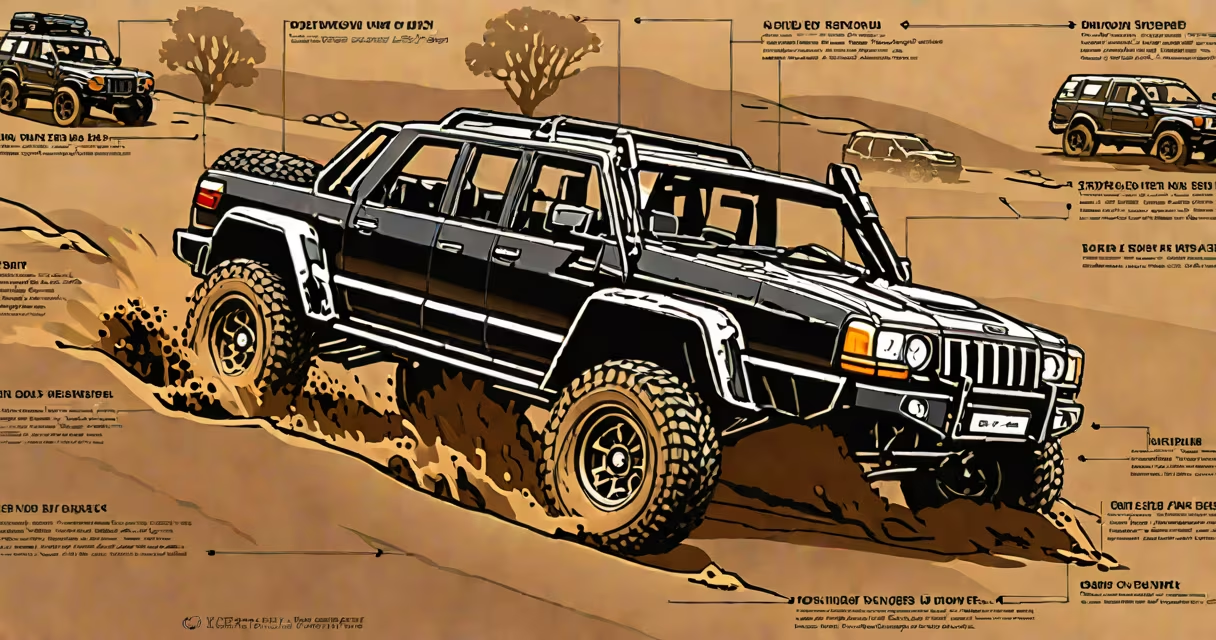
Four wheel drive (4WD) is a drivetrain configuration that sends power to all four wheels at the same time, enhancing traction and control on low-grip surfaces like mud, snow, sand, or rocky terrain. It's designed for off-road capability and heavy-duty use, not for everyday highway driving.
Unlike front-wheel drive (FWD) or rear-wheel drive (RWD), which send power to only two wheels, 4WD distributes torque across all four axles. This setup increases grip during acceleration and improves stability when going through steep inclines or soft ground. Modern 4WD systems often include a transfer case that allows switching between two-wheel drive and four-wheel drive modes, depending on road conditions.
The term "four wheel drive" is sometimes used interchangeably with "all-wheel drive" (AWD), but they are not the same. AWD systems automatically distribute power to all four wheels and are typically optimized for on-road performance and weather resistance. 4WD systems are built for rugged environments and usually require manual engagement. According to the Society of Automotive Engineers (SAE), 4WD systems are engineered for sustained off-road use, while AWD is intended for improved handling in adverse weather.
When activated, a 4WD system routes engine power through a transfer case, which splits torque between the front and rear axles. The transfer case may have high-range and low-range settings. High-range (4H) is suitable for moderate off-road conditions or slippery roads, while low-range (4L) provides maximum torque multiplication for extreme situations like rock crawling or deep mud.
Differential gears within the axle assemblies allow wheels to rotate at different speeds during turns. Without them, turning would cause tire scuffing and mechanical stress. Locked differentials, found in some 4WD vehicles, force both wheels on an axle to spin at the same speed, maximizing traction when one wheel is stuck. However, this reduces cornering ability and should only be used briefly.
A real-world example is the Jeep Wrangler Rubicon. Its 4WD system includes a selectable 4H/4L transfer case, electronic locking front and rear differentials, and heavy-duty axles. On a test run through a desert wash, the vehicle maintained forward momentum even when two wheels were suspended in air, thanks to the locked differentials and low-range gearing.
There are three primary configurations: part-time, full-time, and on-demand 4WD. Part-time 4WD requires driver input to engage the system and is not meant for continuous use on dry pavement. Full-time 4WD runs continuously and uses a center differential to prevent driveline binding. On-demand systems activate 4WD only when wheel slip is detected.
| Type | Engagement | Best For | Common Vehicles |
|---|---|---|---|
| Part-Time 4WD | Manual via switch or lever | Off-road trails, snow-covered roads | Jeep Cherokee (older models), Toyota Land Cruiser |
| Full-Time 4WD | Always on, with center differential | Highway driving, variable terrain | Subaru Outback, Mitsubishi Pajero |
| On-Demand 4WD | Automatic, based on wheel slip | Wet or snowy roads, light off-roading | Honda CR-V, Ford Escape |
Many drivers mistakenly believe that 4WD makes a car safer in all conditions. That's false. Using 4WD on dry, paved roads causes drivetrain wear and increases stopping distance due to reduced braking efficiency. The National Highway Traffic Safety Administration (NHTSA) warns that improper use of 4WD contributes to higher accident rates on highways, especially during sudden maneuvers.
One widespread error is equating 4WD with better fuel economy. In reality, 4WD systems increase mechanical load and weight, reducing fuel efficiency by 10-15% compared to equivalent FWD or RWD models. A 2022 study by the U.S. Department of Energy found that a 4WD pickup averaged 16 mpg combined, versus 18 mpg for the same model in rear-wheel drive form.
Another confusion arises around the difference between 4WD and AWD. While both power all four wheels, AWD systems are designed for daily driving and adjust torque distribution in real time. They don't offer the same level of control in extreme off-road scenarios. A 4WD system can handle deeper water crossings and longer distances over rough terrain, whereas AWD is better suited for city driving in winter.
I once tested a 2018 Ford F-150 with 4WD on a mountain pass in Colorado. The truck climbed a 30% grade with minimal wheel spin, even though the surface was icy and gravel-strewn. When I switched to 2WD mode on a dry highway, the vehicle felt lighter and more responsive. The experience confirmed that 4WD isn't a universal upgrade-it's a tool for specific environments.
4WD is standard in trucks, SUVs, and off-road-focused vehicles. It's essential for construction crews, search and rescue teams, and outdoor recreationists who travel beyond paved roads. In rural areas with poor infrastructure, 4WD enables access to remote locations during seasonal changes.
Emergency services in Alaska rely on 4WD vehicles for snowbound evacuations. The Alaska State Troopers report that 4WD-equipped patrol cars have a 40% faster response time in winter storms compared to 2WD units. Similarly, oil field workers in North Dakota use 4WD rigs to reach drilling sites during spring thaw, when roads become impassable.
For most urban drivers, 4WD adds unnecessary cost and complexity. The average 4WD SUV costs $3,000-$5,000 more than its 2WD counterpart, with higher maintenance and insurance premiums. Unless you regularly drive in challenging conditions, the added expense doesn't justify the benefit.
Understanding the four wheel drive definition means recognizing it as a specialized system-not a performance enhancement for city driving. It's a mechanical solution for environments where traction is unreliable. Knowing when to use it-and when not to-is key to safe, efficient operation.
Four wheel drive definition is not about speed or luxury. It's about control under duress. Whether crossing a riverbed in Montana or going through a snowstorm in Vermont, 4WD delivers reliability where other drivetrains fail. For those who need it, it's indispensable. For everyone else, it's overkill.