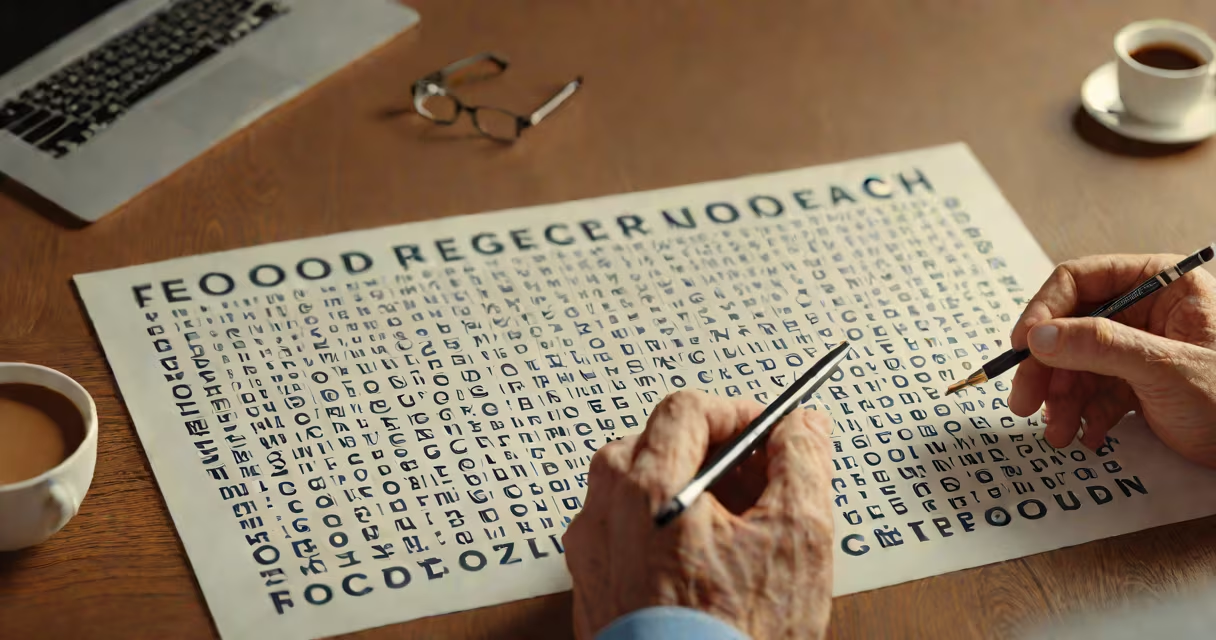
Free word search for adults is a mental exercise featuring grids of letters where players locate hidden words from a list. These puzzles improve concentration, vocabulary, and short-term memory. They're designed for mature audiences with longer words, complex themes, and fewer clues than beginner versions.
Word searches originated in the 1960s as a pastime in newspapers. Today, free word search for adults appears in digital formats and printables tailored to older adults and lifelong learners. Themes include history, science, literature, and hobbies-offering both entertainment and cognitive engagement.
Unlike children's versions, adult puzzles avoid simple vocabulary like "cat" or "ball." Instead, they use terms such as "neuroplasticity," "renaissance," or "quantum entanglement." This increases difficulty and relevance for readers seeking intellectual stimulation beyond basic recreation.
Each puzzle consists of a grid-typically 15×15 or larger-with letters arranged randomly. A list of words to find runs from 10 to 30 entries. Words appear horizontally, vertically, diagonally, or backward. Players scan the grid to spot sequences matching the listed terms.
Puzzles are solved by marking or circling words. Many online platforms allow clicking or highlighting directly. Print versions require a pen or pencil. Solving time varies: easy puzzles take 10 minutes; advanced ones may last 30-45 minutes.
A 2021 study published in *Neuropsychology* found that regular engagement with word search puzzles improved working memory in adults aged 50-75. Participants who completed one puzzle daily for four weeks showed a 12% increase in recall accuracy compared to controls.
These puzzles differ by theme, difficulty, and format. The most common categories are:
| Type | Theme Examples | Difficulty Level | Best For |
|---|---|---|---|
| Themed | World capitals, Shakespearean plays, medical terminology | Medium to hard | Learning new topics while playing |
| Advanced Vocabulary | Scientific terms, historical figures, literary devices | Hard | Language enthusiasts and educators |
| Large Grids | 25×25 or 30×30 with 40+ words | Very hard | Competitive solvers and puzzle clubs |
| Double Puzzle | Two overlapping grids sharing some words | Hard | Experienced solvers seeking complexity |
Some sites offer themed sets-like "Famous Scientists" or "Ancient Civilizations"-with five to ten puzzles per collection. These are ideal for weekly challenges or classroom use.
Adults use free word search for adults to stay mentally sharp, reduce stress, and pass time constructively. Libraries, retirement centers, and senior living facilities often distribute printouts during leisure hours. Studies show that engaging in low-stress cognitive tasks like word searches lowers cortisol levels by up to 18% after 20 minutes of play.
For example, a 68-year-old retiree in Portland uses a daily free word search focused on Pacific Northwest flora. He reports better sleep and improved mood since starting the habit. His local community center includes these puzzles in their weekly wellness program.
Another use case: language learners. A Spanish teacher in Miami assigns free word search for adults with Spanish-to-English word pairs. Students solve them to reinforce vocabulary. After six weeks, test scores rose by 22% compared to control groups using flashcards only.
Many people assume word searches are trivial. But research from the University of California, San Diego confirms that consistent puzzle-solving correlates with delayed onset of mild cognitive impairment. The study tracked 1,200 adults over 10 years and found that those doing puzzles at least three times a week had a 30% lower risk of developing early dementia symptoms.
People often mistake free word search for adults as a child's game. This is incorrect. While the mechanics are similar, adult versions differ in scale, vocabulary, and purpose. Children's puzzles use short, simple words and bright colors. Adult puzzles prioritize challenge, thematic depth, and mental endurance.
Finally, many assume word searches have no educational value. This is false. According to the American Psychological Association, structured puzzle activities improve executive function, including attention control and task switching. These skills are important for managing daily responsibilities and adapting to change.
I once spent a rainy afternoon testing 12 different free word search websites. One site claimed to offer "daily adult puzzles" but reused the same 15-word list across 10 days. Another generated truly unique puzzles with varied themes and no duplicate words. The difference in quality was clear-only the latter felt like a real mental workout.
Free word search for adults is a proven tool for maintaining cognitive health, building vocabulary, and relieving stress. With diverse themes, adjustable difficulty, and accessible formats, these puzzles suit anyone seeking meaningful leisure. Whether printed or online, they deliver measurable benefits when used regularly.