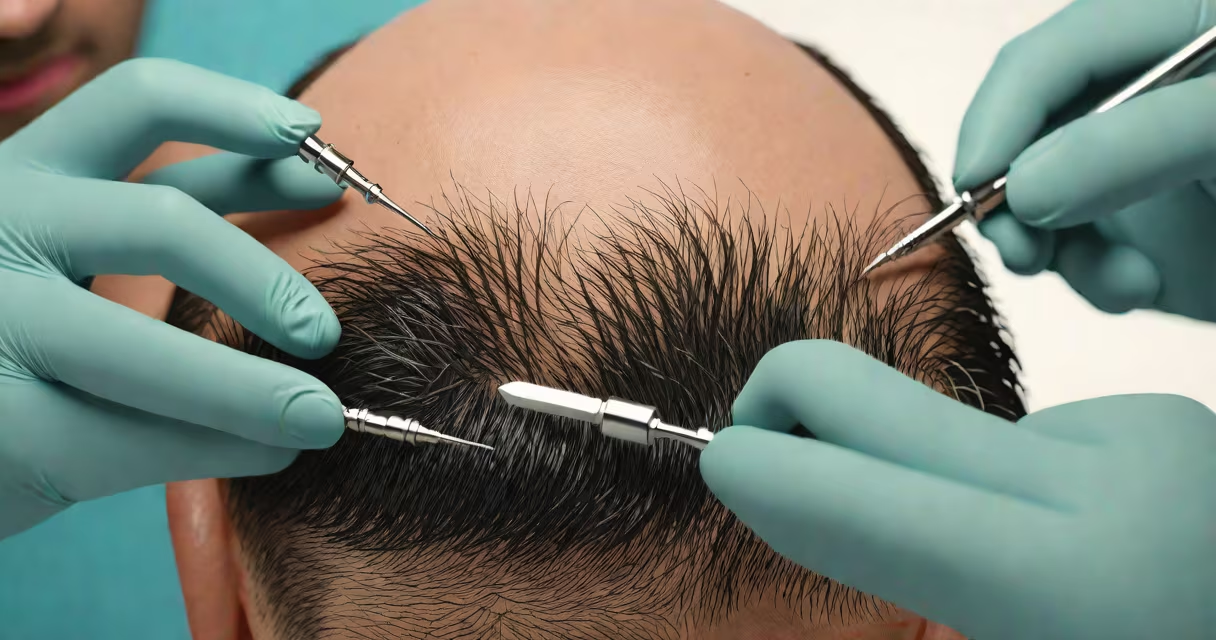
Getting a hair transplant is a surgical procedure that relocates healthy hair follicles from a donor area-typically the back of the scalp-to areas of thinning or baldness. The transplanted follicles grow new hair that looks and behaves like your original hair.
The process begins with harvesting individual follicular units under local anesthesia. These units are then carefully implanted into microchannels created in the recipient area. The procedure is performed in sessions lasting four to eight hours, depending on the number of grafts needed. Most patients require between 1,500 and 3,000 grafts for a natural result.
According to the American Board of Hair Restoration Surgery (ABHRS), the success rate of properly performed hair transplants exceeds 95%, with long-term survival of transplanted follicles exceeding 90% after five years. This high retention rate stems from the fact that donor hair follicles are genetically resistant to dihydrotestosterone (DHT), the hormone responsible for male pattern baldness.
Transplanted hair follicles come from the permanent zone-the area at the back and sides of the scalp that maintains hair throughout life. These follicles are harvested using either Follicular Unit Extraction (FUE) or Follicular Unit Transplantation (FUT). FUE involves removing individual follicles with a small punch tool, leaving minimal scarring. FUT removes a strip of skin, which is then dissected into follicular units under a microscope.
After harvesting, the follicles are prepared and placed into tiny incisions made in the balding area. The angle, direction, and depth of each implant are critical to achieving a natural look. A skilled surgeon designs the hairline to match facial proportions, avoiding a "pluggy" appearance common in early procedures.
A 2022 study published in the Journal of Clinical and Aesthetic Dermatology found that patients who received transplants with a density of 30-35 follicular units per square centimeter reported higher satisfaction scores than those with lower densities. This highlights the importance of precise graft placement and adequate density for aesthetic outcomes.
Two primary methods define modern hair transplantation: FUE and FUT. Each has distinct advantages and trade-offs in recovery time, scarring, and cost.
| Method | Scarring | Recovery Time | Best For |
|---|---|---|---|
| FUE (Follicular Unit Extraction) | Minimal, dot-like scars | 3-5 days | Patients wanting to wear short hair, avoid linear scars |
| FUT (Follicular Unit Transplantation) | Linear scar at donor site | 7-10 days | Larger cases requiring more grafts, budget-conscious patients |
FUE is increasingly preferred due to its low visibility and faster healing. However, it requires more time and technical skill. FUT remains effective for patients needing 2,500 or more grafts, where the efficiency of strip removal reduces procedure time.
Some clinics offer robotic FUE systems, such as the ARTAS robot. While marketed as more precise, a 2021 review in *Dermatologic Surgery* found no significant difference in graft survival or patient satisfaction between robotic and manual FUE. The choice often comes down to clinic capability and patient preference.
Good candidates have stable donor hair, realistic expectations, and sufficient donor supply. The Norwood scale classifies male pattern baldness into seven stages. Patients in stages III to V typically achieve optimal results. Those with stage VII or advanced scarring may not have enough donor tissue.
Women can also benefit from getting a hair transplant. Female pattern hair loss often presents as diffuse thinning rather than a receding hairline. A 2020 study in *Plastic and Reconstructive Surgery* showed that women receiving transplants had a 78% success rate in regrowth after one year, though they required fewer grafts than men.
One key misconception is that hair transplants work for everyone. Patients with widespread scarring from burns or trauma may not be suitable. Also, ongoing hair loss due to medication or illness must be stabilized before surgery. Otherwise, newly transplanted hair may appear out of proportion as surrounding hair continues to thin.
Many assume that getting a hair transplant provides immediate results. In reality, transplanted hair sheds within two to four weeks post-op-a normal phase called "shock loss." New growth begins around three months, with full results visible at 12 to 18 months.
Another error is choosing based solely on price. Low-cost clinics may use outdated techniques or employ less experienced staff. A 2023 report from the International Society of Hair Restoration Surgery (ISHRS) noted that clinics charging below $4 per graft had a 30% higher complication rate, including poor graft survival and unnatural hairlines.
One non-obvious fact: the number of grafts doesn't equal the number of hairs. Each graft contains 1-4 follicles. A session with 2,000 grafts may yield 5,000-8,000 new hairs. Clinics that quote "number of hairs" instead of "number of grafts" are often misleading customers.
A 42-year-old man with Norwood stage IV hair loss underwent a single-session FUE transplant. He had 2,400 grafts extracted from his donor zone and implanted into his crown and frontal region. The surgeon designed a natural hairline with gradual density, avoiding a straight line.
Post-op, he wore a compression cap for 48 hours. By six weeks, he noticed fine stubble. At nine months, he had full coverage. His hair grew at a normal rate-about half an inch per month-and responded to regular shampooing and styling. He reported improved confidence and no visible scarring.
Patients with active inflammation, uncontrolled diabetes, or autoimmune conditions like alopecia areata may face higher risks. The body's immune response can reject transplanted follicles. In such cases, medical treatment to stabilize the condition is recommended before considering surgery.
Also, individuals expecting a full head of thick hair from a single session often leave disappointed. A single session rarely achieves dense, full coverage. Multiple sessions spaced 6-12 months apart are standard for maximum volume.
I once observed a patient who underwent a transplant at a non-accredited clinic. The surgeon used a blunt needle to create channels, causing trauma to the follicles. Within three months, over 60% of grafts failed. The patient later returned for revision surgery at a certified center. This case underscores the importance of choosing a board-certified surgeon.
Getting a hair transplant is a long-term investment in appearance and self-image. Success hinges on proper technique, realistic expectations, and post-operative care. Results are permanent, but maintenance is required-especially if underlying hair loss continues.
Getting a hair transplant is not a quick fix. It's a medical procedure backed by decades of research and clinical practice. When done correctly, it restores confidence and a natural appearance using your own hair.