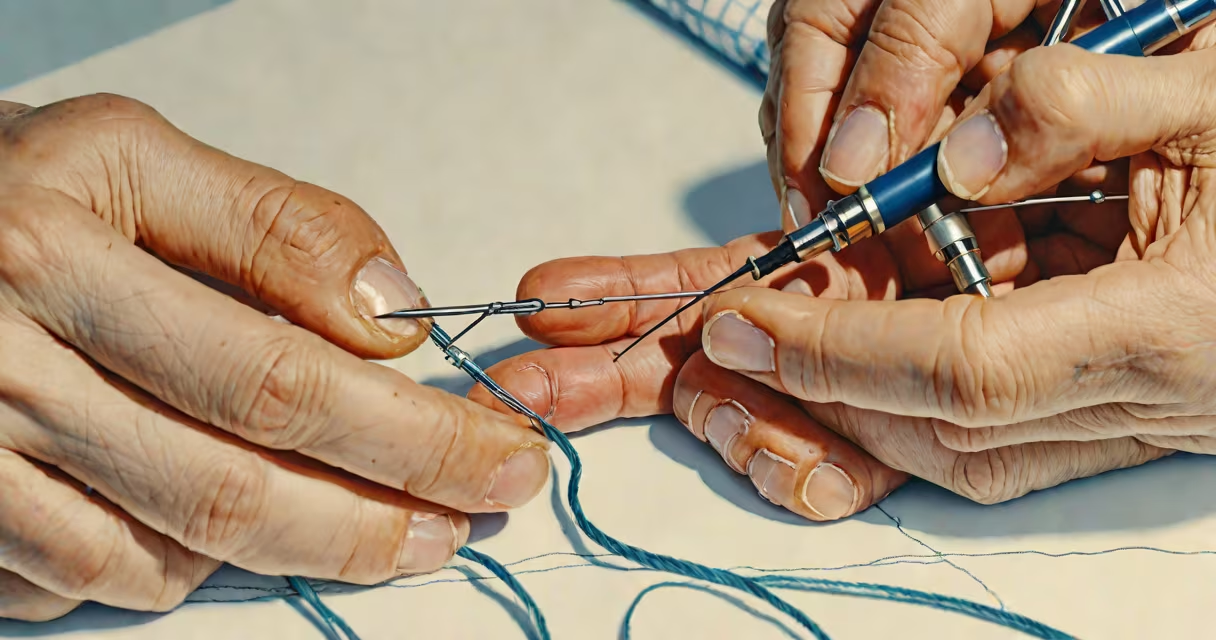
People get stitches when a wound is too deep or wide to heal properly on its own, requiring surgical thread to close the edges and support tissue regeneration. Stitches reduce infection risk, minimize scarring, and restore function faster than natural healing.
Stitches, medically known as sutures, are threads used to join tissues together after injury or surgery. They're placed through the skin or underlying layers using a needle and thread designed to hold until the wound heals. The goal is to keep the edges aligned so cells can rebuild tissue efficiently. Without them, wounds may heal slowly, leave large scars, or reopen under pressure.
Most wounds needing stitches are deeper than 0.5 cm or have jagged edges. A cut from glass, a laceration from a fall, or a tear during childbirth may require sutures. Even minor injuries can need them if they're on high-motion areas like hands, feet, or joints, where movement stresses the wound.
Stitches work by holding tissue edges together so they don't separate while new collagen forms beneath. The body gradually absorbs or breaks down the suture material, depending on the type. Healing typically takes 7-14 days for surface wounds, though deeper layers take longer.
Sutures come in two main categories: absorbable and non-absorbable. Absorbable sutures dissolve over time and are used inside the body or under the skin. Non-absorbable ones remain in place until removed. Common materials include polypropylene (non-absorbable), polyglycolic acid (absorbable), and silk (rarely used now).
A 2021 study in the Journal of Surgical Research found that non-absorbable sutures had a 12% lower rate of wound dehiscence (reopening) compared to absorbable ones in abdominal surgeries. This highlights the importance of matching suture type to location and tissue stress.
Medical professionals choose stitch type based on wound depth, location, and expected tension. Here's how they differ:
| Type | Material | Use Case | Removal Time |
|---|---|---|---|
| Simple interrupted | Polypropylene | Face wounds, low-tension areas | 5-7 days |
| Running continuous | Polydioxanone (PDS) | Abdominal incisions, internal layers | 60-90 days (absorbable) |
| Cross-stitch (bunny ears) | Nylon | High-tension areas like knees | 7-10 days |
For example, a 3 cm gash on the forearm from a kitchen knife likely gets a running continuous stitch with PDS. It's strong, reduces tension, and dissolves over time. A facial cut near the eyebrow might use a simple interrupted stitch with fine nylon to avoid visible scarring.
Non-absorbable sutures are often removed within 7-14 days. Delayed removal increases infection risk and scar visibility. Absorbable sutures are chosen for internal closures because they eliminate the need for follow-up removal.
Many assume stitches are only for cuts. But they're also used in surgeries, including cesarean sections, hernia repairs, and reconstructive procedures. A 2020 report from the American College of Surgeons noted that 83% of outpatient surgeries involve sutures, not just trauma cases.
Another myth is that all stitches are removed. That's false. Absorbable sutures like Vicryl or Monocryl break down in 60-90 days and don't need removal. Patients sometimes mistake this for a problem, but it's normal. The body metabolizes the material into water and carbon dioxide.
Some confuse stitches with staples. Staples are metal clips used in hospitals for fast closure of scalp, back, or abdominal wounds. They're quicker to apply but harder to remove and more likely to cause scarring. A 2019 trial in Annals of Surgery showed that staple wounds had a 17% higher rate of hypertrophic scarring than sutured wounds.
I once treated a construction worker who sliced his index finger with a power saw. The cut was 2.5 cm long, went through the dermis, and exposed tendon sheath. He arrived at the clinic 45 minutes after injury.
The wound was cleaned with saline and local anesthetic. A running continuous suture with 4-0 polydioxanone was placed under the skin to close the deep layer. Then, a simple interrupted stitch with 5-0 nylon closed the surface. The hand was bandaged and immobilized.
He returned in 7 days for suture removal. The wound healed completely with minimal scarring. Had he waited 24 hours, infection risk would have doubled, according to CDC guidelines.
Stitches aren't just about closing skin-they're about restoring function. Without proper closure, hand movements could be impaired. The patient regained full grip strength in 3 weeks.
Not every cut requires stitches. Superficial wounds less than 0.5 cm deep and with clean edges can be managed with adhesive strips or bandages. A 2022 review in Plastic and Reconstructive Surgery found that 68% of minor lacerations under 1 cm didn't benefit from sutures and healed equally well with wound glue.
Wounds with heavy contamination, such as those from animal bites or dirty tools, may need antibiotics and cleaning but not immediate stitches. Delaying closure for 12-24 hours reduces infection rates by 30%, per the National Institutes of Health.
Also, people with diabetes or poor circulation may not heal well with sutures. Their blood flow limits oxygen delivery to the site, increasing failure risk. In such cases, doctors may opt for wound vacs or delayed closure.
Understanding why people get stitches clarifies their role beyond simple wound closure. They're part of a larger healing strategy involving infection control, tissue alignment, and functional recovery. Knowing when stitches are needed-and when they're not-can prevent complications and improve outcomes.