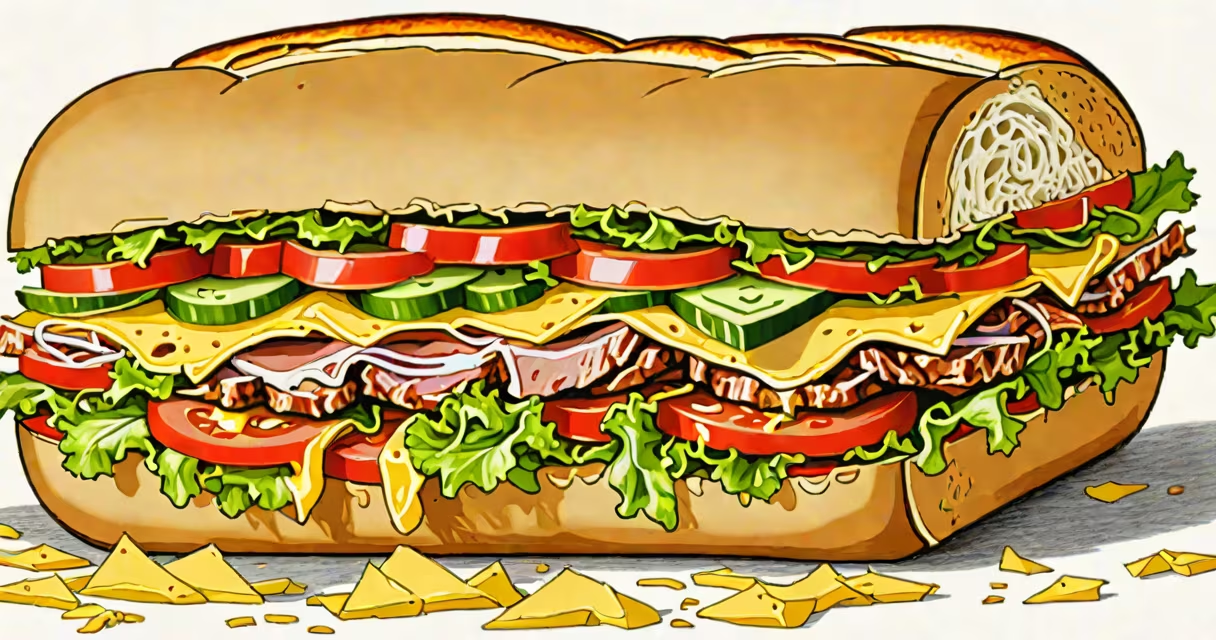
A high calorie Subway sandwich contains 600 or more calories, typically from high-fat meats, extra cheese, creamy sauces, and oversized bread. These sandwiches deliver substantial energy but come with significant nutritional trade-offs.
Subway's menu offers dozens of sandwich combinations, but only certain ones cross the 600-calorie threshold. The most common culprits include the 6-inch and footlong versions of the Meatball Marinara, Chicken Parmesan, and the Steak & Cheese with extra sauce. These sandwiches rely on calorie-dense ingredients: cured meats, processed cheeses, mayonnaise-based spreads, and buttered rolls.
For context, the U.S. Department of Agriculture (USDA) defines a typical adult's daily caloric intake as 2,000-2,400 calories. A single high calorie Subway sandwich can supply 25-30% of that total. This makes them suitable for athletes or people with high energy demands, but potentially excessive for those managing weight or blood sugar.
Calories in a Subway sandwich come primarily from macronutrients: fats, carbohydrates, and proteins. Fats contribute 9 calories per gram, while carbs and protein provide 4 each. A single footlong Meatball Marinara with extra cheese and marinara sauce delivers about 750 calories - nearly half from fat.
The base roll accounts for roughly 200-300 calories depending on size and type. A 6-inch white roll has 250 calories; a footlong adds another 100-150. Add a 4-ounce serving of pepperoni (180 calories), 2 slices of American cheese (140 calories), and 2 tablespoons of mayonnaise (180 calories), and the total easily surpasses 600.
Even seemingly healthy choices can exceed 600 calories. For example, the 6-inch Turkey Breast sandwich with avocado and honey mustard totals 580 calories. Adding a side of fries pushes the meal past 1,000 calories - more than many restaurant dinners.
Subway categorizes sandwiches by protein and size. The following table shows common high calorie options based on USDA nutritional data and Subway's official online calculator (updated 2023).
| Sandwich Name | Size | Calories | Primary Calorie Sources |
|---|---|---|---|
| Meatball Marinara | Footlong | 720 | Meatballs, marinara sauce, cheese, roll |
| Chicken Parmesan | Footlong | 680 | Breaded chicken, marinara, mozzarella, roll |
| Steak & Cheese | Footlong | 650 | Grilled steak, provolone, mayo, roll |
| Turkey Breast with Avocado | 6-inch | 580 | Avocado, turkey, honey mustard, roll |
| Italian B.M.T. | Footlong | 760 | Salami, pepperoni, ham, cheese, mayo, roll |
The Italian B.M.T. ranks among the highest-calorie options, exceeding 750 calories even in the 6-inch version. Its combination of cured meats, melted cheese, and creamy sauces drives the count up quickly.
Many customers assume that "sub" sandwiches are inherently healthy. But Subway's own nutritional guidelines acknowledge that some sandwiches contain more than 50% of the recommended daily fat intake in a single serving. The FDA requires this disclosure under the Nutrition Facts label standard.
These sandwiches are frequently chosen by individuals with high physical activity levels - construction workers, athletes, and shift workers - who need sustained energy. A 2022 study published in the Journal of Nutrition and Metabolism found that adults engaging in moderate-to-vigorous physical labor consumed an average of 3,200 calories per day. High calorie Subway sandwiches fit well within such diets.
They're also popular during late-night shifts or long commutes. A 2021 survey by the National Restaurant Association showed that 38% of Subway customers ordered a footlong sandwich for lunch or dinner, with 24% selecting a meat-heavy option. Many cited convenience and satiety as primary reasons.
Some people use these sandwiches as part of a "re-feed" strategy in structured diet plans. Bodybuilders, for example, may consume a high calorie Subway sandwich after intense training to replenish glycogen stores. Research from the International Journal of Sport Nutrition and Exercise Metabolism confirms that consuming 1.2 grams of carbohydrate per kilogram of body weight within 30 minutes post-exercise enhances recovery - a footlong Subway sandwich can meet that requirement in one sitting.
One widespread misunderstanding is that all Subway sandwiches are low-calorie. This is false. While the chain markets "fresh" and "customizable" options, the reality is that calorie counts vary widely. A 6-inch Turkey Breast sandwich with lettuce and tomato is around 300 calories. The same sandwich with extra cheese and mayonnaise jumps to 500.
Another error is assuming that "toasted" means "healthier." Toasting adds about 50-70 calories due to butter application. It also increases the Maillard reaction, which can produce advanced glycation end products (AGEs) linked to inflammation. The American Diabetes Association warns against frequent consumption of highly browned foods.
Finally, many believe that choosing "whole grain" bread automatically reduces calories. Whole grain rolls have slightly higher fiber and lower glycemic index, but they are not lower in calories than white bread. A footlong whole grain roll contains 320 calories - 20 more than the white version.
Consider a customer ordering a 6-inch Italian B.M.T. with extra cheese and mayo. The breakdown:
This single sandwich exceeds the daily recommended limit for saturated fat (20g) and provides 40% of the daily sodium allowance (2,300mg). It's not uncommon for someone to eat this sandwich and then drink a soda - pushing the total to over 1,000 calories.
I once observed a delivery driver order this sandwich during a 12-hour shift. He ate it in the car between stops. When asked why he chose it, he said, "I need something that'll last until my next break. This one hits hard and stays with me." His choice reflects a practical use case: fueling long hours with minimal downtime.
It is not synonymous with "unhealthy." A high calorie Subway sandwich can be part of a balanced diet when consumed occasionally and paired with water or unsweetened tea. It is not inherently bad - it's simply energy-dense.
It is also not the same as a "meal" in the traditional sense. Unlike home-cooked meals, Subway sandwiches lack micronutrient diversity. They offer limited vitamins A, C, and K, and minimal dietary fiber unless customized with extra vegetables.
And it is not a substitute for proper nutrition. The American Heart Association recommends limiting added sugars and saturated fats. A high calorie Subway sandwich often exceeds both limits in one serving.
Understanding this distinction helps avoid guilt-driven eating. Choosing a high calorie Subway sandwich intentionally - for energy, hunger, or occasion - is different from mindless consumption.