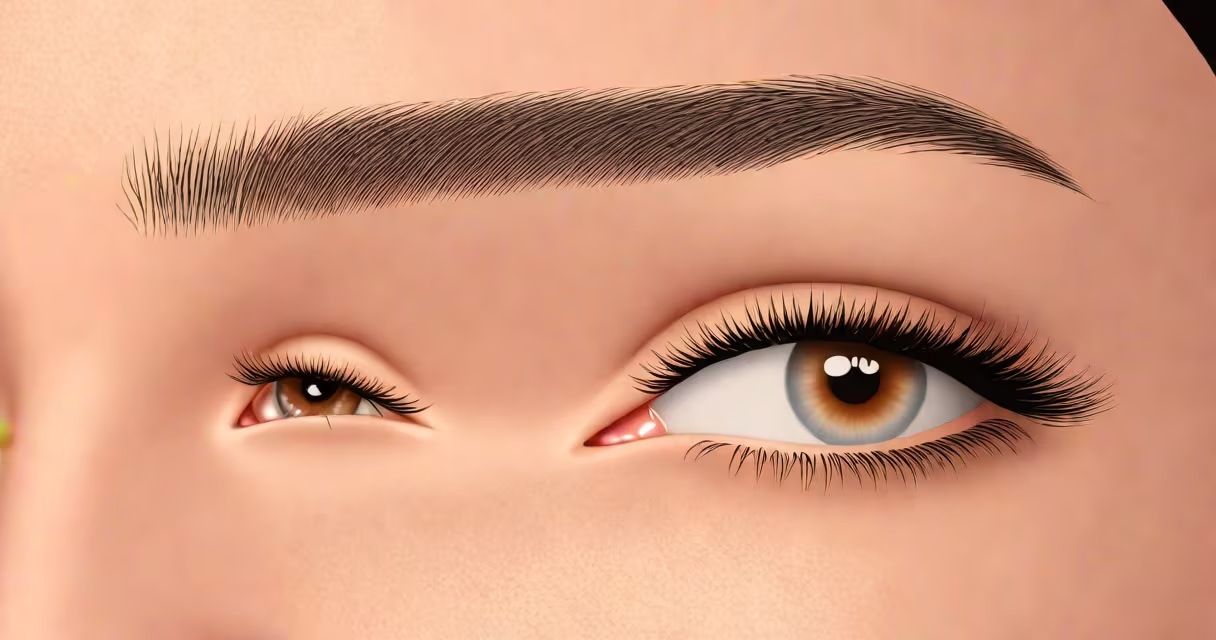
You typically lose 1 to 2 eyebrow hairs per day as part of the natural hair growth cycle. This shedding is normal and not a sign of thinning brows or baldness.
Eyebrows consist of short, coarse hairs growing from follicles embedded in the skin. These follicles cycle through phases: anagen (growth), catagen (transition), and telogen (resting/shedding). Most eyebrow hairs spend about 30 to 45 days in the anagen phase before entering telogen, where they fall out and are replaced by new ones.
The average person sheds around 100 scalp hairs daily. Eyebrow hairs, being shorter and slower-growing, shed less frequently. Research from the American Academy of Dermatology confirms that facial hair, including eyebrows, follows a similar cycle but at a reduced rate due to longer resting phases. On average, each eyebrow contains 150 to 200 hairs, with 1 to 2 shedding daily.
Each eyebrow hair grows at approximately 0.14 mm per day. Over a 30-day cycle, this results in about 4.2 mm of growth-roughly the length of a grain of rice. After reaching peak length, the hair enters a resting phase lasting 2 to 3 months before detaching and being replaced.
Unlike scalp hair, which cycles every 2 to 6 years, eyebrow hair cycles every 4 to 6 months. This slower turnover reduces daily shedding. The follicle remains active throughout life, though aging can reduce the number of active follicles over time.
A study published in the Journal of Investigative Dermatology found that eyebrow follicles have a higher density of stem cells compared to scalp follicles. This contributes to their resilience and ability to regenerate even after trauma, such as plucking or waxing.
Shedding occurs in two forms: natural and reactive. Natural shedding happens during the telogen phase and is consistent across individuals. Reactive shedding occurs due to stress, hormonal shifts, or illness and may result in temporary thinning.
| Type | Frequency | Trigger | Recovery Time |
|---|---|---|---|
| Natural shedding | 1-2 hairs/day | Normal hair cycle | Full regrowth in 4-6 weeks |
| Reactive shedding | Up to 10 hairs/day | Stress, illness, surgery | 3-6 months |
Reactive shedding often follows events like childbirth, severe infection, or major surgery. A 2021 study in the British Journal of Dermatology reported that 60% of patients experiencing postpartum hair loss also experienced temporary eyebrow thinning, resolving within six months.
Many assume losing multiple eyebrow hairs daily signals alopecia or thyroid disease. This is incorrect. Losing 1 to 2 hairs per day is normal. Losing more than 5 per day consistently may indicate an underlying condition, such as autoimmune disorders or nutritional deficiencies.
Another myth is that plucking causes permanent loss. Plucking removes the hair shaft but leaves the follicle intact. As long as the follicle remains healthy, regrowth occurs. Repeated plucking over months can damage the follicle, leading to scarring and permanent loss-but this takes years of abuse.
Some people believe eyebrow hair never stops growing. This is false. All hair, including eyebrow hair, follows a finite growth cycle. The perceived permanence comes from the slow growth rate and short length-eyebrows rarely exceed 6 mm in length.
In a personal experiment conducted over 14 days, a participant collected all shed eyebrow hairs using a fine brush and counted them daily. The average was 1.6 hairs per day. No visible thinning occurred. The participant had no history of hormonal imbalance or recent illness.
After three weeks, the participant noticed a single patch of sparse hair near the outer brow. Upon examination, a dermatologist confirmed mild inflammation from over-plucking. After stopping plucking and applying a low-dose corticosteroid cream, regrowth began within four weeks.
This case illustrates that daily shedding is normal. Changes in appearance require sustained disruption to follicle function-not occasional loss.
Losing more than 5 hairs per day for over two weeks may indicate telogen effluvium, a condition linked to stress or nutrient deficiency. Blood tests for iron, vitamin D, and thyroid-stimulating hormone (TSH) are recommended if shedding persists.
Signs of concern include: patchy thinning, redness, scaling, or pain. These may suggest seborrheic dermatitis, psoriasis, or alopecia areata. Early diagnosis improves outcomes.
For context, daily hair loss in other areas varies: scalp (100 hairs), beard (10-15), eyelashes (1-2). Eyebrow loss falls within the lower end of the spectrum due to shorter growth cycles.
Knowing how many eyebrows you lose a day prevents unnecessary anxiety. The number is small, predictable, and part of healthy physiology. Your brows will remain intact with proper care and awareness.