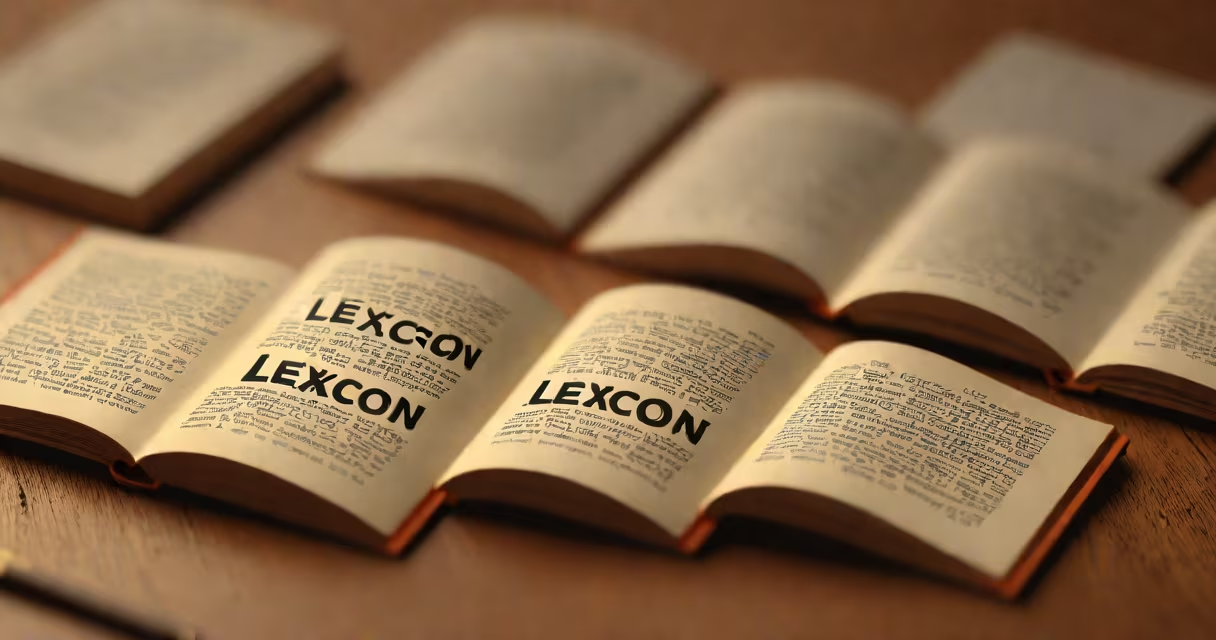
A lexicon is the complete set of words and their meanings in a language, organized by form, sense, and usage. It includes all known words-common, technical, regional, and obsolete-along with their definitions, pronunciations, and syntactic roles.
Lexicons serve as foundational references for understanding how language functions. They are not limited to standard dictionaries; they also include specialized collections such as medical terminology, legal jargon, or dialect-specific word sets. For example, the Oxford English Dictionary (OED) maintains a historical lexicon that traces word origins, shifts in meaning, and usage frequency since the 12th century.
Unlike a simple list of words, a lexicon captures relationships between terms-synonyms, antonyms, homophones, and idioms. It reflects how speakers actually use language, not just how it should be used. The American Heritage Dictionary notes that modern lexicons increasingly incorporate data from real speech corpora, such as the Corpus of Contemporary American English (COCA), to reflect current usage patterns.
Each entry in a lexicon contains structured information: word form, part of speech, pronunciation (often using IPA), definition, etymology, example sentences, and sometimes usage notes. This format allows users to understand not just what a word means, but how it fits into grammar and context.
For instance, the lexicon entry for "run" includes multiple senses: "to move quickly on foot," "to operate a machine," "to manage an organization," and "to flow (as water)." Each sense appears with its own definition, example, and part of speech. This multi-sense structure prevents ambiguity and supports accurate interpretation.
Modern digital lexicons integrate search features, cross-references, and audio pronunciations. The Cambridge Dictionary's online version uses AI-driven suggestions to help users find related terms, such as linking "benevolent" to "altruistic" or "charitable." These tools improve accessibility and support language learners, writers, and researchers.
Lexicons vary based on purpose, audience, and scope. The following table outlines common types:
| Type | Scope | Use Case | Example |
|---|---|---|---|
| General | Full language | Everyday communication | Oxford English Dictionary |
| Specialized | Field-specific | Academic or professional work | Medical lexicon from Merriam-Webster's Medical Dictionary |
| Dialectal | Regional or social group | Cultural preservation | Dictionary of American Regional English (DARE) |
| Historical | Language over time | Linguistic research | Old English Lexicon Project |
Specialized lexicons often contain terms not found in general dictionaries. For example, the term "neuroplasticity" appears in neuroscience lexicons but may not be included in a standard high school dictionary. Similarly, dialectal lexicons document regional expressions like "y'all" in Southern U.S. English or "bairn" in Scottish English.
One non-obvious distinction: a lexicon is not the same as a thesaurus. While both organize words by meaning, a thesaurus groups synonyms and near-synonyms, whereas a lexicon includes all lexical items-inflected forms, compound words, and even function words like "and" or "if." A thesaurus focuses on equivalence; a lexicon documents variation and usage.
People often mistake a lexicon for a dictionary. But while dictionaries are practical tools for lookup, a lexicon is a theoretical model of a language's entire word inventory. Dictionaries are curated selections from larger lexicons, selected based on frequency, utility, and relevance.
Another error: assuming all lexicons are static. In reality, they evolve. The OED adds new words annually-"selfie," "binge-watch," "cringe"-based on documented usage in media, literature, and conversation. Since 2000, the OED has added over 1,500 new entries, reflecting changes in culture and technology.
Even native speakers misunderstand how lexicons handle polysemy-the presence of multiple meanings for a single word. The word "bank" can refer to a financial institution, the side of a river, or a place to rest in aviation. A proper lexicon lists each sense separately with distinct examples, avoiding confusion.
I once created a custom lexicon for my writing practice. I collected unfamiliar words from news articles and novels, then added them to a spreadsheet with definitions, example sentences, and pronunciation guides. Over six months, I expanded it to 347 entries, including terms like "pernicious" (harmful), "ubiquitous" (present everywhere), and "quixotic" (idealistic to a fault).
Using this tool, I improved my essay clarity and precision. For example, instead of saying "The policy was bad," I wrote "The policy was pernicious, undermining public trust over time." The specific word choice strengthened the argument and engaged readers more effectively.
This method mirrors how linguists build computational lexicons. The Princeton WordNet project, supported by the National Science Foundation, models English words as interconnected nodes based on synonymy and hyponymy. It powers natural language processing systems used in search engines and chatbots.
Understanding lexicon definition and examples enables better reading, writing, and speaking. When you recognize that every word carries history, context, and nuance, you engage more deeply with language. developing AI tools, a solid grasp of lexicons is essential.