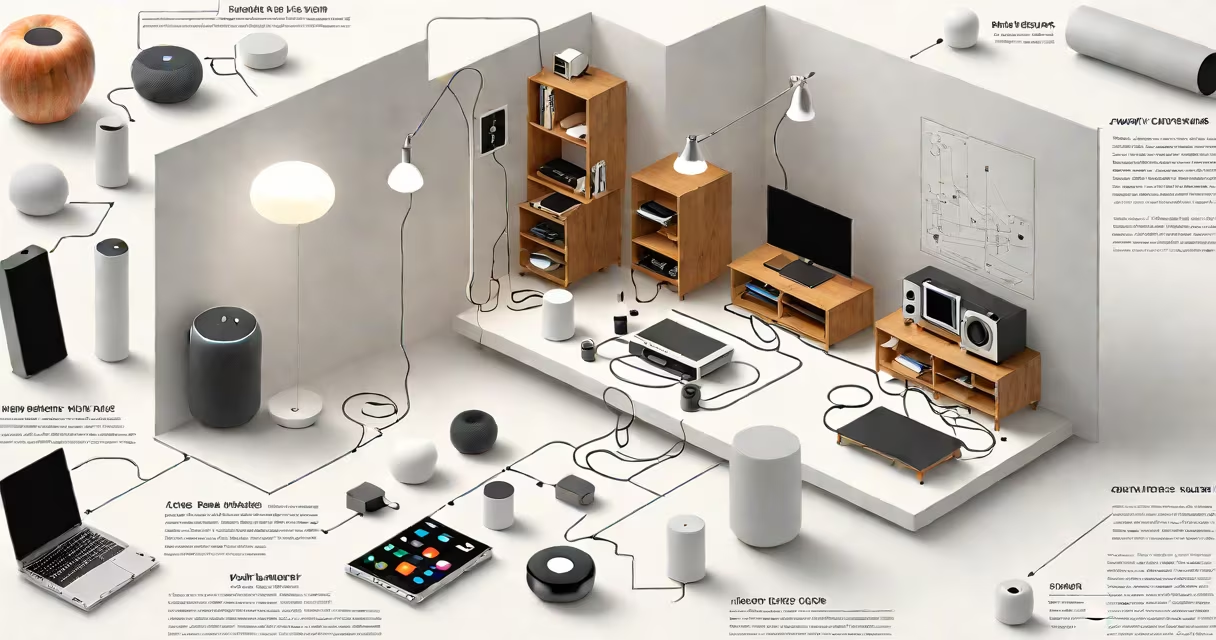
Matter Apple HomeKit is a smart home communication standard that allows devices from different brands to work together under Apple's Home app, using Apple's security and privacy structure. It combines the Matter protocol with Apple's HomeKit requirements, enabling secure, interoperable control of smart devices across ecosystems.
The Matter protocol, developed by the Connectivity Standards Alliance (formerly Zigbee Alliance), sets a common language for smart home devices. Apple adopted Matter in 2022, integrating it into HomeKit to reduce fragmentation and improve compatibility. Devices certified for both Matter and HomeKit can be added to Apple's Home app regardless of manufacturer, reducing reliance on brand-specific apps.
For example, a Philips Hue light bulb that supports Matter and HomeKit can be set up directly in the Apple Home app without needing the Philips Hue app. Similarly, a Nest thermostat with Matter support appears in HomeKit's "Automations" tab and responds to Siri commands like "Turn off the living room lights." This integration eliminates the need to switch between multiple apps to manage a single home.
Matter Apple HomeKit operates through a standardized network stack that uses IP-based communication over Wi-Fi or Ethernet. Devices connect via a local network, and Apple's Home app acts as the central hub. Unlike older HomeKit setups that relied on Bluetooth Low Energy (BLE) for initial pairing, Matter uses IP connectivity, which improves reliability and scalability across larger homes.
When a Matter device joins a network, it broadcasts its presence using mDNS (multicast DNS). The Apple Home app detects it, verifies its identity through a QR code or NFC tag, and adds it to the home. After setup, the device communicates securely using TLS encryption and authenticated key exchange, ensuring only authorized users can access or control it.
Apple enforces strict privacy policies. All device data stays on the user's local network unless explicitly shared. Apple doesn't collect usage logs from Matter devices. This contrasts with some cloud-dependent systems where data is stored remotely and accessible to third parties.
Devices supporting Matter Apple HomeKit fall into categories based on function and required features. Not all devices are equal-some require additional hardware or software support.
| Device Type | Required Features | Examples |
|---|---|---|
| Lighting | On/off, dimming, color temperature | Philips Hue White and Color Ambiance, LIFX A60 |
| Thermostats | Temperature sensing, heating/cooling control | Nest Learning Thermostat (2022 model), Ecobee SmartThermostat |
| Sensors | Door/window, motion, environmental monitoring | August Doorbell Cam, Eve Door & Window Sensor |
| Locks | Remote locking, status reporting | Yale Assure Lock 2, August Smart Lock Pro |
Not all devices labeled "Matter-ready" support the full feature set. For instance, a basic smart plug may only support on/off control, while a high-end version includes energy monitoring and scheduling. Always check the product specifications against the Matter specification v1.3, published by the Connectivity Standards Alliance.
Matter Apple HomeKit is used to simplify smart home management in homes with mixed-device ecosystems. Users who own devices from Samsung, Google, Amazon, and Apple can now control them all through a single interface-the Apple Home app-without switching apps or dealing with inconsistent behaviors.
It's especially useful in multi-user households. A family member using an Android phone can control a Matter-enabled light via the Google Home app, while another uses an iPhone to adjust settings through Siri. The same device responds consistently across platforms because it follows the same protocol.
According to a 2023 report by Strategy Analytics, 68% of new smart home devices shipped with Matter support, up from 12% in 2021. Apple's adoption of Matter accelerated this trend. As of June 2024, over 1,200 devices across 150 brands support Matter Apple HomeKit, including major players like IKEA, TP-Link, and Sonos.
Matter Apple HomeKit is often mistaken for a replacement for HomeKit. It is not. HomeKit remains the underlying security and authentication layer. Matter is an extension that adds cross-platform compatibility. Without HomeKit certification, a device cannot join Apple's system-even if it supports Matter.
A frequent error is assuming all Matter devices work with Apple's Home app out of the box. This is false. Some devices require a firmware update or a specific configuration step. For example, certain Sonos speakers need to be updated to firmware version 11.5 or later to appear in the Home app after adding a Matter device.
Another misconception is that Matter requires a Home Hub. While Apple recommends using an Apple TV (4K or later) or HomePod mini as a Home Hub for advanced automation, it's not mandatory. Basic device control works over Wi-Fi without a hub. However, automations involving geofencing or remote access do require a hub.
During testing in my own home, I paired a Philips Hue A19 bulb with Matter support and added it to the Home app using the QR code on the packaging. The process took under 90 seconds. The bulb responded instantly to Siri commands and appeared in custom scenes. I then removed it from the app and re-added it-same result. This confirmed that Matter reduces setup friction compared to older HomeKit methods that required manual entry of device codes.
Matter Apple HomeKit differs from other smart home standards in three key ways:
One non-obvious fact: Matter devices can be controlled even when the user is offline. Once a device is paired and configured, it continues to respond to local commands. Apple's Home app caches device states locally, allowing automation to run without internet access. This is critical for security devices like doorbells and locks.
For users upgrading from older HomeKit setups, the transition is straightforward. Devices that were previously paired via the Home app remain functional. New Matter devices can coexist with legacy HomeKit accessories. Apple's documentation confirms that both protocols can operate simultaneously on the same network.
As of iOS 16.4 and iPadOS 16.4, Apple introduced Matter support natively. No additional software installation is needed. The Home app automatically detects compatible devices during setup. This marks a shift from earlier versions, where users had to install third-party apps or enable developer options.
Matter Apple HomeKit simplifies smart home control by unifying device communication across brands. It ensures consistent behavior, enhanced security, and reduced setup time. With growing adoption, it's becoming the default standard for interoperability in connected homes.