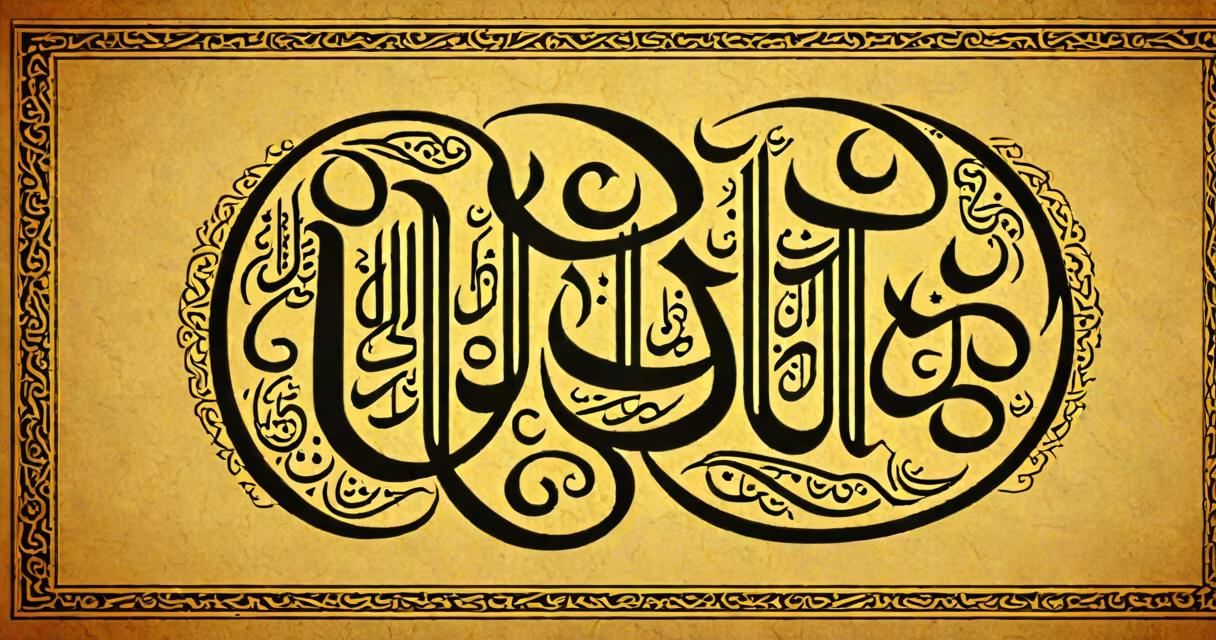
The name of Allah is the personal designation of God in Islam, derived from the Arabic word "al-ilāh," meaning "the god." It is the singular, exclusive name for the divine in Islamic belief and practice, revealed in the Quran and affirmed through prophetic tradition.
Islam teaches that Allah is the one and only deity, transcendent and beyond human comprehension. The term "Allah" is not a cultural or regional variation-it is the Arabic form of the word for "God" used across the Semitic linguistic family, including Hebrew (Elohim) and Aramaic (Alaha). In Islamic theology, the name is not merely a label but a declaration of absolute oneness (tawhid).
Every mention of Allah in the Quran begins with "Bismillah al-Rahman al-Rahim"-"In the name of Allah, the Most Gracious, the Most Merciful." This invocation appears at the start of every chapter except Surah al-Tawbah, underscoring the centrality of the name in worship and daily life. The Quran states: "And to Allah belong the best names" (Surah al-A'raf 7:180).
Using the name of Allah is central to Islamic ritual. Muslims utter "Allahu Akbar" (God is Greater) during prayers, in moments of awe, and at the time of death. The Shahada-the declaration of faith-"There is no god but Allah, and Muhammad is His messenger"-is recited daily by millions and forms the foundation of Islamic identity.
Names of individuals in Muslim cultures often incorporate "Allah" as a root. For example, "Abdullah" means "servant of Allah," and "Aisha" (the name of the Prophet's wife) derives from "aisha," meaning "alive" or "full of life," but is often paired with divine references in poetry and prayer. The name is never used casually; it is treated with reverence, and misuse is considered disrespectful.
When writing Arabic script, the name "Allah" is written with specific diacritical marks (tashkeel) to ensure correct pronunciation. Mispronunciation-such as altering the vowel sound in the second syllable-can change the meaning in other languages but not in Arabic, where the phonetic structure is fixed.
While "Allah" is the primary name, Islamic tradition recognizes 99 names (al-Asma al-Husna) that describe divine attributes. These are not alternative names but descriptors of Allah's nature. Examples include:
| Name | Meaning | Quranic reference |
|---|---|---|
| Ar-Rahman | The Most Gracious | Surah Fatiha 1:1 |
| Ar-Rahim | The Most Merciful | Surah Fatiha 1:1 |
| Al-Malik | The Sovereign | Surah al-Baqarah 2:255 |
| Al-Quddus | The Holy | Surah al-Mulk 67:1 |
These names are not interchangeable with "Allah" but are used together in supplication. For example, a person might say: "O Allah, I seek refuge in You from the evil of Your creation" (referring to Allah by name), then follow with: "O Ar-Rahman, grant me mercy."
Some Sufi traditions emphasize the meditative repetition of Allah's names in dhikr (remembrance). The most common phrase is "Subhanallah" (Glory be to Allah), repeated 33 times after each prayer. This practice is documented in authentic hadith collections such as Sahih al-Bukhari, which records the Prophet Muhammad saying: "The best of speech is the Qur'an, and the best of remembrance is 'La ilaha illa Allah'" (Book 1, Hadith 1).
One widespread misunderstanding is that "Allah" is a separate deity from the God of Christianity or Judaism. This is incorrect. The Quran affirms Abraham as a monotheist who worshipped Allah (Surah al-Baqarah 2:130-131). Christian scholars such as Dr. John W. Welch, a professor at Brigham Young University, have noted that the Arabic word "Allah" was used by Arab Christians centuries before Islam, indicating shared theological roots.
Another misconception is that the name "Allah" can be pluralized or possessive. In Arabic grammar, "Allah" is always singular and never takes plural forms. It cannot be modified with suffixes like "-s" or "-nya." This reflects the belief in Allah's absolute unity-there is no plurality within the divine essence.
A less obvious point: the name "Allah" is not transliterated in all languages. In Turkish, for example, "Allah" becomes "Allah" but is pronounced differently. In Persian, it is "Khoda." In Urdu, it is "Allah." These variations reflect regional linguistic adaptation but do not alter the theological concept. The name remains the same in meaning and function across cultures.
I once attended a mosque in Istanbul where a child wrote the name "Allah" on a piece of paper during a calligraphy class. When asked why he chose that name, he replied, "Because my father says it's the strongest word." That moment illustrated how deeply embedded the name is in everyday life-not as a theological abstraction, but as a lived reality.
In my own study of Arabic, I learned that the name "Allah" appears 2,600 times in the Quran. It is never used as a title or honorific. It is always the subject of verbs: "Allah created the heavens and the earth" (Surah al-Baqarah 2:29). This grammatical consistency reinforces the idea that Allah is not a force, a symbol, or a metaphor-but a being who acts.
For those unfamiliar with Arabic, misreading the name is common. A frequent error is pronouncing "Allah" as "Al-lah" with equal stress on both syllables. The correct pronunciation places the stress on the second syllable: "AL-lah" (with a soft 'l' sound). This distinction matters in recitation and prayer.
The name of Allah is not a philosophical concept or a cultural symbol-it is a living, active name in the lives of over 1.8 billion people. It is spoken in prayer, written in scripture, and invoked in daily life. Its meaning is rooted in revelation, not interpretation.
Understanding the name of Allah requires moving beyond Western assumptions about religion. It is not a synonym for "God" in a universal sense. It is the specific, revealed name of the one true God in Islam, affirmed in the Quran and practiced through generations.