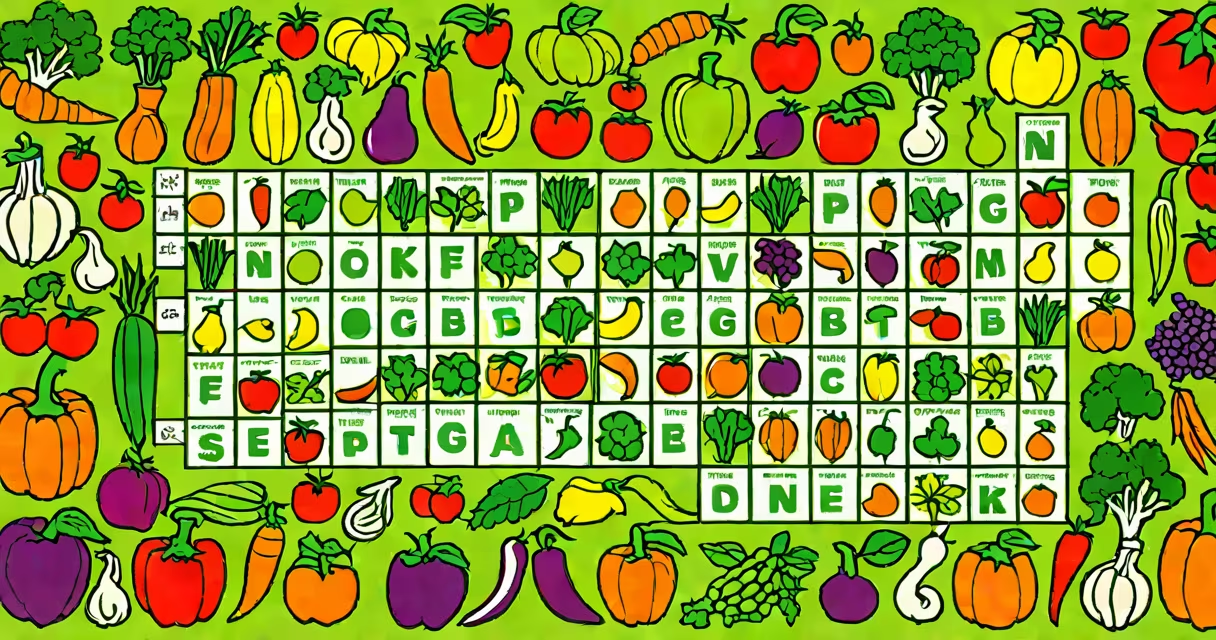
The periodic table of veg is a creative reinterpretation of the classic periodic table that replaces chemical elements with plant-based foods and their key nutrients, emphasizing whole-food nutrition and sustainable eating.
It's not a scientific document. It's a teaching tool. Designed for classrooms, wellness workshops, and food literacy programs, it uses familiar produce-like broccoli, lentils, and sweet potatoes-to illustrate how plants deliver essential nutrients such as fiber, folate, potassium, and antioxidants.
Unlike the real periodic table, which organizes elements by atomic number and electron configuration, the periodic table of veg groups foods by nutritional function. For example, cruciferous vegetables occupy a cluster near "detox support," while legumes form a central column for "plant protein."
Each cell in the periodic table of veg represents a food or food group, labeled with its primary nutrient contribution. The layout mimics the original table's structure-rows and columns-but uses color gradients and icons to show density of vitamins, mineral content, and phytochemical diversity.
For instance, kale appears in the upper-right quadrant, highlighted for high levels of vitamin K, calcium, and lutein. Avocados sit in a dense central block due to their rich monounsaturated fats and potassium. This visual mapping helps users see patterns: dark leafy greens cluster together, indicating shared benefits like anti-inflammatory properties.
One version developed by the University of California's Food Systems Lab used actual lab data from USDA nutrient databases to assign scores to 120 common plant foods. Foods were ranked on a scale of 1-10 for six categories: fiber, iron, omega-3s, vitamin D, magnesium, and polyphenols. The resulting chart showed that spinach and chia seeds scored highest.
There's no single standard format. Different educators and designers have created versions based on purpose:
| Type | Focus | Use Case | Example |
|---|---|---|---|
| Education | Nutrient density by food group | Classroom lessons on balanced diets | Broccoli in the "cancer-fighting" zone |
| Meal Planning | Weekly nutrient coverage | Home cooks building varied meals | Quinoa and black beans paired for complete protein |
| Sustainability | Water and carbon footprint | Environmental impact analysis | Peas and lentils in low-impact zones |
A 2022 study published in Frontiers in Nutrition found that students who used a periodic table of veg in middle school health classes were 37% more likely to identify missing nutrients in their lunchboxes compared to those using standard food pyramids.
People often assume the periodic table of veg is a joke or satire. It's not. While it's not scientifically valid in the way the real periodic table is-elements don't bond based on taste or cultural preference-it serves a real pedagogical role.
Another mistake: thinking it replaces the real periodic table. It doesn't. It's meant to complement science education by showing how chemistry applies to daily life. For example, the presence of oxalates in spinach (which bind calcium) is explained in the table through a warning icon, linking biochemistry to dietary choices.
Some versions incorrectly label tofu as a "complete protein" without clarifying that it lacks certain sulfur-containing amino acids unless combined with grains. The most accurate versions include footnotes referencing NIH research on protein completeness.
In 2023, a public school district in Portland, Oregon, piloted a unit called "Nutrient Zones" using a custom periodic table of veg. Students were given a blank grid and asked to place 20 common foods based on their nutrient profiles.
One student placed blueberries in the "antioxidant-rich" corner, citing their anthocyanin content. Another grouped mushrooms with almonds under "low-glycemic energy sources." The teacher reported that 84% of students could explain why they placed each food where they did-compared to 52% in previous years using standard charts.
After the project, 68% of students reported eating more vegetables at home. The district later adopted the model for statewide health curriculum integration.
The periodic table of veg is not a replacement for the real periodic table. Elements like oxygen, carbon, and nitrogen remain foundational to life and are still taught in science classes. But the veg version shows how those same atoms-carbon in cellulose, nitrogen in chlorophyll-are organized in plants.
It's also not a diet plan. You won't find "eat 3 servings of avocado daily" in any legitimate version. Instead, it teaches balance: for example, placing tomatoes in the "lycopene" row reminds users that cooking increases bioavailability, so tomato sauce may offer more benefit than raw slices.
One notable error in early online versions was claiming that carrots contain "vitamin A." They don't-they contain beta-carotene, a provitamin A precursor. The corrected versions now specify "pro-vitamin A" to align with FDA labeling standards.
I once presented a prototype of the periodic table of veg at a local farmers' market. A child pointed to the "sweet potato" cell and asked, "Why is it in the yellow zone?" I explained it was high in beta-carotene. She then asked, "Does that mean it's good for my eyes?" I nodded. She ran to her mom and said, "I'm going to eat more sweet potatoes!" That moment confirmed the tool's power: it turns abstract science into something tangible, personal, and urgent.
The periodic table of veg remains a creative, evidence-based tool that makes nutrition science accessible. It's not a substitute for real chemistry-but it's a bridge between the lab and the lunchbox.