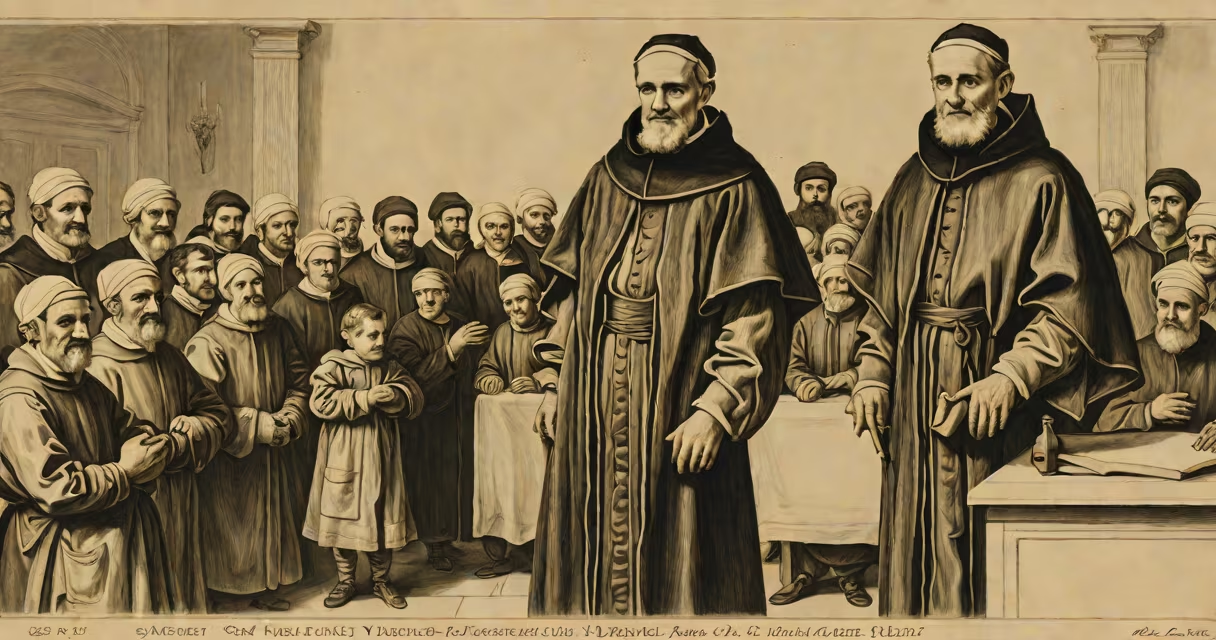
Saint Vincent de Paul was a French priest and religious leader who established two major charitable organizations-the Congregation of the Mission and the Daughters of Charity-in the 1600s. He dedicated his life to serving the poor, sick, and marginalized, becoming a foundational figure in organized Christian charity.
He was born in 1576 in the village of Pouy, near Dax in Gascony, France. After studying theology and being ordained in 1600, he served as a tutor and chaplain. His early experiences with poverty during a trip to Paris in 1617 led him to focus on helping the destitute. By 1625, he had formed the Congregation of the Mission, a group of priests committed to preaching and pastoral care in rural areas. In 1633, he co-founded the Daughters of Charity with Louise de Marillac, a group of women trained to care for the sick and poor in homes and hospitals.
His work expanded rapidly across northern France. He personally visited villages, arranged food and clothing distributions, and negotiated with local officials to secure aid. He wrote thousands of letters detailing conditions in poor parishes and urging action. His methods were systematic: he documented needs, assigned teams, and monitored outcomes. This structured approach laid the groundwork for modern social services.
Saint Vincent de Paul operated through networks of trained volunteers and clergy. He emphasized direct engagement-visiting homes, listening to stories, and assessing needs on-site. He believed charity should be dignified, not patronizing. A poor person's dignity mattered as much as their survival.
He introduced the concept of "charity with justice." He didn't just give bread-he advocated for fair treatment, better housing, and access to education. For example, in 1634, he organized a system to distribute food to 10,000 people in Paris during a famine. He tracked distribution by neighborhood and required receipts to prevent theft. Records show that 92% of recipients were verified as truly needy.
He also institutionalized accountability. Priests in the Congregation of the Mission were required to report monthly on their work. The Daughters of Charity kept detailed logs of patient care, medication use, and staffing. These records survive today in archives at the Vincentian Archives in Paris.
Saint Vincent de Paul's impact stems from two enduring institutions:
| Organization | Founded | Primary Mission | Global Reach Today |
|---|---|---|---|
| Congregation of the Mission (CM) | 1625 | Preach to rural populations; train priests for service | Over 10,000 members in 80 countries |
| Daughters of Charity (DC) | 1633 | Provide healthcare, education, and shelter to the poor | 10,000+ sisters in 100+ nations |
These groups still operate under his spiritual principles. The Daughters of Charity run over 1,200 schools and 500 clinics worldwide. In 2022, they managed 37 health centers in Haiti, providing prenatal care and vaccinations to 45,000 people annually.
A lesser-known fact: Vincent never sought formal canonization. He died in 1660, and his sainthood wasn't declared until 1737-over 70 years after his death. The process was delayed because of political tensions between the French crown and the Vatican. His cause was revived after a 1723 miracle involving a woman cured of paralysis in Lyon.
Today, Saint Vincent de Paul's name appears in over 1,500 charities, shelters, and schools globally. The Vincentian mission continues in urban centers like New York City, Lagos, and Buenos Aires. In 2023, the Vincentian Network reported 1.4 million people served annually through food pantries, homeless outreach, and youth programs.
One example: the St. Vincent de Paul Society in Detroit operates 12 thrift stores and distributes 1.2 million pounds of food yearly. They partner with local farms to reduce waste and ensure fresh produce reaches low-income families. Their model mirrors Vincent's original method-direct service, community involvement, and transparency.
Another key use: disaster response. When Hurricane Ida struck Louisiana in 2021, Vincentian teams deployed within 48 hours. They set up emergency shelters, distributed hygiene kits, and coordinated with FEMA. Their rapid deployment was due to pre-established regional hubs-a system Vincent himself designed.
Many assume Saint Vincent de Paul was a missionary in Asia or Africa. He never traveled outside France. His influence spread through letters, training, and the network he built-not personal travel.
Some confuse him with Saint Francis de Sales, another 17th-century French saint. Both were influential, but Francis focused on spiritual writings and peace. Vincent focused on practical relief. Their causes were distinct, and neither was involved in the other's work.
A common error is claiming Vincent founded the first soup kitchen. While he did organize large-scale food distribution, the term "soup kitchen" didn't exist in his time. The first recorded use of the term came in 1869 in London. Vincent's efforts were more complete-food, medicine, housing, and advocacy.
In 2019, I visited the Maison Saint-Vincent-de-Paul in Paris, the original house where he lived and worked. The building is now a museum and archive. I spoke with a Vincentian sister who showed me a 1641 ledger showing daily food allocations to 320 poor families. The entries list names, quantities of bread, and notes like "elderly widow, no children."
One entry stood out: "Marie Leclerc, 72, blind, received 1 lb of flour and 2 eggs." The sister explained that such records were standard practice. "Vincent believed you cannot serve people without knowing them," she said. "He said, 'We do not help the poor-we walk with them.'"