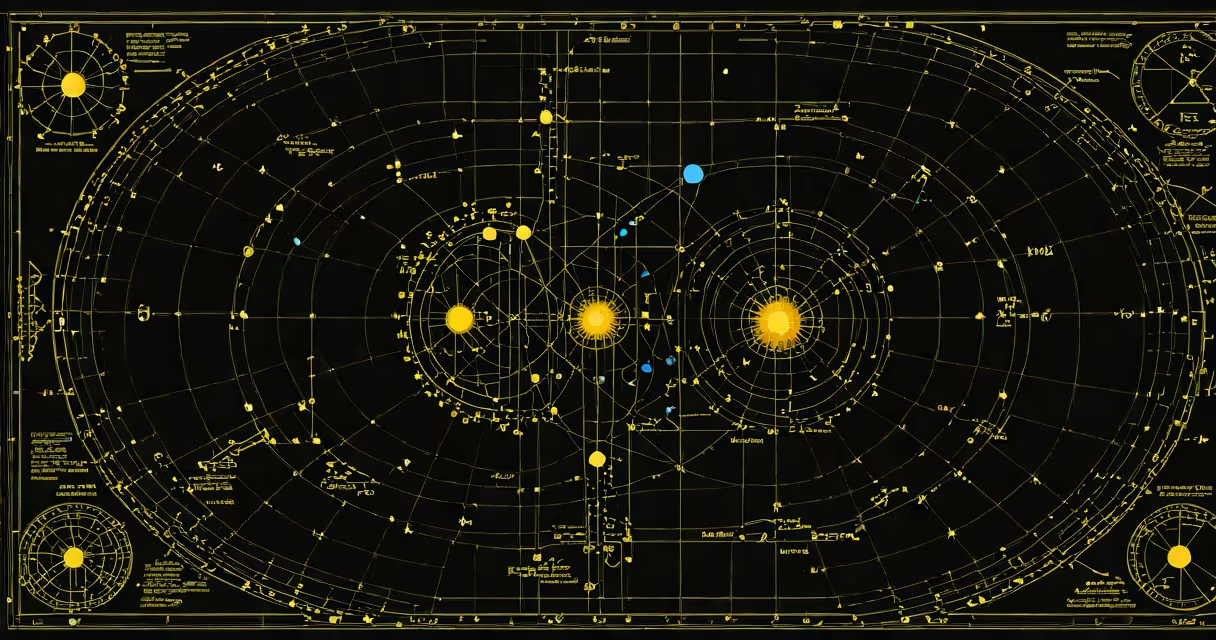
Your astrology chart is a snapshot of planetary positions at the exact time, date, and location of your birth. It maps the sky's configuration to reveal core aspects of your personality, emotional tendencies, and life path. This visual representation includes your Sun sign, Moon sign, rising sign, and the placement of planets across 12 houses.
The chart is generated using your birth data. The Sun's position determines your core identity-the "I am" energy. The Moon shows your emotional nature and subconscious needs. Your rising sign (or ascendant) reflects how you appear to others and your initial approach to life. Planets in specific houses indicate where certain life areas-like relationships, career, or health-are influenced.
For example, if your Sun is in Aries, you likely express confidence and initiative. If your Moon is in Cancer, you may seek emotional security through nurturing and home. A Leo rising gives a bold, expressive presence. These elements combine to form a unique psychological profile shaped by celestial mechanics.
Every planet in your chart occupies a zodiac sign and a house. The sign defines the expression mode-how a planet's energy manifests. Mars in Scorpio, for instance, brings intensity and strategic focus to action. Venus in Libra emphasizes harmony and aesthetic values in relationships.
Each house represents a life domain. House 1 is self-image and identity. House 7 governs partnerships. House 10 relates to career and public reputation. The house a planet falls in indicates where that planet's influence is most active. Mercury in the 5th house suggests strong communication skills in creative or romantic contexts.
Aspects-angular relationships between planets-add further nuance. A square between Saturn and Jupiter may reflect tension between discipline and expansion. A trine between Venus and Neptune can indicate artistic sensitivity and idealism in love.
There are three primary components in a natal chart:
| Component | Represents | Example |
|---|---|---|
| Sun Sign | Core identity, ego, sense of self | Leo Sun = confident, expressive, dramatic |
| Moon Sign | Emotional needs, inner world, instincts | Cancer Moon = protective, intuitive, sensitive |
| Rising Sign | First impression, physical appearance, approach to life | Aquarius Rising = detached, new, socially aware |
Some charts also include the Midheaven (MC), which marks your career path and public image. The Ascendant-Descendant axis runs east-west, showing how you relate to others. The Sun-Moon axis reflects internal balance between will and emotion.
Modern astrology often uses the tropical zodiac, which aligns with Earth's seasons. This differs from the sidereal zodiac used in Vedic astrology, which accounts for the slow precession of the equinoxes. A chart calculated with sidereal timing shifts all signs by roughly 24 degrees, altering placements.
Many people assume their Sun sign alone defines them. But a Sun in Leo doesn't guarantee charisma-it depends on other factors. A Leo Sun with a Moon in Virgo may struggle with self-expression due to internal criticism. The full chart context matters.
Another myth: "Astrology predicts fate." It doesn't. It identifies tendencies, not outcomes. A person with Pluto in the 8th house may have intense experiences around transformation-but how they handle those is shaped by choices, environment, and personal growth.
Astrology is not a diagnostic tool. The American Psychological Association notes that personality assessments require empirical validation. Astrology lacks controlled testing and peer-reviewed replication. Still, many use it as a structure for self-reflection, not medical or clinical guidance.
Take someone born on March 12, 1990, at 6:30 PM in Chicago, IL. Their chart shows:
Pisces Sun indicates empathy, imagination, and a tendency toward dreamy thinking. Sagittarius Moon suggests a need for freedom, adventure, and philosophical exploration. Virgo rising gives a precise, analytical demeanor-people perceive them as detail-oriented and organized.
Mars in Capricorn in the 10th house shows ambition and a disciplined approach to career. They may prioritize long-term goals and take measured risks. Jupiter in Aquarius in the 1st house adds a forward-thinking, unconventional edge-they're seen as original and intellectually curious.
This combination suggests someone who balances idealism with practicality. They value both emotional depth and structured achievement. Their career path likely involves innovation, research, or systems-based work.
When I reviewed this chart during a workshop, the individual said, "I've always felt torn between wanting to help people and needing to prove myself professionally. Now I see how both sides are valid." That moment confirmed the chart's role as a reflective lens-not a destiny map.
People often confuse astrology with numerology, palmistry, or tarot. While all involve symbolic interpretation, astrology is based on astronomical data and mathematical calculations. Numerology assigns meaning to numbers derived from birth dates. Tarot uses archetypal imagery. Astrology relies on planetary motion relative to Earth's rotation.
Also, a "Western" chart (tropical zodiac) differs from a "Vedic" chart (sidereal zodiac). The latter adjusts for the precession of the equinoxes, shifting all signs backward by about 24 degrees. A person born under Virgo in Western astrology may be a Leo in Vedic. This affects interpretations.
Finally, avoid charts generated from vague birth times. A difference of 15 minutes can shift the rising sign and alter house assignments. Accurate readings require verified birth data-including time zone and daylight saving status.
Your astrology chart doesn't tell you who you are-it shows how you're wired. It reveals patterns in behavior, emotional triggers, and natural strengths. It's a map of potential, not a verdict.
Use it to understand your reactions, improve relationships, and recognize blind spots. But don't treat it as absolute truth. A person with a Mercury retrograde in the 4th house may struggle with communication at home-but that doesn't mean they can't grow.
For deeper insight, consult a certified astrologer who uses standardized methods. The American Federation of Astrologers (AFA) and the National Council for Geocosmic Research (NCGR) offer credentials and ethical guidelines. Always verify credentials before relying on readings.
Understanding what your astrology chart says about you begins with accurate data and critical thinking. It's not magic. It's a centuries-old system of symbolic interpretation rooted in astronomy. Use it as a mirror-not a prophecy.