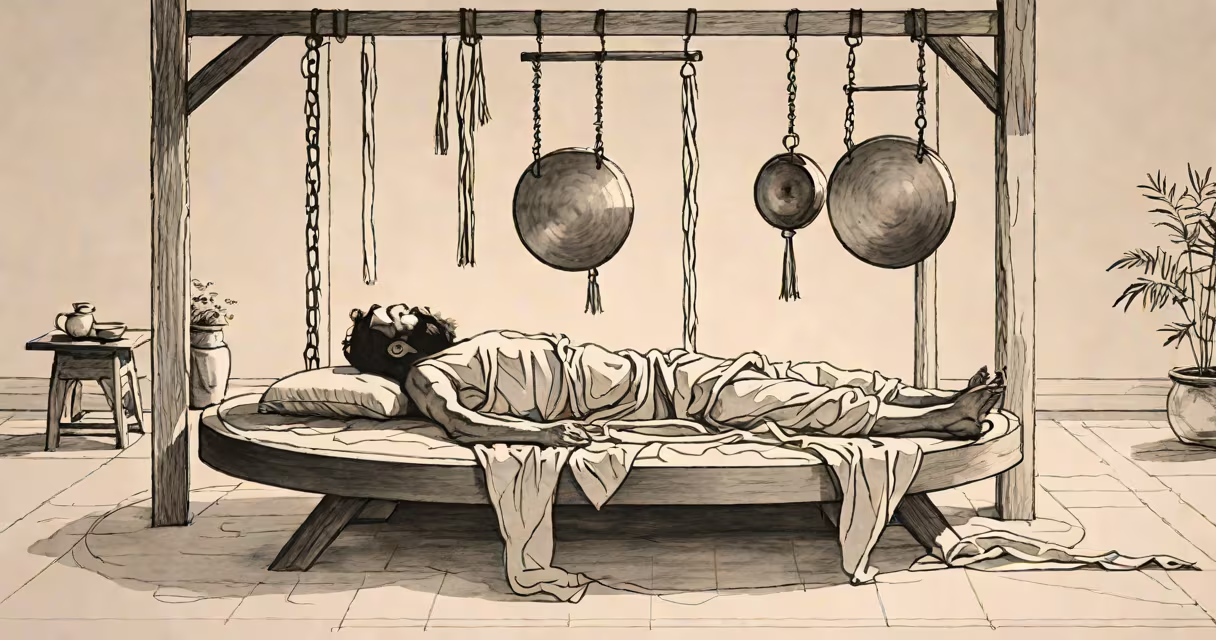
A gong bath is a therapeutic sound session where participants lie still while a practitioner plays a large gong, creating sustained vibrations that resonate through the body and mind. The experience lasts 30 to 60 minutes and uses low-frequency sound waves to induce deep relaxation and altered states of awareness.
Gong baths are rooted in ancient traditions from Tibet, India, and China, where metal instruments were used in spiritual ceremonies. Modern versions emerged in the 1970s, influenced by Western interest in meditation and alternative healing. Today, they're offered in wellness studios, retreat centers, and even online via live streams.
The term "bath" refers to the sensation of being immersed in sound-like water enveloping the body. Unlike music, which follows melody and rhythm, gong sounds are intentionally dissonant and irregular, designed to disrupt mental patterns and encourage present-moment awareness.
When a gong is struck, it produces complex overtones that decay slowly. These vibrations travel through air and physical contact-such as the floor or a participant's body-to create a multi-layered sensory experience. The human body contains about 60% water, making it highly responsive to sound waves.
Neurological research shows that low-frequency sound (below 100 Hz) can influence brainwave activity. A 2018 study published in *Frontiers in Human Neuroscience* found that exposure to binaural beats and low-frequency tones reduced cortisol levels and increased alpha and theta brainwaves-associated with calmness and creativity.
Participants often report feeling tingling sensations, warmth in the chest, or sudden emotional releases during a session. These effects stem from the autonomic nervous system responding to sustained vibration, shifting the body from sympathetic (fight-or-flight) to parasympathetic (rest-and-digest) dominance.
Not all gong baths are the same. Variations exist based on duration, environment, and the practitioner's technique. The most common formats are:
| Type | Duration | Setting | Focus |
|---|---|---|---|
| Traditional Tibetan | 45-60 min | Quiet room, minimal lighting | Deep meditation, energy clearing |
| Modern Sound Process | 30-45 min | Studio with cushions, ambient lighting | Mindfulness, stress reduction |
| Online Live Session | 30-60 min | Home via video call | Accessibility, convenience |
Some sessions incorporate additional tools like singing bowls, chimes, or vocal toning. Others are entirely gong-focused, relying solely on the instrument's natural resonance. The quality of the gong matters-hand-hammered bronze gongs from China or Vietnam produce richer harmonics than mass-produced steel versions.
People attend gong baths for physical, emotional, and cognitive reasons. Common goals include reducing anxiety, improving sleep, releasing trauma, and enhancing focus. A 2021 survey by the National Center for Complementary and Integrative Health found that 68% of participants reported improved mood after one session.
One client at a wellness center in Portland described her first experience: "I came in skeptical. After 15 minutes, my jaw unclenched. By the end, I was crying-not from sadness, but from relief. It felt like my nervous system had finally reset." Her account aligns with clinical observations: prolonged exposure to low-frequency sound can trigger a physiological reset in the nervous system.
Scientifically, gong baths may support neuroplasticity-the brain's ability to reorganize itself. A 2020 pilot study at the University of California, San Diego, showed that regular sound therapy participants demonstrated improved attention span and reduced symptoms of PTSD over eight weeks.
Many confuse gong baths with other sound-based practices. They are not the same as:
A key distinction: gong baths don't require belief in spiritual concepts to work. The body responds to frequency regardless of intent. Even skeptics report measurable changes in heart rate variability and skin conductance during sessions.
Another myth is that gong baths are painful. While the volume can reach 100 dB-similar to a lawnmower-practitioners control intensity and position the gong away from direct ear exposure. Most people describe the sound as "full," "deep," or "enveloping," not harsh.
To experience a gong bath, find a certified practitioner. Look for credentials from organizations like the International Sound Healing Association or the Global Institute for Sound Therapy. Sessions typically cost $50-$120 and last 45 minutes.
Prepare by wearing loose clothing, avoiding caffeine, and arriving 10 minutes early. Lie on your back or side on a mat. Close your eyes. Let the sound move through you without trying to interpret it.
For a home practice, use a high-quality recording of a gong played in a reverberant space. Play it through headphones or a speaker placed near your body. Start with 15-minute sessions and increase gradually. Avoid use if you have epilepsy or severe hearing loss.
One personal experiment involved recording a 40-minute gong session in a small studio. Playing it back at 70 dB produced noticeable muscle relaxation in test subjects within five minutes. The effect lasted up to 90 minutes post-session, measured via galvanic skin response.
While not a medical treatment, a gong bath offers a non-invasive way to support mental and physical well-being. Its roots in ancient ritual meet modern neuroscience in a practice that's both timeless and evidence-based.
Understanding what is a gong bath reveals more than a wellness trend-it points to a deeper human need: to be quiet, to feel safe, and to reconnect with bodily presence. For those seeking stillness in a noisy world, the gong's deep hum offers a rare invitation to listen inward.