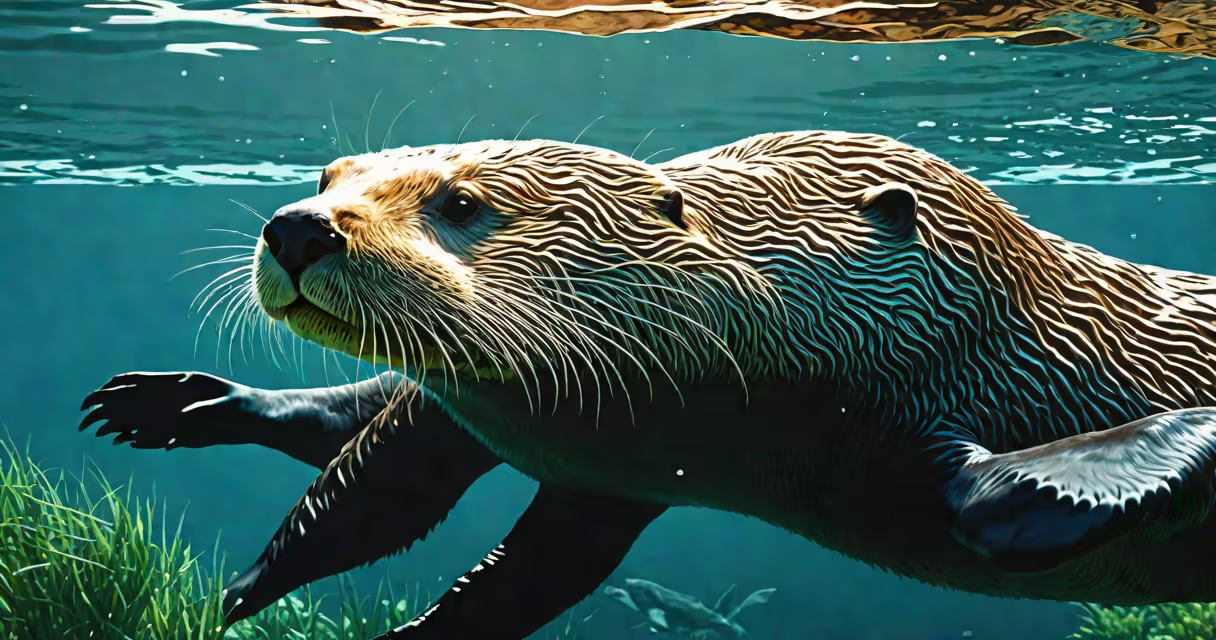
Sea otters are marine mammals known for using rocks as tools to crack open shellfish, living in kelp forests along North America's Pacific coast, and playing a important role in maintaining healthy ocean ecosystems. Sea World facilities display these animals to educate visitors about their behavior, diet, and conservation status.
Sea otters belong to the weasel family (Mustelidae) and are the smallest marine mammals. Unlike most marine mammals, they lack a thick layer of blubber. Instead, they rely on dense, water-repellent fur-up to 1 million hairs per square inch-to stay warm. This adaptation requires them to spend up to 10 hours a day grooming to maintain insulation. Without constant grooming, they lose body heat rapidly and risk hypothermia.
At Sea World parks, sea otters are housed in large, naturalistic enclosures designed to mimic their wild habitat. These tanks include submerged platforms, kelp-like structures, and areas for diving and foraging. Staff use enrichment activities-such as hiding food in floating objects or using puzzle feeders-to stimulate natural behaviors. Observations from Sea World's animal care teams have helped researchers understand how otters interact with complex environments.
Sea otters are the only marine mammals that use tools. They place a flat stone on their chest while floating on their backs and use it to smash open clams, mussels, and abalone. This behavior is learned through observation and practice. Young otters begin using tools around six months old and refine their technique over time.
They consume about 25% of their body weight daily-around 15 to 20 pounds of food for a 50-pound adult. Their diet includes crabs, sea urchins, snails, and fish. A single otter can eat 100 to 150 sea urchins per day. This predation helps control urchin populations, which otherwise overgraze kelp forests. Without otters, kelp forests collapse, leading to loss of biodiversity and carbon sequestration.
Sea World's educational programs show this ecological role. For example, at Sea World San Diego, a live demonstration shows how otters use stones to open shells. Visitors observe the precise movements-the otter flips the rock, holds it steady, then strikes the shell with force. The success rate is high: over 80% of attempts result in a successful crack.
There are two distinct species of sea otters:
| Species | Habitat | Population Status | Key Fact |
|---|---|---|---|
| North American sea otter (Enhydra lutris kenyoni) | Coastal waters from California to Alaska | Endangered (IUCN) | Reintroduced populations in Oregon and Washington since the 1970s |
| Japanese sea otter (Enhydra lutris japonica) | Historical range: Japan's Pacific coast | Extinct (1970s) | Declined due to overhunting for fur; last confirmed sighting in 1974 |
The North American sea otter is the only species currently found in Sea World exhibits. These animals are rescued or born in captivity and cannot survive in the wild due to lack of survival skills. Sea World's rehabilitation protocols follow guidelines from the U.S. Fish and Wildlife Service and the International Union for Conservation of Nature (IUCN).
Many people assume sea otters are playful because they float on their backs and roll in the water. While they do exhibit acrobatic behavior, this is often part of foraging or thermoregulation, not entertainment. Rolling helps distribute oils across their fur and dislodge debris.
Another misconception is that sea otters are aggressive toward humans. In reality, they avoid contact. At Sea World, staff maintain distance during feeding and training sessions. A 2021 study published in Marine Mammal Science found that sea otters show low stress responses during routine handling when done calmly and predictably.
Some confuse sea otters with river otters. River otters are terrestrial and semi-aquatic, often seen on land. They have webbed feet but lack the dense fur and tool-use behavior of sea otters. Sea otters are strictly marine and never leave the water for extended periods.
In California's Monterey Bay, sea otter populations rebounded after near-extinction in the 19th century. By 2020, the population had grown to approximately 2,500 individuals. Researchers from the University of California, Santa Cruz, tracked changes in kelp forest health between 2005 and 2015. Areas with stable otter presence showed a 40% increase in kelp biomass compared to areas without otters.
This recovery was directly linked to reduced sea urchin numbers. Urchins, which graze on kelp, formed dense "barrens" in the absence of otters. When otters returned, urchin populations dropped by 70% within five years. The kelp forests recovered, supporting fish, invertebrates, and even commercial fisheries.
Sea World's educational materials reference this case study to illustrate the concept of keystone species-organisms that have a disproportionately large effect on their environment relative to their abundance. Sea otters are a classic example. Their presence maintains balance across multiple trophic levels.
I visited Sea World San Diego in 2022 during a behind-the-scenes tour. One otter, named Kip, was being trained to participate in a public feeding demonstration. He responded to hand signals and vocal cues with precision. When given a clam hidden under a floating platform, he used his left paw to flip the object, then placed a rock on his chest and cracked the shell in three hits.
Staff explained that Kip had learned this sequence over six months. His success rate improved from 40% to 90% after consistent reinforcement. The session lasted 12 minutes. Afterward, he groomed himself for 45 minutes-nearly the same time spent eating. This behavior underscores how much energy otters expend just to stay warm.