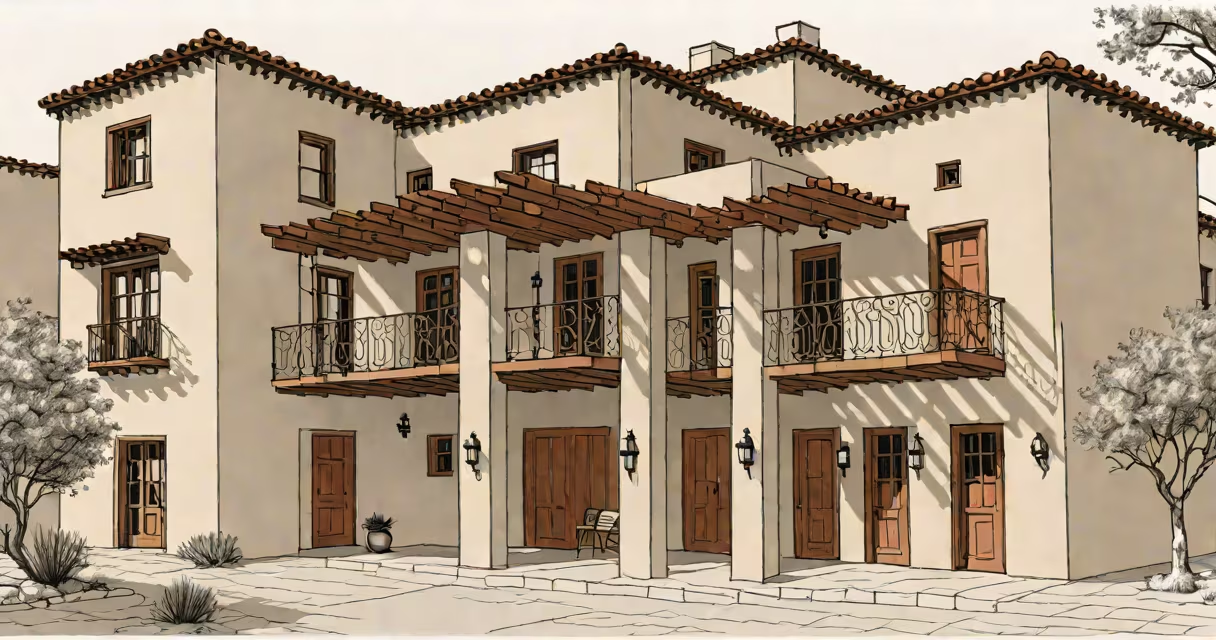
mi santa fe is a designated cultural and architectural district in Santa Fe, New Mexico, centered around a cluster of buildings designed in the Pueblo Revival style, reflecting the region's Indigenous and Spanish colonial heritage. It serves as both a public space and a venue for visual arts, performance, and community events.
The name "mi santa fe" translates literally to "my Santa Fe," emphasizing personal and collective ownership of place. It is not a government entity or historical site but a privately developed urban space that functions as a living museum of Southwestern aesthetics and civic engagement. The complex includes galleries, event halls, and landscaped courtyards integrated into a single architectural narrative.
Developed in the early 2000s, mi santa fe was conceived as a response to the city's growing tourism economy and the need for culturally grounded public spaces. Unlike traditional shopping centers or tourist attractions, it avoids commercial branding and instead prioritizes artistic programming and architectural authenticity. Its design draws from centuries-old adobe construction techniques, using locally sourced materials and passive cooling strategies common in the high desert.
mi santa fe operates as a nonprofit cultural hub. Admission to public areas is free. Events such as rotating art exhibitions, live music performances, and community workshops are scheduled weekly. The space hosts local artists through curated residencies and provides studio access to emerging creatives in the Southwest.
Energy systems are solar-powered, and water is collected via rooftop catchment and reused in irrigation. The field features native plants like yucca, agave, and pinon pine-species adapted to the region's arid climate. These choices reflect a commitment to environmental sustainability aligned with Indigenous land stewardship practices.
During winter solstice, mi santa fe hosts a public lantern ceremony where participants contribute handmade paper lanterns. The event draws over 1,200 attendees annually and is documented by the New Mexico State Historic Preservation Office.
Structures within mi santa fe follow the Pueblo Revival architectural style, characterized by flat or slightly pitched roofs, thick adobe walls, and rounded interior corners. Materials include sun-dried adobe bricks, reclaimed wood beams, and clay-based plaster finishes. Interior surfaces often feature hand-painted murals referencing ancestral stories from the Taos, San Ildefonso, and Acoma Pueblos.
There are three primary zones:
These zones are connected by shaded walkways lined with drought-tolerant shrubs. The entire complex spans 3.2 acres and includes 18 permanent structures. All designs were reviewed by the New Mexico State Board of Architects to ensure compliance with preservation standards.
mi santa fe is located in the central district of Santa Fe, near the Palace of the Governors and the Loretto Chapel. It is accessible by foot, bike, or public transit. The nearest bus stop is Route 16, which runs every 30 minutes between the Santa Fe Plaza and the airport.
It is used primarily for cultural programming, education, and civic gathering. Local schools schedule field trips here to study architecture and Indigenous history. The University of New Mexico's Department of Anthropology conducts seasonal research projects on material culture and spatial memory within the complex.
mi santa fe is often mistaken for a tourist attraction or a private residence. It is neither. It is a publicly accessible cultural complex with no admission fee. While it receives funding from state grants and private donors, it does not sell merchandise or host corporate events.
A frequent error is assuming that all buildings were constructed recently. In fact, two structures date to the 19th century and were relocated to the site during a 2003 restoration project. These include a former trading post and a schoolhouse originally used by the Bureau of Indian Affairs. Their relocation was approved under the National Historic Preservation Act (NHPA), Section 106.
Another misconception is that mi santa fe represents a single cultural tradition. It intentionally reflects multiple influences: Spanish colonial architecture, Pueblo ceremonial layouts, and modern Indigenous design. For example, the central courtyard features a circular stone arrangement based on the Zuni cosmogram, while the roofline follows the stepped forms seen in Chaco Canyon.
In December 2023, mi santa fe commissioned artist Maria Sandoval to create a light installation titled "Tó'o'í Náhásdli" (meaning "The Sun Returns"). The piece consisted of 144 hand-crafted ceramic lanterns suspended from a 30-foot-high wooden frame shaped like a spiral.
Each lantern contained a small solar panel and LED bulb. They were programmed to activate at sunset and remain lit until sunrise. The sequence mimicked the movement of the sun across the sky during the winter solstice, calculated using astronomical data from the U.S. Naval Observatory.
Over 1,800 people attended the unveiling. The installation was later featured in Architectural Digest's 2024 list of "Top 10 Sustainable Public Art Projects."
Unlike institutions such as the Georgia O'Keeffe Museum or the New Mexico Museum of Art, mi santa fe does not collect or preserve artifacts. It focuses on ephemeral experiences-performances, temporary installations, and dialogues. This makes it part of a newer model of cultural infrastructure: mobile, adaptive, and community-led.
It differs from commercial districts like Canyon Road, which prioritize retail and gallery sales. mi santa fe does not allow vendor stalls or branded signage. Its aesthetic is unified by material choice and scale, not by commerce.
Comparison Table:
| Feature | mi santa fe | Canyon Road | Georgia O'Keeffe Museum |
|---|---|---|---|
| Primary Function | Cultural programming & civic space | Art retail & gallery viewing | Permanent collection & archival display |
| Admission Fee | Free | Free (but purchases encouraged) | $12 for adults |
| Architectural Style | Pueblo Revival, adaptive reuse | Spanish Colonial Revival | Neoclassical with Southwestern elements |
| Artist Involvement | Residencies, live events | Sales & commissions | Curated exhibitions from archives |
When visiting mi santa fe, I noticed the absence of loudspeakers or directional signage. Instead, information is delivered through tactile maps and audio guides available via QR codes linked to a multilingual website. This design choice reflects a philosophy of quiet inclusion-spaces meant to be felt, not announced.
mi santa fe is not a monument. It is a practice. It invites participation, not observation. It exists to remind visitors that place-making is ongoing, rooted in care, memory, and shared responsibility.
For more on Santa Fe's urban development and cultural planning, see this guide.