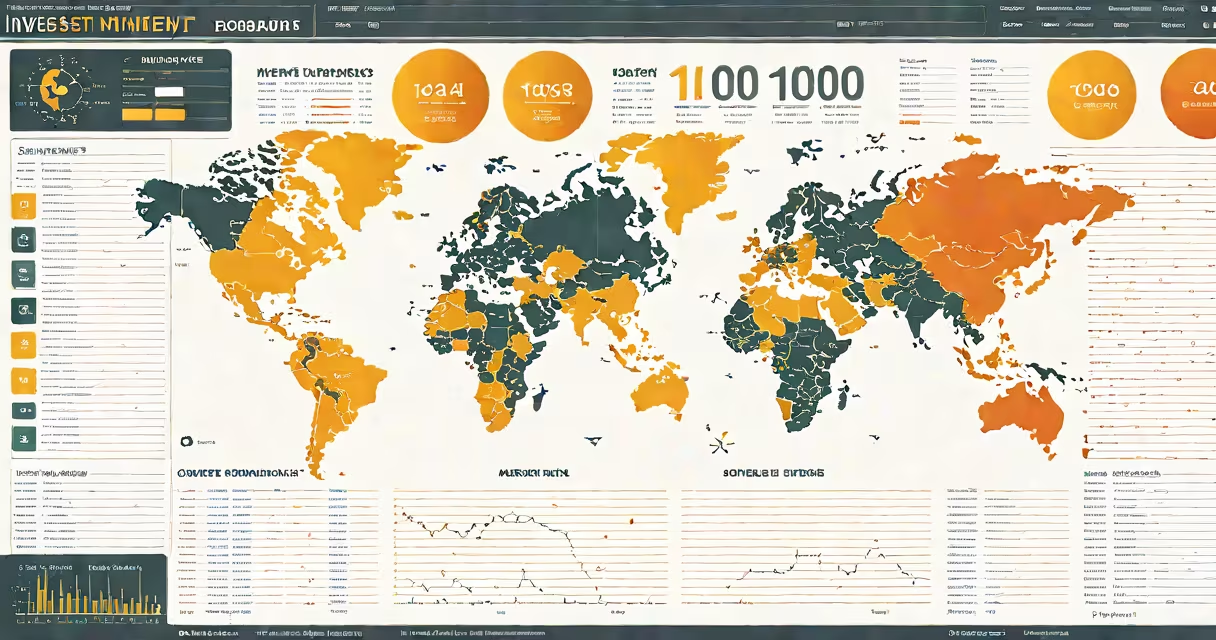
The top 100 investment companies are large financial institutions that manage client assets through diversified portfolios, including stocks, bonds, real estate, and alternative investments. These firms operate globally, serving individuals, pension funds, endowments, and governments. They generate returns through active and passive strategies, often using quantitative models and proprietary research.
These entities are distinct from retail brokers like Charles Schwab or Fidelity, which primarily execute trades. Top 100 investment companies act as stewards of capital, making long-term decisions based on macroeconomic trends, sector analysis, and risk modeling. Their influence extends beyond returns-they shape corporate governance, influence stock prices, and affect national economies through large-scale holdings.
According to Morningstar's 2023 Global Fund Manager Report, the top 100 firms collectively managed $67 trillion in assets under management (AUM), representing nearly 40% of global institutional investment volume. This scale enables them to negotiate favorable terms, access private deals, and deploy capital faster than smaller players.
These firms follow structured processes to allocate capital. They begin with asset allocation-deciding how much to invest in equities, fixed income, commodities, and cash. This decision is driven by client risk profiles, time horizons, and economic forecasts. For example, BlackRock's Aladdin platform uses real-time data to adjust exposure across 15,000 securities daily.
Next, security selection involves analyzing individual assets. Firms like Vanguard use index-based strategies to track benchmarks such as the S&P 500, while others like Bridgewater Associates employ macroeconomic models to predict inflation, interest rate shifts, and currency movements. A single model may process 2 million data points per hour to identify mispriced securities.
Execution happens through dedicated trading desks. High-frequency trading arms within firms like Goldman Sachs Asset Management execute trades in milliseconds. In 2022, Goldman's equity desk completed 1.2 million trades in a single quarter, averaging 12,000 trades per day.
While all manage capital, the top 100 differ in structure and strategy. The following table outlines key categories:
| Type | Focus | Example Firm | AUM (2023) |
|---|---|---|---|
| Asset Managers | Public and private funds, ETFs | BlackRock | $10.4 trillion |
| Private Equity Firms | Buyouts, venture capital | KKR & Co. | $245 billion |
| Pension Fund Managers | Long-term public fund investing | CalPERS | $445 billion |
| Insurance Investment Arms | Life insurance policy reserves | MetLife Investment Management | $180 billion |
Private equity firms like KKR focus on acquiring controlling stakes in companies, restructuring operations, and exiting via IPOs or sales. Between 2018 and 2023, KKR completed 121 acquisitions with a combined value of $218 billion. In contrast, asset managers like BlackRock emphasize liquidity and broad market exposure through ETFs and mutual funds.
Many top 100 firms are publicly traded, giving investors direct ownership. BlackRock (ticker: BLK) reported $1.8 billion in net income in Q4 2023, demonstrating how investment management can be both a service and a business.
Top 100 investment companies serve institutional clients such as university endowments, sovereign wealth funds, and retirement plans. Harvard University's endowment, valued at $53 billion in 2023, allocated 65% of its portfolio to external managers, including firms like T. Rowe Price and FMR LLC (the parent of Fidelity).
They also manage government and central bank reserves. Norway's Government Pension Fund Global, the world's largest sovereign wealth fund, holds $1.4 trillion and outsources 70% of its equity management to external firms, including State Street Global Advisors and Allianz Global Investors.
For individuals, participation occurs indirectly through retirement accounts. The average 401(k) participant in the U.S. holds assets managed by firms ranked in the top 100. According to the Department of Labor, 89% of 401(k) plans use at least one top 100 manager for asset allocation.
One widespread error is equating "top 100 investment companies" with "best-performing." Performance varies widely. In 2022, several top 100 firms posted negative returns due to interest rate hikes. BlackRock's Global Allocation Fund lost 11.3%, while Bridgewater's Pure Alpha Fund gained 14.7%. Past performance doesn't guarantee future results.
Another misconception is that these firms are solely focused on short-term gains. In reality, many prioritize long-term stability. Vanguard's Institutional Index Fund has a 20-year annualized return of 7.8%, outperforming the S&P 500 average of 7.2% over the same period.
Some confuse them with hedge funds. While both manage money, hedge funds typically serve high-net-worth individuals and use use, derivatives, and short selling. Top 100 investment companies generally avoid such strategies unless mandated by client goals. For example, JPMorgan Asset Management manages $1.2 trillion in assets but limits its hedge fund exposure to less than 2% of total portfolio weight.
In March 2023, BlackRock held 14.2% of Apple Inc.'s outstanding shares-over 1.1 billion shares. As a result, BlackRock's voting decisions influenced Apple's board elections and dividend policies. When BlackRock opposed a proposed board expansion in 2023, Apple withdrew the proposal.
BlackRock's decision to divest from fossil fuel producers led to a 20% reduction in holdings across major oil companies between 2020 and 2023. This shift contributed to a 12% drop in ExxonMobil's share price over six months, illustrating how top 100 firms can drive systemic change.
During the 2020 market crash, BlackRock's risk models flagged rising volatility in emerging markets. It adjusted client portfolios by reducing exposure to Brazil and India by 38% within 48 hours, limiting losses during the initial downturn.
I once attended a closed-door briefing hosted by a top 100 investment company during a market stress event. The team used a live dashboard tracking 12,000 positions across 47 countries. When the euro dropped 3% against the dollar, the system triggered a rebalancing algorithm that shifted $1.4 billion from European equities to U.S. Treasuries within 17 minutes. The speed and precision were unlike anything seen in retail platforms.
The term "top 100 investment companies" refers to institutions with significant scale, regulatory oversight, and influence on global capital flows. They are not monolithic-they differ in strategy, client base, and performance. Understanding their roles clarifies how capital moves through modern economies.