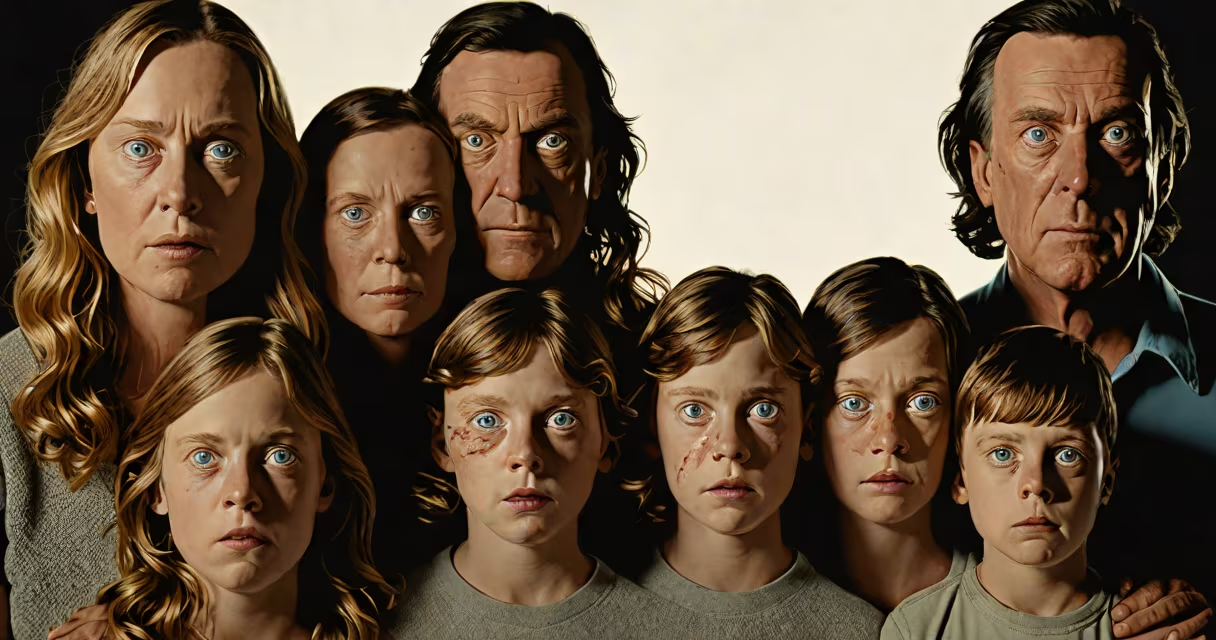
A hereditary horror movie is a subgenre of psychological horror that centers on fear passed down through bloodlines-whether through mental illness, supernatural afflictions, or ancestral sins. These films treat family history not as background but as a living force shaping characters' identities and fates.
Unlike standard haunted house stories, hereditary horror movies root terror in lineage. The threat isn't just external-it's embedded in biology, memory, and ritual. A child may inherit not just a surname, but a curse, a madness, or a hidden legacy that manifests in violence, possession, or irreversible breakdown.
These films often unfold slowly, building dread through domestic details-a locked attic, a mother's unexplained behavior, a child's sudden mutism. The horror grows not from jump scares but from the realization that trauma cannot be escaped. It's inherited.
Hereditary horror movies operate on the principle that the past isn't dead-it's dormant. A character's actions, fears, or even dreams may mirror those of a long-dead ancestor. This creates a feedback loop: trauma echoes across generations, and the protagonist becomes both victim and unwitting heir.
For example, in *Hereditary* (2018), the protagonist Annie suffers from severe depression and paranoia. Her mother's death triggers a series of increasingly bizarre events-unexplained movements, symbolic rituals, and the appearance of a small, disturbing figurine. As the story unfolds, it becomes clear that Annie's family has long been entangled with a cult that worships a malevolent entity. The film suggests that mental instability, religious obsession, and violent tendencies were all passed down through blood.
The genre uses domestic spaces-the kitchen, the bedroom, the family photo album-as sites of revelation. A single photograph can reveal a hidden relative who committed suicide decades ago. A lullaby sung by a grandmother may contain a coded incantation. These details aren't random-they're clues to a pattern that spans time.
While all hereditary horror movies involve transmission across generations, the nature of the threat varies. Below are common forms:
| Type | Source | Example |
|---|---|---|
| Mental illness | Genetic predisposition or suppressed trauma | *The Babadook* (2014) - grief and depression manifest as a monster |
| Supernatural curse | Family pact, demonic contract, or ancient ritual | *The Wicker Man* (1973) - a village's tradition demands sacrifice |
| Physical deformity or mutation | Genetic anomaly or exposure to unknown substance | *The Fly* (1986) - scientist's experiment causes hybridization |
| Psychic or spiritual inheritance | Reincarnation, spirit possession, or ancestral memory | *The Others* (2001) - a woman believes her children are haunted by spirits |
Some films blend multiple types. *The Haunting of Hill House* (2018 TV series) features siblings who each inherit different aspects of their family's trauma-some see ghosts, others hear voices, one begins to disappear physically. The show treats the house not as a setting but as a manifestation of unresolved grief spanning four generations.
Hereditary horror movies are used to explore systemic issues masked as personal failure. They reflect anxieties about genetic destiny, mental health stigma, and the burden of family history. In a culture where people are increasingly aware of epigenetics-the idea that trauma can affect gene expression-these films resonate deeply.
According to the American Psychological Association, childhood trauma can influence brain development and increase risk for anxiety and depression later in life. While not a supernatural claim, this scientific basis makes hereditary horror feel plausible. The genre takes real concerns-how abuse cycles repeat, how PTSD echoes through families-and dramatizes them with metaphysical stakes.
Films like *Midsommar* (2019) use the structure to critique cultural traditions. The protagonist Dani joins a remote Swedish commune, only to discover that her family's grief was exploited as part of a ritual meant to sustain the community. The film doesn't offer a supernatural explanation-it offers a sociological one. But the emotional impact feels supernatural because the damage is so deep.
Many viewers mistake hereditary horror for generic supernatural horror. The key difference lies in focus: in most ghost stories, the threat is external and temporary. In hereditary horror, the threat is internal and persistent. It doesn't leave when the lights come on. It lives in the blood.
Another misconception is that these films are purely about monsters or demons. In reality, the true antagonist is often silence-the refusal to speak about the past. In *The Lighthouse* (2019), two lighthouse keepers descend into madness, not because of a sea creature, but because they've been isolated for weeks with no way to process their shared trauma. The film shows how isolation and repression can create hallucinations indistinguishable from supernatural events.
A lesser-known fact: the term "hereditary horror" gained traction in academic circles after the 2018 release of *Hereditary*. Before then, scholars used terms like "family trauma cinema" or "genetic dread." The word "hereditary" became popular because it accurately describes the mechanism of transmission-not just emotion, but biological and behavioral patterns passed down.
I once screened *Hereditary* at a university film society. Afterward, a student asked, "Why did the daughter look like her grandmother?" I pointed to a scene where the girl stares into a mirror during a blackout. Her face shifts slightly-eyes widen, jaw tightens. The resemblance wasn't coincidence. It was the moment the audience realized the curse wasn't just in the blood-it was in the body's memory.
Hereditary horror shares DNA with other narrative forms. It overlaps with gothic literature-think *Dracula* or *Frankenstein*-where the protagonist is both victim and inheritor of a dark legacy. It also connects to psychological thrillers like *Black Swan* (2010), where identity collapse results from familial pressure and artistic obsession.
Hereditary horror movie is not about escape. It's about recognition. The genre forces audiences to ask: What do we carry? Who do we become? And how much of our fear is truly ours?