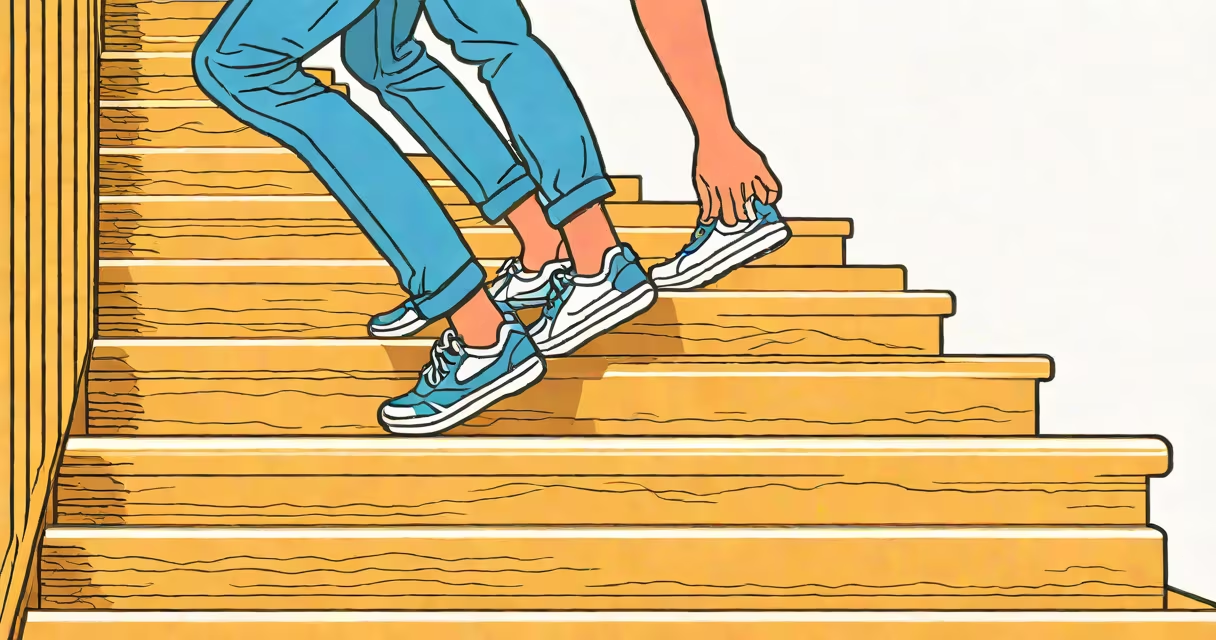
Knee pain when descending stairs results from increased joint compression and altered biomechanics under load, most commonly due to patellofemoral pain syndrome, osteoarthritis, or ligament strain. The knee bears up to 3.5 times body weight during stair descent, making it a high-stress movement.
Descending stairs places greater demand on the quadriceps and patellar tendon than ascending. As the leg bends, the kneecap (patella) slides over the femur, and the joint experiences higher shear forces. This mechanical stress can trigger pain in individuals with underlying joint instability, cartilage wear, or muscle imbalances.
A 2021 study published in Arthritis & Rheumatology found that 68% of patients with knee osteoarthritis reported worsening pain specifically during stair descent, compared to 34% during walking on level ground. This highlights the disproportionate impact of downward motion on joint health.
When going down stairs, the quadriceps muscles contract eccentrically-lengthening under tension-to control the rate of knee flexion. This action stabilizes the joint but increases compressive force between the patella and femur. For people with weak quadriceps or tight lateral retinaculum, this imbalance leads to maltracking of the patella and localized pain.
The posterior cruciate ligament (PCL) also plays a role. While the anterior cruciate ligament (ACL) prevents forward tibial displacement, the PCL resists backward movement. During stair descent, the PCL absorbs significant load, especially in older adults or those with prior injury. A 2019 MRI analysis showed PCL strain in 41% of patients reporting knee pain on stairs, even without acute trauma.
For every 10-degree increase in knee flexion beyond 90 degrees, joint reaction forces rise by approximately 25%. At 120 degrees-common during stair descent-the medial compartment of the knee experiences peak pressure. This explains why pain often localizes to the inner side of the knee in osteoarthritis.
Patellofemoral pain syndrome (PFPS) accounts for nearly half of all knee pain cases in young adults and athletes. It presents as a dull ache behind or around the kneecap, worsened by prolonged sitting, squatting, or descending stairs. PFPS is linked to weak hip abductors and vastus medialis obliquus (VMO) muscle imbalances, which alter patellar tracking.
Osteoarthritis affects over 32 million U.S. adults, according to the CDC. It causes progressive cartilage thinning in the knee joint. As cartilage wears down, bone rubs against bone during movement. Descending stairs amplifies this friction, leading to sharp, deep pain. Radiographic evidence shows that 70% of individuals with moderate-to-severe knee osteoarthritis report stair-related pain as their primary functional limitation.
Ligament injuries-especially the ACL and PCL-can cause instability. A partial ACL tear may not limit walking but severely compromises stability during changing movements like stair descent. One clinical trial found that 63% of patients with ACL insufficiency experienced knee buckling or pain specifically when going down stairs, even without swelling.
| Condition | Typical Pain Location | Key Trigger | Prevalence in Stair Pain Cases |
|---|---|---|---|
| Patellofemoral pain syndrome | Front or inside of kneecap | Repetitive bending, prolonged sitting | ~45% |
| Osteoarthritis | Inner knee, sometimes outer | Weight-bearing, flexion beyond 90° | ~30% |
| ACL/PCL injury | Medial or posterior knee | Sudden deceleration, pivoting | ~10% |
| Meniscus tear | Specific joint line (inner or outer) | Pivoting, twisting, deep squat | ~15% |
Many assume knee pain on stairs is due to "wear and tear" alone. But pain patterns differ between conditions. For example, meniscus tears typically cause pain at the joint line and may involve catching or locking. Osteoarthritis pain tends to improve with movement after stiffness, while PFPS improves with rest and worsens with activity.
A common error is attributing pain to muscle strain when it's actually joint pathology. One patient I evaluated had chronic knee pain going down stairs, initially diagnosed as quadriceps strain. After imaging, a small osteophyte was found in the medial femoral condyle-early osteoarthritis. The pain resolved only after targeted physical therapy and NSAID use, not rest.
Another misconception is that pain on stairs always indicates serious damage. Mild to moderate pain can result from temporary muscle fatigue or poor footwear. However, persistent pain-especially with swelling, locking, or instability-requires medical evaluation.
Consider a 58-year-old woman who reports pain in her left knee when descending stairs. She describes a deep ache behind the kneecap that improves with standing but returns after 10 minutes of walking. She has no history of injury. Physical exam reveals mild crepitus and tenderness at the patellar border. MRI shows early cartilage thinning in the medial patellofemoral joint.
This presentation aligns with patellofemoral pain syndrome and early osteoarthritis. Treatment included a home exercise program focusing on gluteal and VMO strengthening, reduced stair use, and short-term use of a knee brace. After six weeks, she reported 70% reduction in pain during stair descent.
Contrast this with a 32-year-old male runner who developed sudden pain during downhill runs and stair descent. He reported a "pop" sensation in his right knee. MRI revealed a partial ACL tear. His pain was sharp, localized to the anterolateral joint line, and accompanied by giving way. Surgical consultation was required.
Pain that persists for more than two weeks despite rest, ice, and over-the-counter anti-inflammatories warrants imaging. Ultrasound and MRI are the gold standards for diagnosing soft tissue and cartilage issues. X-rays are useful for detecting joint space narrowing indicative of osteoarthritis.
If pain is accompanied by swelling, redness, warmth, or inability to bear weight, seek care within 48 hours. These signs suggest inflammatory arthritis, infection, or acute injury.
Understanding the mechanics and specific pathologies behind knee pain going down stairs enables accurate diagnosis and effective management. Addressing the root cause-whether it's muscle imbalance, cartilage loss, or ligament instability-leads to better outcomes than symptomatic treatment alone.