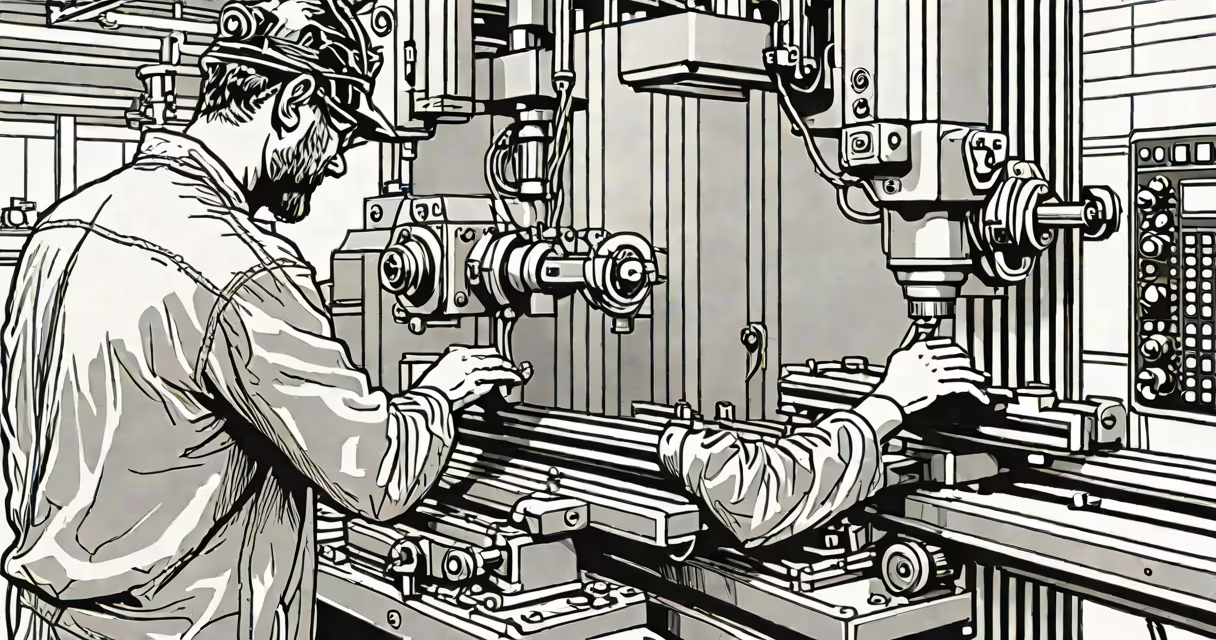
A CNC machine operator sets up, programs, and monitors computer-controlled machines to cut metal, plastic, or composite materials into precise parts based on digital blueprints. They ensure accuracy, safety, and efficiency throughout production runs.
CNC stands for Computer Numerical Control. These machines follow coded instructions-typically G-code-to move tools along multiple axes. The operator's job is to prepare the machine, verify tool paths, load raw material, run test cuts, and inspect finished parts for dimensional compliance.
According to the U.S. Bureau of Labor Statistics, CNC machine operators earn a median annual wage of $56,370 as of May 2023, with higher pay in manufacturing hubs like Michigan, Ohio, and Texas. The role requires mechanical aptitude, attention to detail, and familiarity with shop math and blueprint reading.
The operator begins by reviewing engineering drawings and CNC program files. These documents specify dimensions, tolerances, and material types. A typical part might require ±0.001-inch tolerance-tighter than a human hair.
Next, they secure the workpiece in a vise or fixture, install the correct cutting tool, and enter tool offset values into the machine's control panel. This step ensures the tool starts at the right position relative to the material.
After loading the program, the operator performs a dry run or simulation to check for collisions. Once verified, they initiate the actual cut. During operation, they monitor spindle speed, feed rate, coolant flow, and tool wear. If the machine alarms or produces chatter, they stop the process and diagnose the issue.
Each shift involves a checklist of actions:
For example, a machinist at a defense contractor in California produced 120 titanium aircraft brackets per week. Each bracket had 17 features requiring five different tools. The operator spent 45 minutes setting up the machine, ran a 12-minute test cycle, and validated dimensions using a coordinate measuring machine (CMM).
Operators also maintain logs for quality assurance. When a batch fails inspection, they trace errors to tool wear, incorrect offsets, or software bugs. Some facilities use automated inspection systems that flag out-of-tolerance parts in real time.
Operators must understand basic geometry, trigonometry, and metric conversions. A common task is calculating tool path depth from a drawing that specifies a 3mm chamfer at a 45-degree angle. Without proper math, the cut may remove too much material or leave burrs.
Tools include digital calipers (accurate to 0.001 inch), surface plates, edge finders, and tool preservers. Many operators use hand-held gages to verify hole positions before drilling.
Training typically takes 6 to 12 months through vocational schools or on-the-job programs. The National Institute for Metalworking Skills (NIMS) certifies operators in areas like CNC lathe operations and precision measurement. Employers often prefer candidates with NIMS credentials, especially for aerospace or medical device manufacturing.
| Task | Frequency | Required Skill |
|---|---|---|
| Program verification | Before every run | Understanding of G-code syntax |
| Tool change and alignment | Per job or every 2 hours | Manual calibration and probe use |
| First-piece inspection | After setup | Measurement with micrometer and CMM |
| Downtime reporting | End of shift | Documentation and troubleshooting |
One operator at a Midwest automotive supplier shared that a misaligned fixture caused 37 defective engine mounts in a single batch. The error was caught during first-piece inspection, saving $12,000 in rework and scrap costs. That incident reinforced the importance of double-checking setup procedures.
CNC machine operators are not programmers. While some operators learn basic G-code editing, most rely on certified CNC programmers to generate the initial code. The operator's role is execution, not creation.
Another myth is that CNC machines run entirely autonomously. In reality, operators intervene frequently. A study by the Association for Manufacturing Technology (AMT) found that 68% of CNC jobs involve at least one manual adjustment per cycle. Machines don't "think"-they follow instructions precisely, but humans still manage variables like material variation and tool deflection.
Some confuse CNC operators with general machinists. Traditional machinists operate manual lathes and mills. CNC operators specialize in automated systems. The skill sets overlap, but CNC roles demand more digital literacy and software familiarity.
Manufacturers in aerospace, automotive, medical devices, and robotics depend on CNC operators. Precision parts like turbine blades, surgical implants, and robotic joints require tolerances below 0.0005 inches-impossible to achieve consistently by hand.
For example, a company producing MRI scanner components uses CNC machines to mill aluminum housings with 0.0002-inch flatness tolerance. An operator checks each housing with a laser interferometer before assembly. Without accurate setup and monitoring, the entire system could fail during scanning.
Factories also use CNC machines for high-volume production. A car manufacturer in Indiana runs 24/7 shifts, with three operators per shift handling 15 machines. Each machine produces 200 brake calipers per hour. Operators rotate between stations, checking for wear, debris, and alignment drift.
These roles are essential in lean manufacturing environments. According to AMT, CNC automation reduces waste by up to 30% compared to manual methods, but only when operators maintain consistent setup and monitoring practices.
A CNC machine operator helps digital designs become physical parts with exact specifications. Their work spans setup, monitoring, inspection, and documentation. The role demands technical knowledge, vigilance, and problem-solving under pressure.
Understanding what a CNC machine operator does reveals the critical link between design and production. Without skilled operators, even the most advanced CNC programs cannot deliver precision parts reliably.