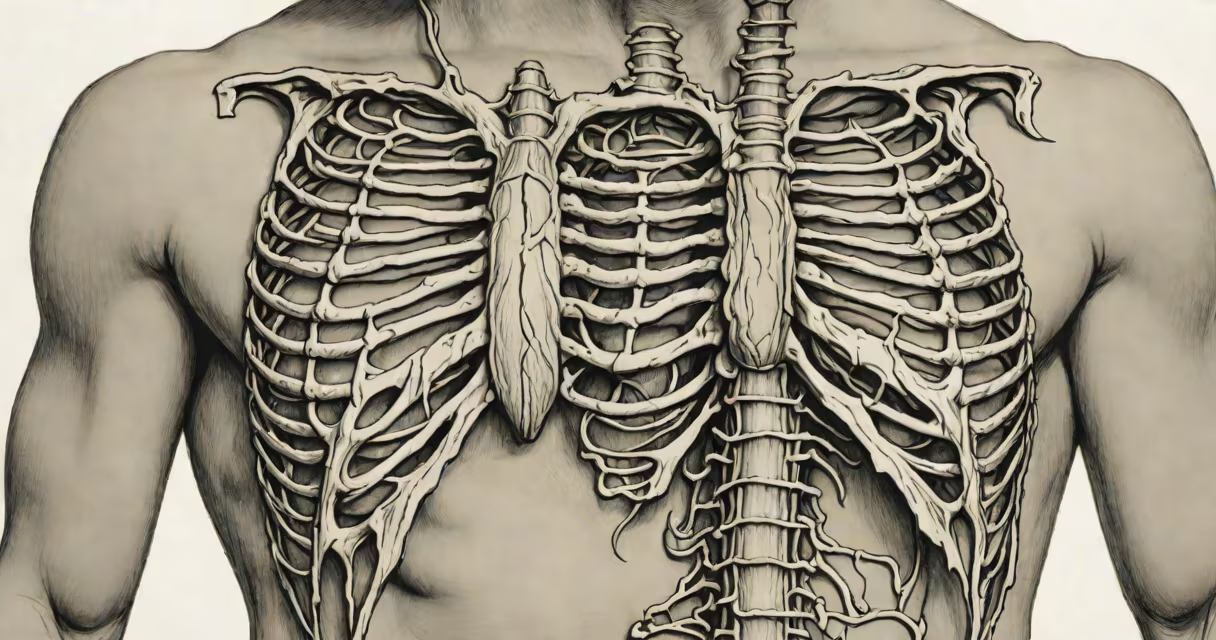
The thorax is the central region of the human trunk, located between the neck and the abdomen, containing the heart, lungs, and major blood vessels. It is protected by the rib cage and forms the core of the upper body's skeletal structure.
Medically, the thorax refers specifically to the bony structure formed by the 12 pairs of ribs, sternum, and thoracic vertebrae. This structure encloses the thoracic cavity, which houses the important organs essential for respiration and circulation. The term originates from the Greek word *thōrakos*, meaning "breastplate," reflecting its protective role.
Understanding the thorax is critical in clinical settings. A physical exam of the thorax includes assessing breath sounds, heart rate, and symmetry of movement during breathing. Abnormal findings-such as asymmetrical expansion or dullness on percussion-can indicate conditions like pneumonia, pleural effusion, or pneumothorax.
The thorax functions as both a mechanical and protective unit. During inhalation, the diaphragm contracts and moves downward, while the intercostal muscles between the ribs lift the rib cage upward and outward. This increases the volume of the thoracic cavity, reducing pressure and drawing air into the lungs.
Exhalation reverses this process passively, driven by elastic recoil of lung tissue and relaxation of the diaphragm. The rib cage acts as a rigid scaffold that maintains the integrity of the chest wall, shielding delicate internal structures from trauma.
A 2021 study published in Journal of Anatomy confirmed that the average adult thorax has a transverse diameter of 26 cm and an anteroposterior diameter of 16 cm, with variation based on sex and body habitus. These measurements help clinicians assess chest development and detect abnormalities such as pectus excavatum or kyphoscoliosis.
The thorax consists of three main parts:
The first seven pairs of ribs are called "true ribs" because they attach directly to the sternum. The next three pairs (8-10) are "false ribs" due to indirect attachment through cartilage. The last two pairs (11-12) are "floating ribs" because they lack anterior attachments entirely.
| Rib Type | Number of Pairs | Attachment |
|---|---|---|
| True ribs | 7 | Direct to sternum |
| False ribs | 3 | Indirect to sternum via cartilage |
| Floating ribs | 2 | No anterior attachment |
Many people confuse the thorax with the chest. While "chest" is often used colloquially, it lacks anatomical precision. The chest may refer to the entire front of the torso, including the upper abdomen and shoulders, whereas the thorax is strictly defined by the bony cage and its contained organs.
Another frequent error is equating the thorax with the respiratory system. Though the lungs lie within the thorax, the thorax itself is not limited to breathing-it supports cardiovascular function, protects neural pathways, and contributes to posture and balance.
The thorax is not interchangeable with the abdomen. The diaphragm separates the two regions. Damage to the thorax can impair breathing, but injuries to the abdomen affect digestion and organ function. Confusing them leads to misdiagnosis and delayed treatment.
In emergency medicine, assessing the thorax is important. For example, during a trauma evaluation, a patient with blunt force to the chest may develop a flail chest-a condition where multiple adjacent ribs fracture, creating a segment that moves paradoxically during breathing. This disrupts ventilation and requires immediate intervention.
I once observed a paramedic stabilize a motor vehicle crash victim whose thorax showed asymmetrical movement. Using a chest seal and oxygen, they prevented tension pneumothorax until hospital arrival. The diagnosis was confirmed via CT scan, revealing a collapsed right lung caused by a fractured rib piercing the pleura.
Imaging techniques like CT and MRI rely on accurate anatomical labeling. Radiologists distinguish between the thorax and abdominal regions using anatomical landmarks such as the diaphragmatic dome and the level of the fourth thoracic vertebra. Mislabeling can lead to incorrect staging of tumors or missed diagnoses of metastatic spread.
When discussing the thorax, clarity matters. Here's how it differs from similar terms:
Understanding what thorax means enables clearer communication between patients and providers. It ensures accurate documentation, proper imaging interpretation, and effective treatment planning. Whether in a classroom, clinic, or emergency room, knowing the precise definition prevents errors and improves outcomes.