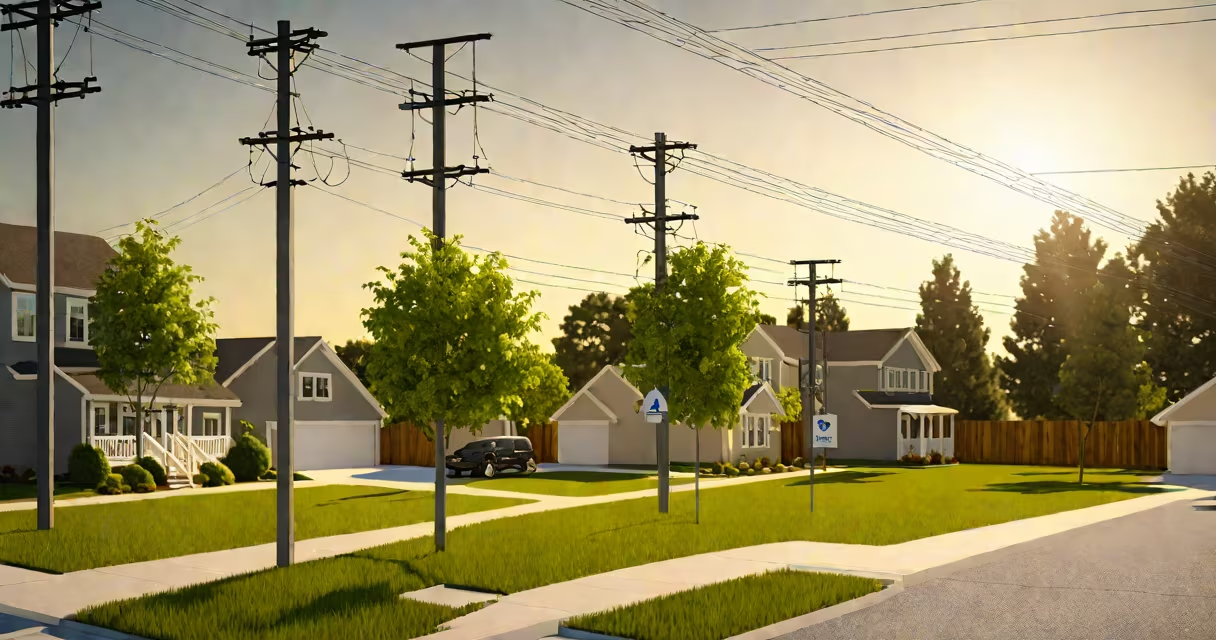
A utility easement is a legal right allowing a utility provider or public agency to install, operate, and maintain infrastructure-such as power lines, water mains, sewer pipes, or fiber-optic cables-on a portion of private land, even though the land remains privately owned.
This arrangement grants limited access to a specific area of a property for utility purposes. The landowner retains title and most rights to the land, but cannot build permanent structures or obstruct access within the easement zone. The right is recorded in public land records and binds future owners.
Utility easements are typically established through a written agreement between the landowner and the utility company, or automatically by local zoning laws when new infrastructure is installed. They are common in both urban and rural areas and often appear on property surveys and deeds.
When a utility company needs to run a pipeline or electrical line across private property, it doesn't take ownership of the land. Instead, it obtains an easement-a legal permission to use a defined strip of land for utility operations. This allows the company to access the area for installation, maintenance, and emergency repairs.
The easement is usually narrow-between 5 and 20 feet wide-and runs along the boundary of a property or through a backyard. It's marked with physical signs or metal stakes at regular intervals. These markers indicate where the easement begins and ends, helping landowners avoid building over it.
For example, a homeowner in suburban Chicago discovered that their backyard had a 10-foot-wide utility easement running east-west, marked by steel rods set every 25 feet. When they planned to build a deck, they checked the property survey and found the structure would fall directly over the easement. The utility company required them to relocate the deck to avoid interference with underground gas lines.
Utility easements differ based on the type of infrastructure involved and who controls the right. The most common categories include:
| Type | Infrastructure | Owner/Operator | Key Limitation |
|---|---|---|---|
| Electric Power | Overhead and underground lines | Local utility company | Cannot build over lines; restricted tree trimming |
| Water & Sewer | Pipes and manholes | Municipal water authority | Access for pipe replacement; excavation may occur |
| Gas Distribution | Underground gas lines | Natural gas provider | Prohibited digging without notification; safety zones apply |
| Telecommunications | Fiber-optic cables, cell towers | Internet or phone provider | May require small trenches; limited surface disruption |
Some easements are permanent, meaning they remain in effect indefinitely. Others may be temporary, such as those created during construction projects. However, most utility easements are permanent and transfer with the property.
Landowners often assume that a utility easement gives the provider full control. That's incorrect. The utility cannot alter the land beyond what's necessary for maintenance, nor can it charge the landowner for access. The landowner still pays property taxes and can sell the property-but the new owner assumes the same easement obligations.
Utility easements exist because infrastructure cannot always follow public roads or rights-of-way. In many neighborhoods, especially those developed after 1950, utility lines were routed through backyards or side yards due to space constraints and cost efficiency.
According to the American Society of Civil Engineers (ASCE), over 60% of U.S. residential properties have at least one utility easement on the property. These easements reduce the need for expensive trenching through streets and allow utilities to serve homes efficiently.
For example, in a newly developed housing subdivision in Austin, Texas, the developer included a 12-foot-wide utility easement along the rear property line of each home. This allowed the city's water department to lay a central distribution line without disturbing individual driveways or front yards. Homeowners signed agreements during purchase that acknowledged the easement.
Another key reason for easements is emergency response. If a gas line ruptures or a transformer fails, utility crews must reach the site quickly. An easement ensures they can enter the property legally and safely without needing to obtain permission each time.
Many people confuse utility easements with property boundaries or right-of-way corridors. A boundary line defines ownership. An easement is a legal privilege to use part of that land for a specific purpose. You can own land up to the boundary, but the easement may extend past it into adjacent parcels.
Another misconception is that utility companies can build anything they want in an easement. That's false. The company must stay within the agreed-upon scope. For example, a utility cannot install a large transformer station in a residential easement unless approved by local zoning boards and the landowner.
Also, while the landowner cannot construct permanent buildings over an easement, they can plant grass, install fencing, or field the area-so long as the work doesn't interfere with access. However, planting trees near a gas line easement is risky. Roots can damage pipes, and cutting trees in an easement requires prior notice to the utility.
A lesser-known fact: some states allow landowners to reclaim an easement if it's no longer used. In California, for instance, under Civil Code § 807, a utility must demonstrate ongoing use every 10 years to maintain the easement. If it stops using the corridor, the landowner can petition to remove it from the deed.
In 2019, a couple in Portland, Oregon, bought a single-family home with a large backyard. They planned to install a swimming pool and hired a contractor to survey the property. The survey revealed a 15-foot-wide utility easement running diagonally across the yard-originally placed by the city for stormwater drainage.
The contractor warned that installing a pool would violate the easement and could lead to legal action. The homeowners contacted the city and learned that the easement was still active and enforceable. They relocated the pool to a different area, avoiding costly delays and potential removal orders.
This case illustrates why reviewing property documents before major improvements is essential. Even if an easement isn't visible, it exists in public records and can affect development plans.
Understanding what a utility easement means is important for property owners. It's not just about utility access-it's about knowing your rights and limitations. While you retain ownership of the land, you surrender certain uses within designated zones.
Always review your deed, survey, and local zoning regulations before making changes to your property. If you're unsure about an easement's location or scope, contact your local utility or county recorder's office. Some counties offer online maps showing easement locations.