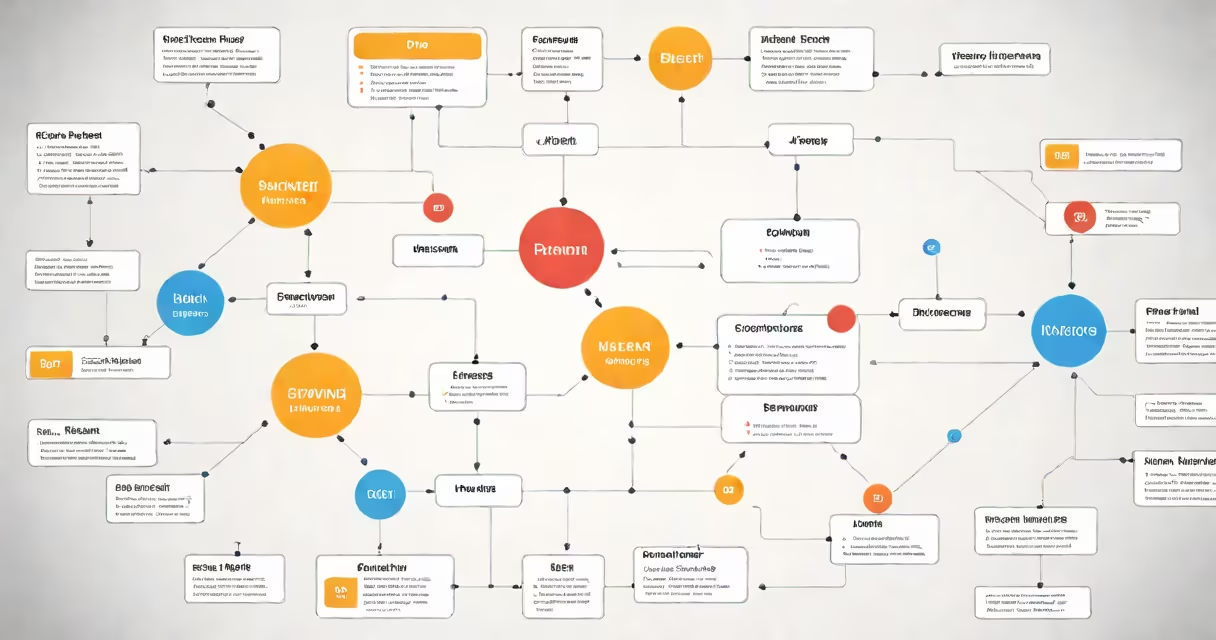
BPMN (Business Process Model and Notation) is a standardized graphical language used to represent business processes in a clear, consistent way. It enables teams to visualize workflows, define process logic, and communicate process designs across departments and technical roles.
BPMN was developed by the Object Management Group (OMG), a global consortium that sets standards for software and systems architecture. The current version, BPMN 2.0, was released in 2011 and is widely adopted in enterprise environments for designing, analyzing, and executing business processes.
Unlike informal flowcharts, BPMN uses precise symbols and syntax. Each element-such as a start event, task, gateway, or end event-has a defined meaning and behavior. This consistency allows developers, analysts, and business users to interpret the same diagram with minimal ambiguity.
BPMN models are structured around a sequence of activities connected by flow objects. These flows represent the order in which steps occur, based on conditions, decisions, or time triggers. The model captures both the intended behavior and the constraints of a process.
For example, a customer order fulfillment process begins with a "Start Event" (like a new order being received). It then moves through tasks such as "Validate Payment," "Check Inventory," and "Ship Product." Decision points-shown as diamonds-are used to route the process based on conditions (e.g., "Is inventory available?").
Each element follows strict semantics. A "Parallel Gateway" splits execution into multiple concurrent paths. A "Sequence Flow" connects elements in order. A "Message Flow" shows communication between different participants or systems. These rules ensure that models can be interpreted correctly by both humans and software tools.
BPMN defines several categories of elements. The most common are:
| Element Type | Symbol | Purpose | Example |
|---|---|---|---|
| Flow Objects | • Start Event • Task • Gateway • End Event |
Define the structure and logic of the process | "Order Received" (start event) |
| Connecting Objects | → Sequence Flow ↔ Message Flow |
Show control and data flow between elements | "Approve Request" → "Update Database" |
| Swimlanes | Vertical or horizontal lanes | Assign responsibilities to roles or departments | "Sales Team" lane handles customer contact |
| Artifacts | Annotations, Data Objects | Provide additional context or information | "Customer ID: 12345" written near a task |
Swimlanes are especially useful for clarifying ownership. A process involving sales, finance, and logistics can be split into separate lanes, making it easy to see who performs each step.
Artifacts like annotations or data objects aren't part of the execution logic but support understanding. For instance, adding a note that says "Must comply with GDPR" near a data handling task ensures compliance awareness during review.
BPMN is used across industries-from healthcare to banking-to document, analyze, and automate business processes. It's central to business process management (BPM), workflow automation, and integration projects.
Major software platforms like Camunda, Activiti, and IBM Business Automation Workflow use BPMN as their native format. When a company wants to automate a loan approval process, they model it in BPMN first. The model is then executed by a workflow engine that follows the defined logic.
A real-world example: A hospital uses BPMN to map patient admission. The process starts with a "Patient Arrives" event. Tasks include "Register Patient," "Assign Bed," and "Notify Doctor." A gateway checks whether the patient has insurance. If yes, the process continues; if no, it routes to a financial counselor. This model is shared with IT, nurses, and administrators to align expectations.
According to the OMG, BPMN aims to be readable by both technical and non-technical stakeholders. A nurse can understand the flow of care steps, while a developer can export the model to code or integrate it with a backend system.
BPMN is often mistaken for UML activity diagrams. While both use similar shapes, they serve different purposes. UML focuses on software behavior and is used in system design. BPMN is focused on business processes and includes constructs like message flows and human tasks that UML lacks.
Another misconception: BPMN is only for documentation. In reality, it supports execution. Tools like Camunda allow BPMN models to run in production-automating decisions, routing tasks, and tracking progress in real time.
Many assume BPMN requires complex software. But simple models can be drawn in free tools like Lucidchart, Draw.io, or even PowerPoint. The key is using correct symbols-not artistic freedom.
One non-obvious fact: BPMN supports both human and system tasks. A task labeled "Approve Loan" can be assigned to a person (human task) or a software service (service task). This dual capability makes BPMN ideal for hybrid processes involving people and machines.
I once helped redesign a claims processing workflow for an insurance firm. The original process was documented in scattered Word files and emails. We rebuilt it in BPMN using swimlanes for underwriting, claims, and legal teams. After validation with stakeholders, we deployed the model in a workflow engine. Processing time dropped by 37%, and errors decreased by 62% within six months.
The clarity of BPMN made it easier to spot bottlenecks-like a manual review step that delayed approvals. Once automated, the system flagged high-risk cases for human attention, improving accuracy without slowing down volume processing.
What is bpmn? It is a standardized, visual language for modeling business processes. It provides a shared vocabulary for describing how work gets done, from initial trigger to completion. Its precision and broad adoption make it essential for process analysis, automation, and cross-team alignment.
BPMN is not just a diagramming tool-it's a foundation for executable process design. automating a regulatory compliance check, BPMN delivers clarity, consistency, and scalability.