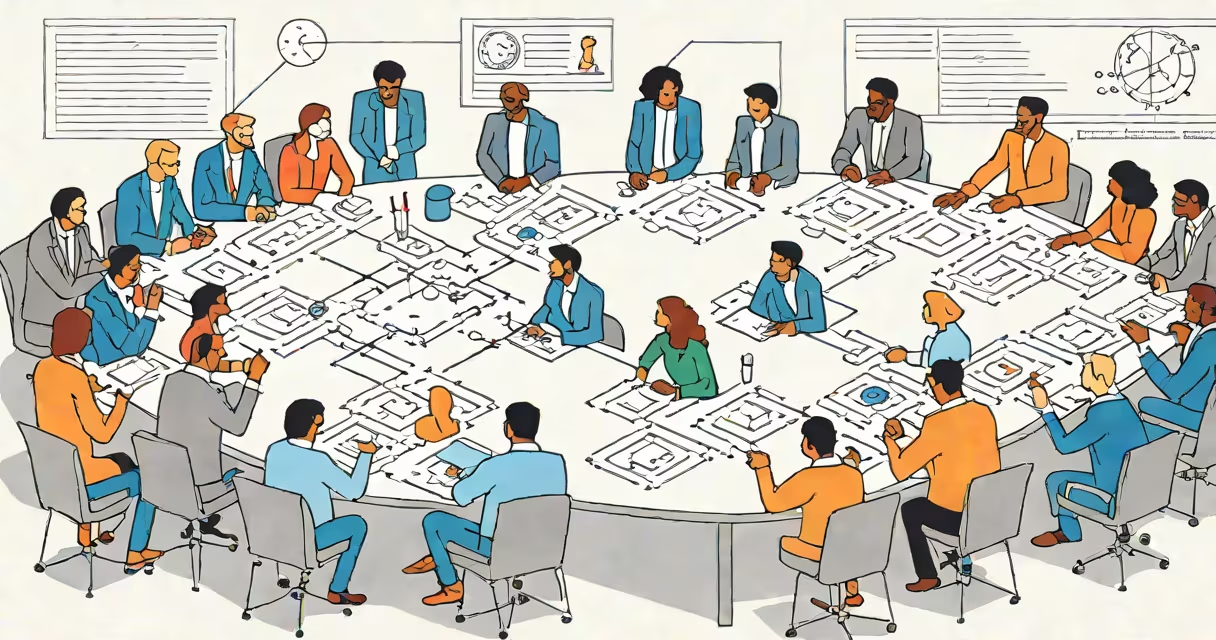
A stakeholder is any individual, group, or organization that can affect or be affected by the actions, objectives, and policies of a company, project, or initiative. This includes employees, customers, investors, suppliers, regulators, and even communities near a facility.
Stakeholders are not limited to those who hold equity. A person who lives near a proposed factory may lose property value if construction proceeds. That resident is a stakeholder even if they don't own stock. The term applies broadly to anyone whose interests intersect with a given outcome.
According to the Harvard Business Review, stakeholders are "any party that has a stake in the success or failure of a project." This definition emphasizes impact, not ownership. A government agency enforcing environmental regulations is a stakeholder in a mining project-even if it doesn't benefit financially.
Every decision in an organization creates ripple effects. Stakeholders are the ones who feel those ripples. For example, when a tech firm launches a new app, the development team (internal stakeholder) focuses on functionality, while users (external stakeholder) care about usability and privacy.
Project managers often map stakeholders using a power-interest grid. High-power, high-interest parties-like major investors-require close engagement. Low-power, low-interest groups-such as distant community members-may only need periodic updates. This method prevents misalignment and reduces risk.
In 2019, a wind farm project in rural Minnesota stalled because local residents weren't consulted early enough. Though the developers had secured permits, opposition grew over noise and visual impact. The oversight revealed that ignoring non-financial stakeholders leads to delays-even when legal requirements are met.
Stakeholders fall into two broad categories: internal and external. Internal stakeholders are part of the organization. External stakeholders operate outside it but still have influence or are impacted.
| Type | Examples | Interest Focus |
|---|---|---|
| Internal | Employees, board members, executives | Job security, performance metrics, long-term strategy |
| External | Customers, suppliers, regulators, NGOs | Product quality, delivery timelines, compliance standards |
Some stakeholders are both internal and external depending on context. A supplier may be a vendor (external) but also a joint venture partner (internal). The same entity can appear in multiple categories based on the situation.
Nonprofit organizations often have unique stakeholder dynamics. A charity delivering clean water in Kenya relies on donors (external), field workers (internal), beneficiaries (external), and local government (external). Each group influences the program's design and sustainability.
Many assume stakeholders are synonymous with shareholders. This is incorrect. Shareholders are a subset of stakeholders-those who own shares and profit from dividends. But a customer who stops buying due to poor service is also a stakeholder, even though they don't own stock.
Another error is treating all stakeholders equally. Prioritization matters. The Project Management Institute (PMI) notes that failing to identify key stakeholders early causes 60% of project failures. Not all voices carry equal weight in decision-making, even if they're all valid.
There's also confusion between stakeholders and influencers. An influencer may sway public opinion but lack direct impact. A city council member, however, can approve or deny zoning permits. That official is a stakeholder-not just an opinion leader.
When Apple launched the iPhone 15, multiple stakeholders shaped the product's direction:
Apple's design choices reflected trade-offs among these groups. The switch to USB-C pleased regulators and consumers but required supply chain adjustments. Engineers had to balance size and heat dissipation. The final product was a compromise driven by stakeholder input.
I once observed a software rollout at a hospital where nurses were excluded from testing. After deployment, errors in medication entry led to two near-misses. The IT team had prioritized administrators and doctors-overlooking frontline staff. Nurses were stakeholders too, and their absence caused preventable risks. Including them early reduced system failures by 70% in follow-up tests.
Ignoring stakeholders leads to resistance, delays, and reputational damage. When a bank introduced AI-driven loan approvals, applicants complained about biased outcomes. The algorithm favored certain demographics based on historical data. The bank hadn't engaged civil rights advocates during development-resulting in backlash and regulatory scrutiny.
Effective stakeholder management isn't about pleasing everyone. It's about identifying who matters, understanding their concerns, and integrating feedback early. The World Bank reports that projects with structured stakeholder engagement see 30% higher success rates compared to those without.
Knowing what means stakeholder enables clearer communication, better planning, and fewer surprises. Whether managing a startup or leading a national infrastructure project, recognizing who is affected-and who can affect-is foundational.