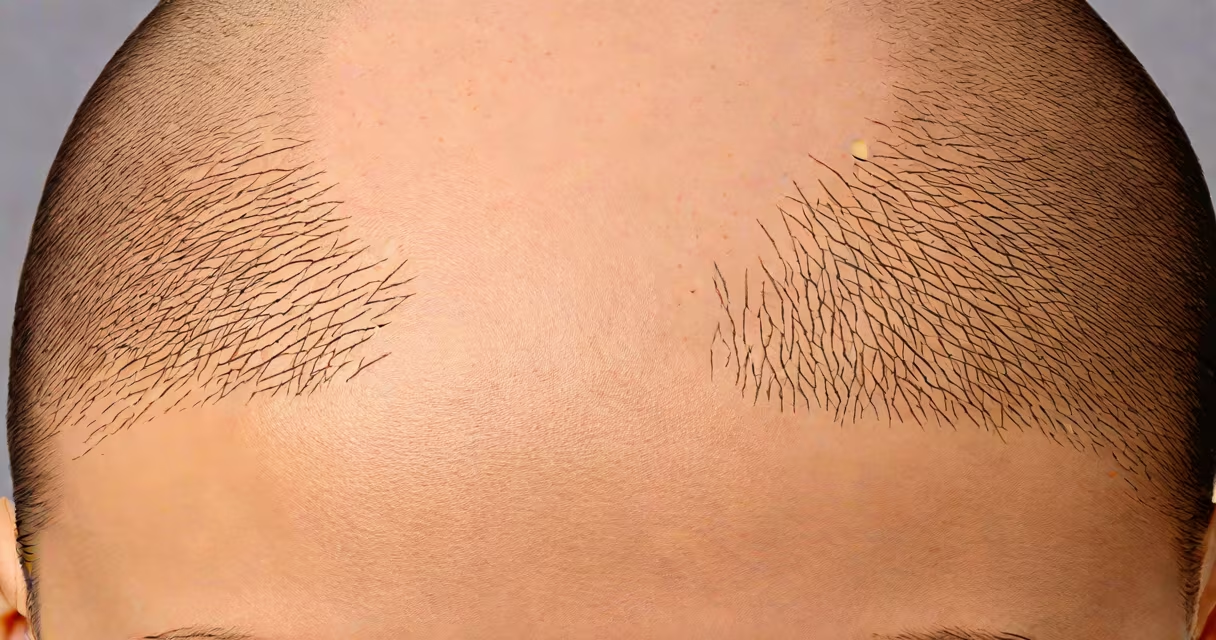
A bald spot on top of head female is a localized area of hair loss typically appearing as a round or oval patch on the crown or vertex of the scalp. It results from disrupted hair follicle function due to autoimmune activity, hormonal shifts, or inflammation.
This condition differs from diffuse thinning seen in female pattern baldness. A bald spot on top of head female often appears suddenly, sometimes within days, and may be accompanied by mild itching or tenderness. The skin underneath usually remains intact and unpigmented.
According to the American Academy of Dermatology Association (AAD), alopecia areata affects about 2% of the U.S. population, including women. The condition occurs when the immune system attacks hair follicles, leading to patchy hair loss. In women, the crown is a common site due to higher density of androgen-sensitive follicles in that region.
The process begins when immune cells infiltrate the hair follicle during the anagen (growth) phase. This triggers inflammation and disrupts the follicle's ability to produce hair. The exact trigger remains unclear, but genetics and environmental stressors play roles.
Research published in JAMA Dermatology shows that individuals with alopecia areata often have genetic variants near the HLA-DQB1 gene, which regulates immune responses. These variants increase susceptibility, especially when combined with life stressors such as illness, childbirth, or trauma.
Once the immune attack halts hair production, the follicle enters a resting state called telogen. Without regrowth stimulation, the hair falls out and the area becomes visibly bald. In some cases, regrowth occurs spontaneously within months. In others, treatment is needed.
Bald spots on top of head in women fall into several categories based on cause and appearance:
| Type | Appearance | Common Triggers | Recovery Rate |
|---|---|---|---|
| Alopecia areata | Round, smooth, well-defined patch | Autoimmune response, stress, genetics | ~50% resolve within a year without treatment |
| Folliculitis | Red, inflamed patch with pustules or crusting | Bacterial or fungal infection, blocked follicles | Improves with antibiotics or antifungals in 2-4 weeks |
| Female pattern baldness | Diffuse thinning, widening part line | Hormonal imbalance, aging, genetics | Progressive; rarely reverses without therapy |
While alopecia areata accounts for most isolated bald spots, folliculitis is frequently misdiagnosed as autoimmune hair loss. A key distinction: folliculitis patches are red, tender, and may contain pus. They often develop around hair follicles rather than in uniform circles.
One non-obvious fact: a bald spot on top of head female can appear after a viral infection-even a mild cold. A 2021 study in Frontiers in Immunology documented 14% of new alopecia areata cases following upper respiratory infections, suggesting immune system cross-reactivity may trigger hair loss.
The crown of the scalp is a hotspot for bald spots due to high concentration of androgen receptors. These receptors bind testosterone metabolites, making follicles sensitive to hormonal fluctuations. Even normal levels of dihydrotestosterone (DHT) can shrink follicles over time.
Women who've recently given birth or are on hormonal contraceptives may experience sudden hair shedding. Postpartum hair loss peaks at 3-4 months after delivery and often affects the entire scalp, not just one spot. However, if a single bald spot emerges during this period, it may indicate alopecia areata rather than telogen effluvium.
Another overlooked cause: traction alopecia from tight hairstyles. Women who wear ponytails, braids, or extensions daily may develop scarring alopecia. The pressure damages follicles at the crown, leading to permanent hair loss if untreated early.
Many assume a bald spot on top of head female always means cancer or severe illness. That's false. While rare, some cancers do cause paraneoplastic alopecia, but these cases involve widespread hair loss, not isolated patches.
Another myth: bald spots are always irreversible. In reality, spontaneous regrowth happens in nearly half of cases. A 2022 review in Dermatologic Clinics reported that 46% of patients with small (<1 cm diameter) alopecia areata patches saw full regrowth within 12 months without intervention.
People also confuse alopecia areata with dandruff or seborrheic dermatitis. The latter causes flaky, itchy scalp but doesn't lead to complete hair loss. A patch of hair loss with scaling and redness likely indicates a fungal infection like tinea capitis, not autoimmune disease.
Sarah, a 34-year-old teacher, noticed a 2 cm round bald spot on her crown six weeks after recovering from a flu. She had no family history of hair loss. Her doctor examined the area under a dermoscope and observed absence of follicular openings and a smooth, shiny surface-classic signs of alopecia areata.
Lab tests ruled out thyroid dysfunction and iron deficiency. A scalp biopsy confirmed lymphocytic infiltration around follicles. Sarah began topical minoxidil and intralesional corticosteroid injections. After eight weeks, visible hair regrowth appeared at the edges. By 16 weeks, the patch was nearly filled in.
This case illustrates that early diagnosis prevents progression. Delayed treatment increases risk of expanding patches or conversion to alopecia totalis (complete scalp hair loss).
Consult a dermatologist if a bald spot on top of head female persists beyond four weeks, spreads, or recurs. Early intervention improves outcomes. The National Alopecia Areata Foundation recommends evaluation within three months of onset.
Do not attempt to treat with over-the-counter shampoos or oils unless the cause is known. Some products irritate inflamed skin and worsen conditions like folliculitis.
A bald spot on top of head female is not a sign of personal failure or poor hygiene. It is a medical condition with identifiable causes and treatments. Early recognition leads to better outcomes. Understanding the difference between autoimmune, infectious, and hormonal causes ensures proper care.