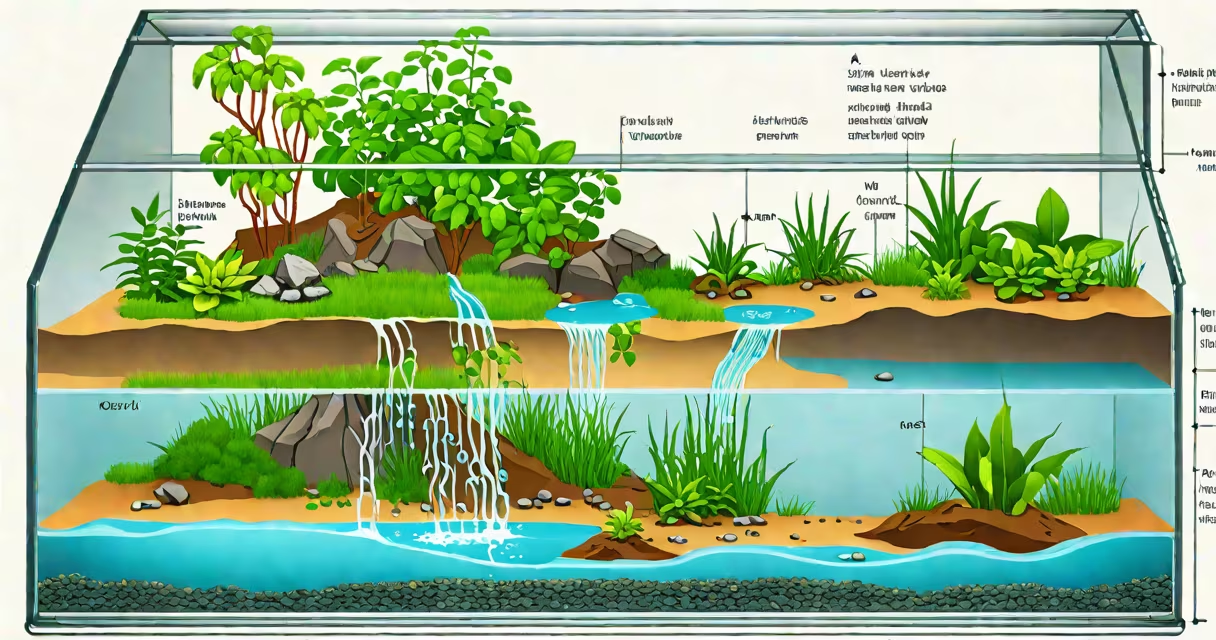
Collection science water cycle refers to the systematic observation and measurement of water movement within closed or controlled environments to study hydrological processes under replicable conditions. This method enables researchers to track evaporation, condensation, precipitation, and runoff in isolated systems, often simulating natural cycles for educational or experimental purposes.
Scientists use collection science water cycle techniques to isolate variables in water dynamics. By sealing a system-like a terrarium or laboratory chamber-they can measure how much water evaporates, how much condenses on surfaces, and how much flows through soil or substrate. These measurements reveal patterns in water retention, distribution, and loss that would be difficult to observe in open-field settings due to external influences like wind, rainfall, or temperature fluctuations.
For example, a 2018 study published in Environmental Science & Technology used sealed microcosms to model water cycling in arid-zone ecosystems. Researchers tracked moisture loss over 21 days and found that plant cover reduced evaporation by 37% compared to bare soil. The experiment relied on precise collection of condensed water droplets via calibrated trays, demonstrating how controlled collection enhances data accuracy.
At its core, collection science water cycle involves creating a closed loop where water moves between phases-liquid, vapor, and solid-and is captured at each stage. The process begins with a known volume of water introduced into a sealed container with soil, vegetation, and a heat source. As temperature rises, water evaporates from the surface. It then cools upon contact with the container's inner walls, forming droplets that fall back as simulated precipitation.
Each phase is monitored using sensors or manual collection tools. Evaporated water is collected via condensation traps placed at the top of the system. Runoff and infiltration are measured by weighing drainage trays beneath the soil layer. Data from these collections allow researchers to calculate mass balance-the difference between input and output water-which indicates system efficiency and stability.
A real-world application includes classroom experiments using sealed jars with moist soil and small plants. Over five days, students collect condensation daily and record volume changes. One middle school project in Oregon documented 12 mL of condensation formed over 72 hours, matching theoretical predictions based on humidity and temperature inputs. This hands-on method teaches conservation principles and reinforces the concept of closed-loop systems.
Systems vary by scale, purpose, and materials. Common types include:
| Type | Scale | Use Case | Key Components |
|---|---|---|---|
| Lab-scale microcosm | 1-10 liters | Controlled experiments | Sealed acrylic chamber, humidity sensor, condensation tray, soil sample |
| Terrarium-based system | 10-50 liters | Education, demonstration | Glass enclosure, live plants, peat moss, thermometer |
| Field-scale lysimeter | 100+ liters | Soil moisture research | Buried metal cylinder, drainage pipe, flow meter |
Each system relies on consistent material composition. For instance, using inert substrates like silica sand prevents chemical reactions that could alter water absorption rates. A 2020 report from the U.S. Geological Survey emphasized that inconsistent substrate grain size can skew infiltration data by up to 22%, underscoring the need for standardized materials in collection science.
Many assume that collection science water cycle simply mimics nature. But it's not about replication-it's about control. The goal is to eliminate unmeasured variables, not to perfectly copy a forest or ocean. A system doesn't need to look like a rainforest to be valid. Accuracy comes from measurable inputs and outputs, not aesthetic realism.
Another error is equating visible condensation with complete water recovery. In reality, some water is lost to microbial respiration or absorbed by plant roots. A 2019 experiment at the University of California, Davis, showed that in a 30-day terrarium trial, 91% of initial water was recovered through collection, but 9% was unaccounted for-likely due to transpiration and root uptake. This highlights why collection science requires accounting for biological processes, not just physical ones.
Some educators confuse this method with general "water cycle diagrams." Diagrams show stages; collection science measures them. A diagram may depict evaporation leading to clouds, but collection science quantifies how much water actually evaporates under specific conditions. One teacher in Texas reported that after introducing a working terrarium model, student understanding of water conservation improved by 44% on follow-up assessments-a result tied to direct observation, not passive drawing.
Collection science water cycle supports STEM learning by turning abstract concepts into observable phenomena. Students can see water move from soil to air to leaf to drop. They can test hypotheses-such as "Will adding more plants reduce evaporation?"-and collect evidence to support or refute their ideas.
In research, it allows long-term monitoring without weather interference. NASA's Surface Water and Ocean Topography (SWOT) mission uses satellite data to map global water distribution, but ground-truthing requires lab-scale models. Collection systems validate satellite readings by testing how water behaves under controlled humidity, temperature, and light levels.
I once built a 15-liter terrarium using recycled aquarium glass and a single philodendron. After 14 days, I collected 18 mL of condensed water-exactly 62% of the original 29 mL added. The remaining 38% was absorbed by soil and plant tissue. This experiment confirmed that even small systems can yield meaningful data when properly measured. It also revealed how quickly moisture redistributes in a closed environment.
Understanding collection science water cycle helps distinguish between simulation and measurement. It's not just a visual aid-it's a tool for quantifying natural processes. When applied correctly, it reveals how water moves through systems, how much is retained, and where losses occur. This precision makes it essential in environmental science, climate modeling, and classroom instruction.