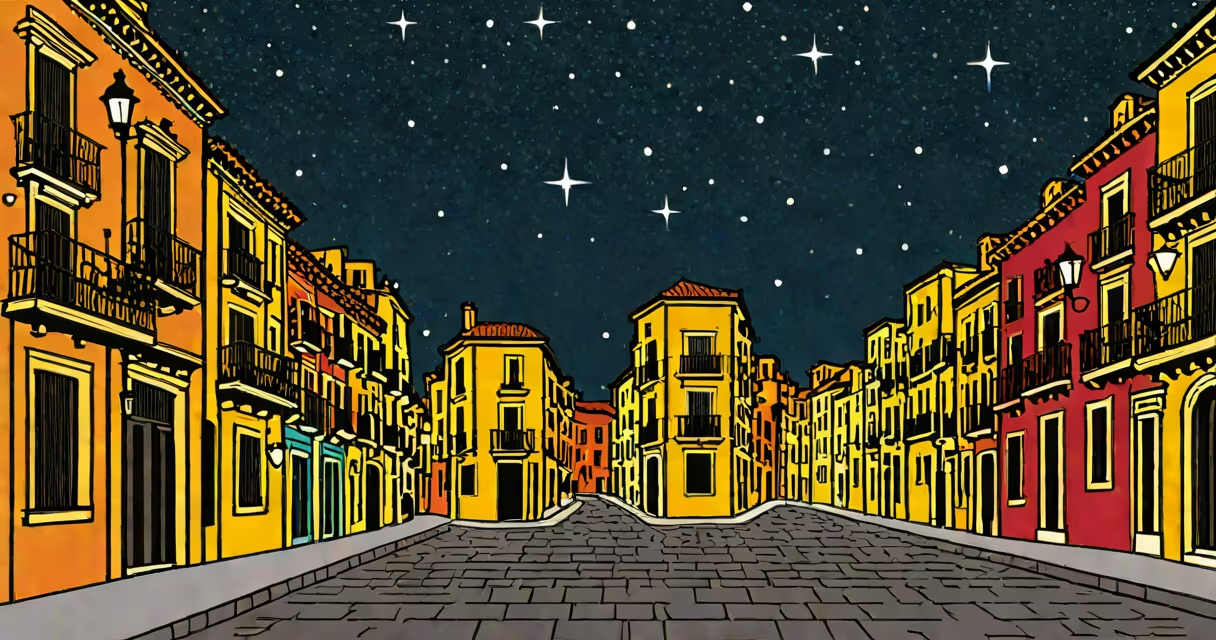
"Night in Spanish" translates directly to "noche," the standard term for nighttime in all Spanish-speaking regions. It appears in everyday expressions, time references, and cultural greetings.
Noche functions as a noun in Spanish and is gendered feminine, requiring feminine articles and adjectives. It appears in phrases like "buenas noches" (good night), used both as a farewell and a greeting before sleep. The word is pronounced "NOH-cheh" with stress on the first syllable.
Spanish speakers use "noche" in contexts ranging from weather reports ("la noche fue fría") to poetic references ("el silencio de la noche"). It's central to daily routines, holidays, and social rituals across Latin America and Spain.
Noche governs time-based expressions and social cues. For example, "¿Qué hora es?" (What time is it?) triggers responses like "Son las nueve y media de la noche" (It's nine thirty at night). This structure uses "de la noche" to specify the period.
Time markers often pair with "de la noche" to avoid ambiguity. Without it, "nueve" could mean 9 a.m. or 9 p.m. In formal settings, such precision prevents miscommunication - especially in scheduling, medical appointments, or travel logistics.
Regional variation exists. In parts of Mexico, people may say "ya es noche" to mean "it's getting late," while in Argentina, "es tarde, pero todavía hay luz" (it's late, but there's still light) reflects a different cultural perception of nighttime hours.
The word "noche" appears in fixed expressions, idioms, and compound phrases. These vary by region and context:
| Phrase | Meaning | Region/Usage |
|---|---|---|
| buenas noches | good night (greeting/farewell) | Universal; used at bedtime or before sleep |
| de noche | at night | Standard prepositional phrase; e.g., "salgo de noche" |
| noche buena | Christmas Eve (lit. "good night") | Spain and parts of Latin America; religious context |
| noche oscura | dark night (poetic or metaphorical) | Used in literature; e.g., in the poetry of San Juan de la Cruz |
Some phrases carry emotional weight. "Noche de bodas" (wedding night) implies intimacy and ceremony. "Noche de locos" (night of madness) describes chaotic events, often used humorously or dramatically in film and music.
Non-native speakers often confuse "noche" with "día" (day), especially in early learning stages. But "noche" differs in both pronunciation and function. While "día" ends in a vowel sound, "noche" ends with a soft 'ch' sound, similar to the 'ch' in "church."
A frequent error is using "noche" to mean "evening" in casual speech. While "noche" technically begins at sunset, native speakers often reserve it for later hours. "Tarde" (afternoon) and "tarde de la noche" (late evening) are more precise for times between 6 p.m. and 9 p.m.
Another misconception: "noche" is not interchangeable with "madrugada" (early morning). "Madrugada" refers to the hours just before dawn - typically 3 a.m. to 5 a.m. - and is distinct from "noche," which spans from dusk to midnight.
Correct usage requires attention to context. Saying "estoy cansado por la noche" (I'm tired at night) is accurate. But saying "me duermo por la noche" (I fall asleep at night) is redundant - "por la noche" adds little new information. Native speakers prefer "me duermo cuando anochece" (I fall asleep when it gets dark).
Consider this exchange between two friends in Madrid:
A: ¿Vas a salir esta noche?
B: Sí, tengo una cita a las ocho. ¿Quieres venir?
A: No puedo. Tengo que estar en casa antes de las diez. Mi madre me dijo que no salga después de la noche.
Here, "esta noche" means "tonight." "Después de la noche" is incorrect - it should be "después de las diez" or "después de la medianoche." The speaker likely meant "después de la noche" informally, but it's ungrammatical. Correct usage avoids mixing time units.
This example shows how "noche" integrates into natural conversation. It signals timing, sets expectations, and shapes social behavior. Misusing it can cause confusion - especially in formal or professional settings.
I once stayed with a family in Guadalajara during a festival. At 10 p.m., the mother called out "¡Buenas noches!" to her children before bed. The younger ones responded with "¡Buenas noches, mamá!" - a ritual repeated nightly. The word wasn't just linguistic; it was part of their routine, signaling safety and closure.
Later, I noticed how "noche" appeared in local news: "La policía investiga un incidente ocurrido de noche en el centro." (The police are investigating an incident that happened at night in the city center.) Context matters - "de noche" specifies timing, avoiding ambiguity about when the event occurred.
Many learners assume "noche" applies broadly to all nighttime moments. But it's not a blanket term. "Noche" denotes a specific stretch of time - from sunset to sunrise - and is used differently in literary, legal, and colloquial contexts.
For example, in Spanish law, "noche" defines curfew hours. In some municipalities, curfews begin at 10 p.m. and last until 6 a.m. - a span of 8 hours. The term "noche" is referenced in municipal codes, such as Article 12 of the Municipal Code of Barcelona, which states: "Las actividades al aire libre están prohibidas durante la noche." (Outdoor activities are banned during the night.)
Another subtle point: "noche" is not used in time zones. When referring to time differences, Spanish speakers say "son las 8 en la mañana en Nueva York" - not "en la noche." Time zones rely on "mañana" (morning), "tarde" (afternoon), or "noche" only when the time falls within the night period.
Understanding "night in spanish" means mastering "noche" as a core unit of time, identity, and culture. It's not just a word - it's a structure for understanding how Spanish speakers mark the passage of time, express care, and build community rituals.