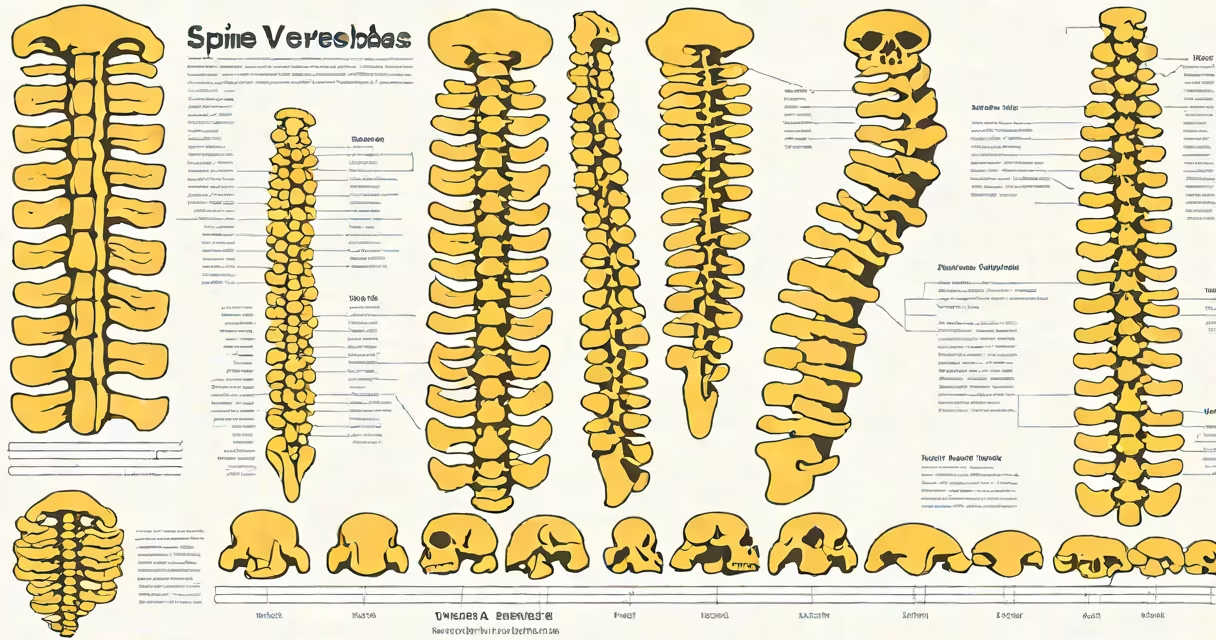
The human spine contains 33 individual vertebrae grouped into five regions: 7 cervical, 12 thoracic, 5 lumbar, 5 fused sacral, and 3-5 fused coccygeal vertebrae. These bones form the vertebral column, which supports the head, protects the spinal cord, and enables upright posture.
Vertebrae are named and numbered based on their location along the spinal axis. The numbering system begins at the base of the skull and proceeds downward through the neck, upper back, lower back, pelvis, and tailbone. Each region serves a distinct mechanical and neurological function. For example, cervical vertebrae allow head rotation and flexion, while lumbar vertebrae bear most of the body's weight during standing and walking.
Each vertebra consists of a central body, a neural arch enclosing the spinal canal, and processes for muscle and ligament attachment. The intervertebral discs between adjacent vertebrae absorb shock and allow limited movement. This structure enables flexibility while maintaining stability under load.
The spine is divided into five functional zones, each with a consistent number of vertebrae. The standard count is 33, though minor variation occurs due to fusion patterns and individual differences.
| Region | Number of Vertebrae | Function | Key Features |
|---|---|---|---|
| Cervical | 7 | Support head, enable neck motion | Transverse foramina for vertebral arteries |
| Thoracic | 12 | Attach ribs, protect heart/lungs | Costal facets for rib articulation |
| Lumbar | 5 | Bear body weight, enable bending | Larger bodies, short pedicles |
| Sacral | 5 (fused) | Form pelvic foundation | Fused into single bone (sacrum) |
| Coccygeal | 3-5 (fused) | Support sitting, attach muscles | Smallest, variable fusion |
While the total number of vertebrae is typically 33, the sacral and coccygeal regions show natural variation. Some individuals have four or six sacral vertebrae, and coccygeal counts range from two to five. These differences do not affect function and are often discovered incidentally on imaging.
A common misconception is that all vertebrae remain separate throughout life. In reality, the sacral and coccygeal segments fuse during adolescence. Fusion stabilizes the pelvis and transfers weight from the spine to the hip bones. This process begins around ages 16-20 and completes by age 25.
Accurate identification of vertebrae is essential for diagnosing spinal disorders. A fracture at T10 requires different treatment than one at L1, even though both are in the lower back. Radiologists and surgeons rely on standardized numbering to communicate precisely.
For example, a patient with a herniated disc at L4-L5 experiences pain radiating down the leg due to compression of the L5 nerve root. Knowing the correct vertebral level ensures accurate surgical planning and avoids complications. Misidentifying the level can lead to incorrect incision placement or nerve damage.
Spinal cord injury levels are also reported using vertebrae numbers. An injury at C5 affects arm function, while one at T10 may result in loss of abdominal control. The American Spinal Injury Association (ASIA) uses this system to classify severity and guide rehabilitation.
Many assume the spine has 26 bones because adults have fewer bones than infants. Newborns have about 270 bones, including unfused vertebrae. As the skeleton matures, bones like the sacrum and coccyx fuse, reducing the total count. The adult spine still contains 33 vertebrae, but they are organized into fewer functional units.
Another misunderstanding is that all vertebrae are identical. They are not. Cervical vertebrae have transverse foramina for blood vessels, thoracic vertebrae articulate with ribs, and lumbar vertebrae have larger bodies to handle greater loads. These structural differences reflect functional specialization.
Even the term "numbered" can mislead. Vertebrae are not assigned numbers arbitrarily. The cervical vertebrae are labeled C1 through C7, thoracic T1 to T12, lumbar L1 to L5, and so on. This system allows clinicians to reference specific levels unambiguously.
In 2021, a 42-year-old woman presented with lower back pain and sciatica. MRI revealed a disc herniation at L4-L5. The L4 nerve root was compressed, causing weakness in ankle dorsiflexion. The diagnosis relied on identifying the correct vertebral level.
Using the standard numbering system, the surgeon confirmed the lesion was at the L4-L5 interspace. The procedure involved removing the herniated portion of the disc at that level. Post-op recovery included physical therapy targeting core strength and posture correction.
This case illustrates how precise knowledge of spine vertebrae numbers leads to effective treatment. Mislabeling the level could have resulted in surgery on the wrong segment, leading to persistent symptoms or new deficits.
During my time working in a musculoskeletal clinic, I observed a patient whose initial X-ray report incorrectly cited a "T11 fracture." Upon review, the actual injury was at T12. The error stemmed from misreading the image orientation. Correcting the vertebral level changed the management plan from conservative care to surgical stabilization.
Spine vertebrae numbers differ from spinal segment counts. A spinal segment includes a pair of nerves exiting between two vertebrae. There are 31 pairs of spinal nerves, but 33 vertebrae. The mismatch arises because the cervical and lumbar regions have more nerve pairs than vertebrae due to the way nerves exit the spinal cord.
For example, the C8 nerve exits below C7, even though there is no C8 vertebra. This pattern continues: the T1 nerve exits below T1, and so on. Understanding this distinction prevents confusion when interpreting imaging reports or neurology exams.
Medical professionals use the vertebral level to describe injury sites, while neurological function is mapped to nerve roots. A patient with numbness in the left foot may have a compressed L5 nerve root, which exits between L4 and L5 vertebrae. The symptom correlates with the nerve root, not the vertebra itself.
Knowing spine vertebrae numbers provides a foundation for understanding spinal anatomy, diagnosing conditions, and guiding interventions. It's not just academic-it's essential for safe, accurate healthcare.