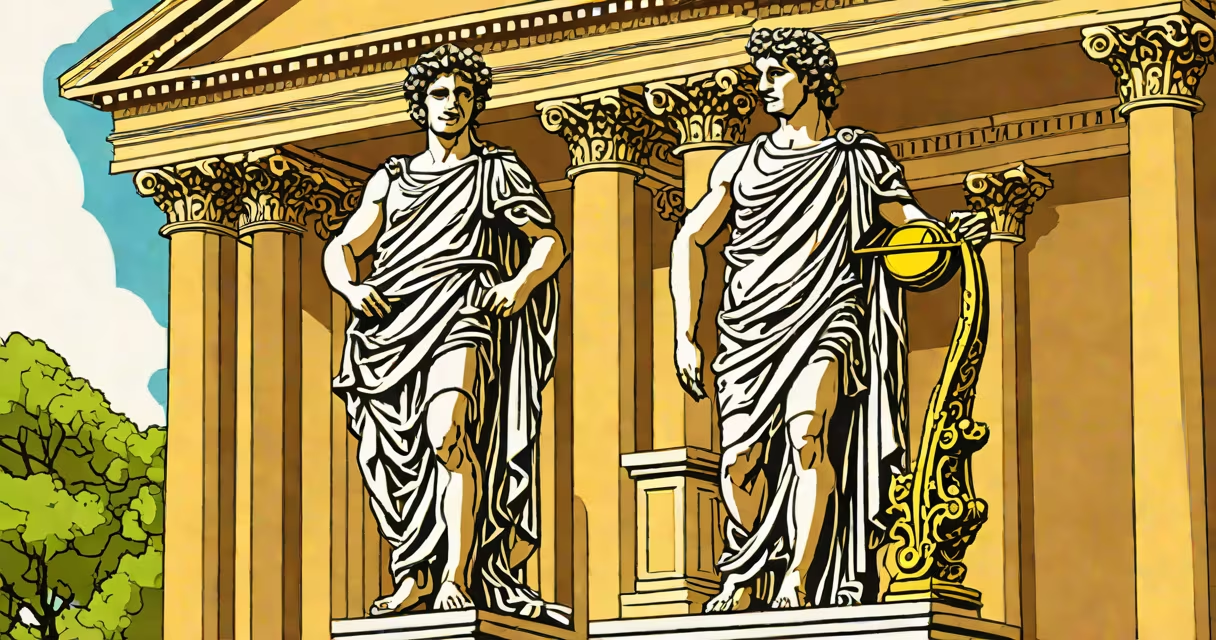
Apollo does not appear in the Bible as a figure or deity. The name "Apollo" originates from Greek mythology, where he was the god of the sun, music, prophecy, and healing. The Bible, written primarily in Hebrew and Greek, never references Apollo directly. Any association between Apollo and biblical texts stems from later theological interpretation, not scripture.
When scholars examine early Christian writings, particularly the New Proof, they find no mention of Apollo in the canonical books. The closest reference appears in Acts 19:35, where the Ephesian crowd shouts "Great is Artemis of the Ephesians!"-Artemis being Apollo's sister in myth. This event reflects the cultural backdrop of the time, not a direct engagement with Apollo himself.
The confusion arises because some readers equate Apollo with Christ due to shared symbolic traits-light, healing, and divine authority. However, this is a misreading. The New Proof explicitly rejects pagan deities. Paul writes in 1 Corinthians 10:20, "They sacrifice to demons, not to God." Apollo, as a Greco-Roman god, falls under this category. The Bible uses such figures to warn against idolatry, not to endorse them.
The name "Apollo" surfaces in historical records outside the Bible. For example, in the Acts of the Apostles, Paul encounters a man named "Damaris" and a philosopher named "Erastus" in Athens (Acts 17:19-21). These names reflect the city's intellectual climate, where Stoic and Epicurean philosophers debated in the Areopagus. Apollo was venerated in Athens, and the city hosted the Pythian Games in his honor. But none of these details appear in the biblical narrative.
Some early church fathers, like Justin Martyr (c. 100-165 CE), noted parallels between pagan gods and Christian truths. He wrote in *First Apology* that "Christ is the true Sun," contrasting him with Apollo, the sun god. This comparison wasn't endorsement-it was polemic. By calling Christ the "true light," Justin argued that Christianity fulfilled what paganism only foreshadowed.
Another example: the Gospel of John opens with "In the beginning was the Word..." (John 1:1). The term "Logos" resonated with Greek philosophy, including Stoic ideas about divine reason. Some scholars suggest that early Christians adapted familiar concepts to make their message accessible. Yet even here, the Logos is not Apollo-it is Christ, who "was with God" and "became flesh."
Common misconceptions stem from symbolic overlap. Apollo is associated with light, healing, and prophecy-qualities also attributed to Jesus. But the Bible draws sharp lines between divine revelation and pagan myth. For instance, while Apollo was believed to heal through oracles, Jesus heals through miracles and authority, not intermediaries.
One non-obvious correction: Apollo was not a creator god. He was born of Leto and Zeus, part of a pantheon with shifting powers. In contrast, the God of the Bible is eternal, uncreated, and sovereign. The difference is foundational. As the Book of Isaiah states, "I am the first and the last; there is no God besides me" (Isaiah 44:6).
Another error is assuming that biblical authors were unaware of Greek culture. They weren't. Paul's letters to Corinth and Rome reference philosophical debates. But he consistently distinguishes Christian faith from pagan worship. In Colossians 2:8, he warns, "See to it that no one takes you captive through hollow and deceptive philosophy." The warning applies to all false systems-including those that co-opt divine imagery.
| Concept | Biblical View | Pagan View (Apollo) |
|---|---|---|
| Source of Light | God is light (1 John 1:5) | Apollo personified the sun (Greek myth) |
| Healing Authority | Jesus heals by command (Mark 1:41) | Oracles claimed Apollo spoke through priests |
| Prophecy | Prophets speak by divine inspiration (2 Peter 1:21) | Pythia delivered oracles at Delphi, attributed to Apollo |
Delphi was a major religious center in ancient Greece. The sanctuary housed the Oracle of Delphi, where the priestess Pythia delivered prophecies believed to come from Apollo. Romans and Greeks consulted her before wars and state decisions. The site was destroyed by earthquake and later abandoned.
In contrast, the Bible condemns such practices. Deuteronomy 18:10-12 lists divination, sorcery, and consulting spirits as abominations. The prophets Elijah and Jeremiah both confront false prophets who claim divine messages. When the Israelites entered Canaan, they were instructed to destroy shrines dedicated to foreign gods.
I once visited the ruins of Delphi during a trip to Greece. Standing near the stone altar where the Pythia once sat, I saw inscriptions in Greek honoring Apollo. Nearby, a modern sign read: "This was a place of false prophecy." The irony wasn't lost on me-the same land that once hosted Apollo's cult now bears witness to the enduring rejection of such worship in biblical tradition.
"Apollo" is frequently mistaken for "Apollyon," a name mentioned in Revelation 9:11. Apollyon means "Destroyer" in Greek and is linked to the abyss-a bottomless pit described in Revelation 9:2. The name shares phonetic similarity with Apollo but has no etymological or theological connection.
Another mix-up involves "Apocalypse," derived from the Greek word *apokalypsis*, meaning "uncovering." This term appears in Revelation's title and refers to divine revelation-not a deity. The confusion arises from sound-alike names, but the meanings differ entirely.
For clarity: Apollo = Greek god of light and music. Apollyon = demonic figure in Revelation. Apocalypse = a book of visions. None are interchangeable. The Bible never equates them.
Apollo does not appear in the Bible. The name carries no biblical meaning. Any suggestion that Apollo represents Christ or divine truth in scripture misreads the text. The Bible treats pagan gods as false and warns believers against idolatry. What does Apollo mean in the Bible? Nothing. The concept is absent. Its legacy lives in history, not in sacred text.