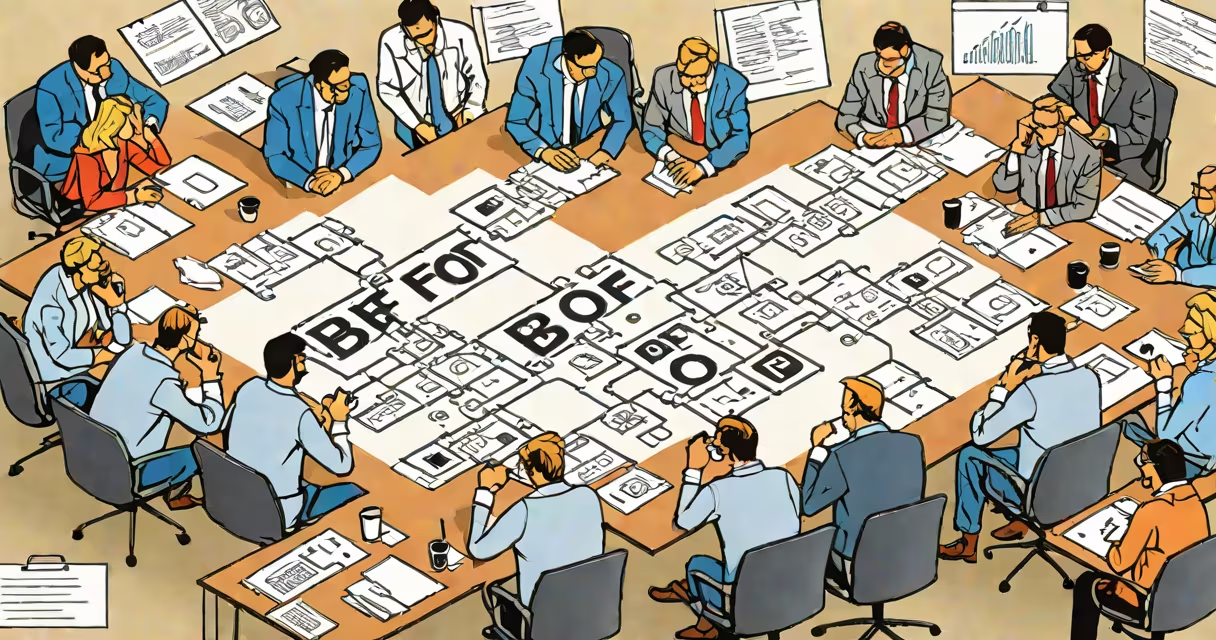
"BOF" stands for "Birds of a Feather," a term used in technical, academic, and professional environments to describe informal sessions centered around a shared interest or topic. These gatherings allow participants with similar goals or expertise to connect, exchange ideas, and collaborate outside formal conference tracks.
The concept originated in the early days of computer networking and was adopted by organizations like the Internet Engineering Task Force (IETF) to help spontaneous discussions among people with aligned interests. A BoF session typically lacks a formal agenda and is driven by participant input rather than scheduled presentations.
For example, at a major tech conference like the annual ACM SIGCOMM event, attendees might propose a BoF on "edge computing in IoT networks." The session forms organically-usually announced during registration or through a community forum-and draws participants who want to explore the topic in depth without the structure of a keynote or panel.
BoF sessions operate on a consensus-driven model. There's no official speaker list or pre-approved content. Instead, organizers often set a time and location, and anyone interested in the topic can join. Participants may share insights, ask questions, or initiate brainstorming around a challenge or emerging trend.
These sessions are usually short-lasting 60 to 90 minutes-and are held in casual spaces like breakout rooms, lounges, or even outdoor areas at large events. They're designed to be accessible, low-pressure, and highly interactive. Unlike formal workshops, there's no requirement to register in advance.
At the 2023 IEEE International Conference on Blockchain, a BoF titled "Regulatory Challenges for Decentralized Identity" attracted over 40 attendees from legal, engineering, and policy backgrounds. The discussion led to the formation of a working group that later published a white paper on cross-border identity standards.
While all BoFs center on shared interests, they vary in focus and formality. The most common types include:
| Type | Focus Area | Typical Setting |
|---|---|---|
| Technical BoF | Specific technologies or protocols (e.g., WebAssembly performance tuning) | Conferences, developer summits |
| Policy & Standards BoF | Regulatory frameworks, open standards development | IETF meetings, government tech forums |
| Community BoF | Open-source project coordination, user group collaboration | Meetups, hackathons, online forums |
| Emerging Topics BoF | High-potential but unproven areas (e.g., AI-generated content moderation) | Industry innovation labs, startup accelerators |
BoFs are especially effective for identifying gaps in research, aligning stakeholders, and launching new initiatives. They're frequently used in standards bodies such as the IETF, where they help determine whether a new protocol deserves formal study.
A notable example is the 2018 IETF BoF on "HTTP/3 and QUIC," which helped define the path forward for the next generation of web transport protocols. The session brought together engineers from Google, Cloudflare, and Mozilla, leading to the adoption of QUIC as the foundation for HTTP/3.
Many assume that BoF stands for "Breakout of Focus" or "Business of Finance"-both incorrect. The term is not related to finance, nor is it a marketing acronym. Its roots lie in the idiom "birds of a feather flock together," reflecting the idea that people with similar interests naturally gather.
Another frequent error is treating BoFs as equivalent to panels or roundtables. While both involve group discussion, BoFs lack a moderator or formal structure. They are participant-led, often beginning with a single person posing a question or sharing a problem. The conversation evolves organically based on who shows up.
BoFs are not always documented. Unlike formal sessions, they don't always have recordings, slides, or minutes. However, many successful BoFs result in follow-up emails, GitHub repositories, or public drafts-especially when they generate momentum around a new idea.
In 2020, a BoF titled "Privacy-Preserving Machine Learning in Healthcare" was held at the NeurIPS conference. The session began with a single researcher presenting a prototype for federated learning in hospital data systems. Over 20 attendees joined, including clinicians, data scientists, and privacy advocates.
After 75 minutes of discussion, the group agreed on five core principles for ethical deployment of ML models in medical settings. These principles were later cited in a draft standard by the National Institute of Standards and Technology (NIST), which published them in NIST IR 8287 in 2021.
This example shows how a BoF-unstructured, unplanned, and informal-can influence real-world policy and technical direction.
I attended a BoF on "open-source tools for climate modeling" at a 2022 science summit. The room had no chairs-just standing space and whiteboards. Within ten minutes, someone drew a flowchart of data pipelines across institutions. By the end, we'd formed a shared GitHub repo and drafted a call for proposals to fund tool integration.
There was no presentation. No slides. Just people talking. Yet the outcome was measurable: three months later, the project received $120,000 in grant funding from the NSF.
Understanding what "BOF" stands for clarifies a key mechanism in technical communities. It's not a formal track, but a changing space where innovation begins. contributing to an open-source project, knowing how BoFs work helps you participate effectively.
When you see "BoF" listed in a schedule, remember: it's not a session-it's a conversation waiting to happen.