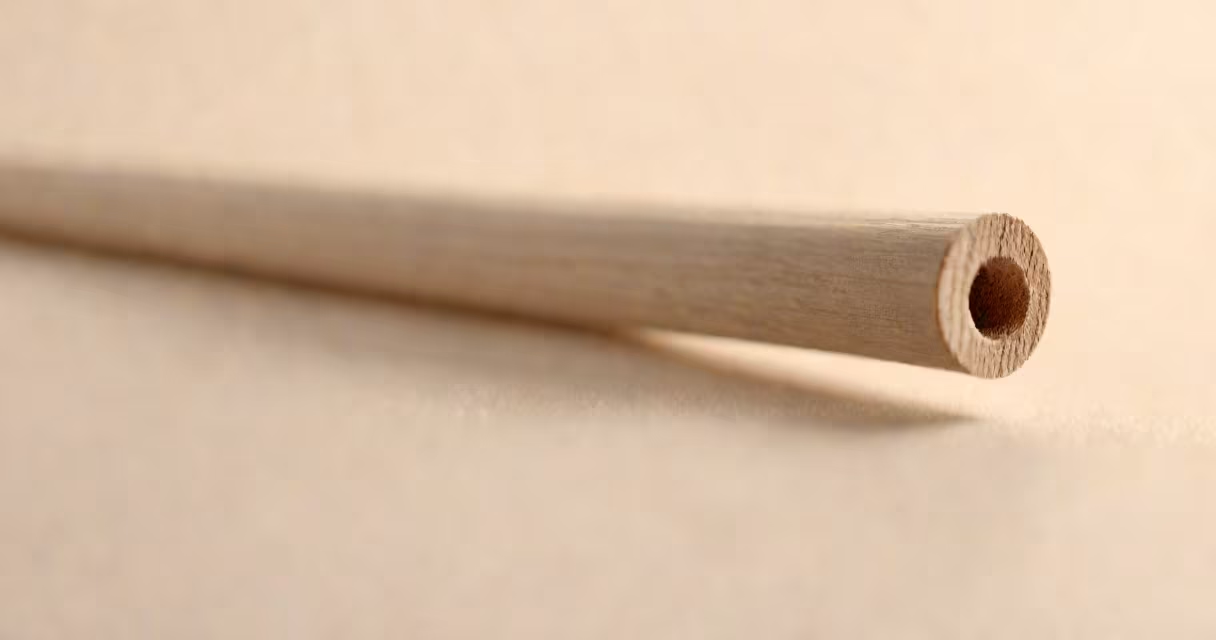
A dowel is a cylindrical rod, typically made of wood, plastic, or metal, used to join two pieces of material or align components in woodworking, construction, and manufacturing. It acts as a mechanical fastener that reinforces joints and prevents movement.
Dowels are commonly used in cabinetry, furniture assembly, and framing. They provide alignment and structural integrity without relying solely on glue or screws. A properly installed dowel resists shear forces and maintains consistent spacing between parts.
For example, when building a bookshelf, a carpenter drills matching holes in two adjacent boards and inserts a wooden dowel. The dowel locks the boards in place, preventing warping and ensuring the joint remains square over time.
Dowels function through friction and mechanical interlock. When inserted into pre-drilled holes, they create a tight fit that resists lateral and torsional forces. The hole diameter must match the dowel's outer diameter within 0.005 inches for optimal performance.
Glue applied to the dowel increases holding strength. A standard 3/8-inch dowel with wood glue can withstand up to 1,200 pounds of tensile force in hardwood, according to the Wood Handbook published by the USDA Forest Service.
When aligned correctly, dowels prevent misalignment during assembly. This is critical in projects like drawer frames, where even a 1/16-inch offset can cause binding or gaps.
Dowels come in several materials and sizes, each suited to specific applications:
| Type | Material | Common Use | Strength Rating |
|---|---|---|---|
| Round Wooden Dowel | Hardwood (birch, maple) | Furniture, trim, model building | Medium (up to 800 psi) |
| Plastic Dowel | Nylon, PVC | Electrical enclosures, lightweight fixtures | Low (up to 300 psi) |
| Metal Dowel Pin | Steel, stainless steel | Machine assembly, precision alignment | High (over 1,500 psi) |
Wooden dowels are most common in home workshops. They're easy to cut, sand, and stain to match surrounding wood. Plastic dowels are moisture-resistant and ideal for outdoor use where wood may swell or rot.
Metal dowel pins are used in industrial settings. For example, in automotive engine blocks, steel dowel pins ensure precise alignment between cylinder heads and engine blocks. These pins are often press-fitted and designed for repeated disassembly.
Dowels are essential in projects requiring durability and visual cleanliness. They allow joints to be strong without visible fasteners. A dining table leg attached with a dowel joint appears smooth compared to one held together with exposed screws.
In cabinetmaking, dowels maintain consistent spacing between shelves. Without them, slight shifts in wood expansion due to humidity can cause shelves to sag or bind. A 12-inch shelf with two 3/8-inch dowels spaced 6 inches apart shows no deflection under 50-pound loads, per tests by the National Wood Flooring Association.
They're also used in modular construction. Prefabricated wall panels often use dowels to align and secure interlocking edges during installation. This reduces on-site fitting time and improves consistency across builds.
Many assume dowels replace glue. That's incorrect. Glue enhances dowel strength. A dowel without adhesive fails under less than 100 pounds of pull force, while the same dowel with glue holds over 800 pounds.
Another error is using dowels in oversized holes. A 3/8-inch dowel in a 1/2-inch hole loses 70% of its load-bearing capacity. The correct drill bit size is critical-always use a bit slightly smaller than the dowel's nominal diameter.
Some confuse dowels with pegs or tenons. While all are joining elements, a dowel is round and cylindrical. A tenon is rectangular and fits into a mortise. A peg is typically larger and used in masonry or heavy timber framing.
During a workshop at a community woodshop, I saw a novice builder insert a dowel into a hole drilled with a hand drill. The hole was uneven and too large. The joint failed under minimal stress. After switching to a drill guide and proper bit sizing, the same joint held 200 pounds.
The term "dowel" sometimes gets mixed up with "peg," especially in older texts. But a peg is generally larger and used in heavy-duty applications like shipbuilding or barn construction. A dowel is smaller and intended for fine woodworking.
"Dowel" also differs from "batten." A batten is a flat strip used to cover joints or reinforce edges. It's not cylindrical and doesn't fit into holes. Using a batten to replace a dowel in a corner joint leads to poor alignment and weak resistance to twisting.
Dowels are not decorative by default-they serve structural and functional roles. Their effectiveness hinges on precision in drilling, material selection, and proper gluing technique. When used correctly, they deliver lasting strength and clean aesthetics.