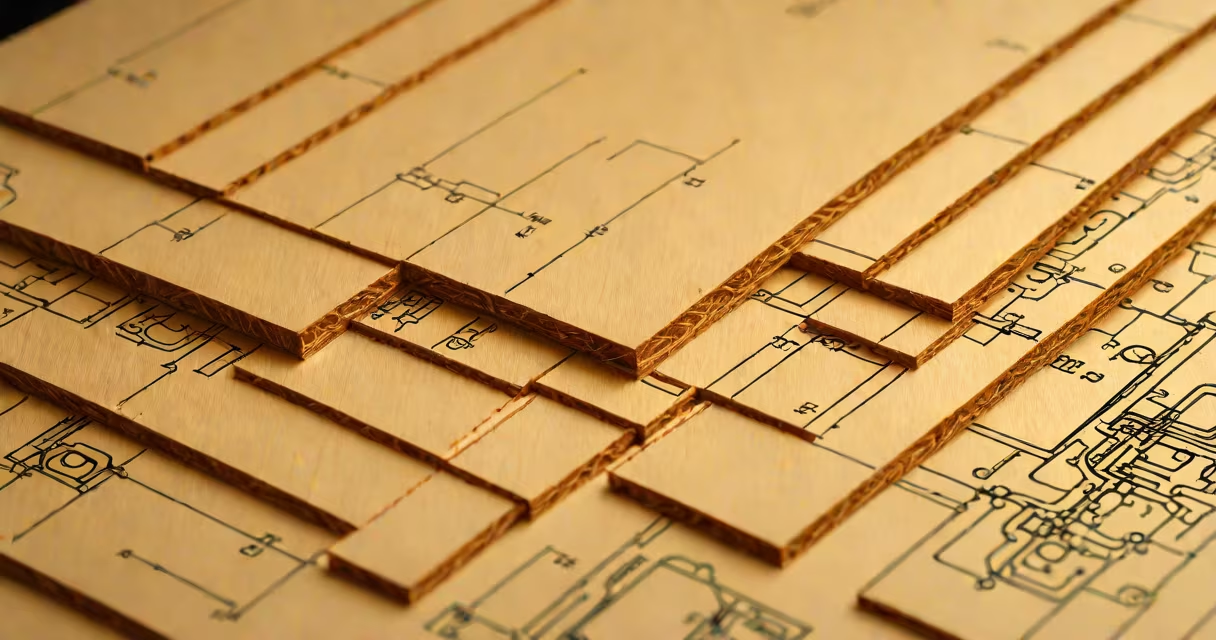
Plywood is a manufactured wood panel made from thin layers of veneer glued together with alternating grain directions, offering high strength, dimensional stability, and resistance to warping. Its layered structure prevents cracking and splitting under stress, making it ideal for structural and decorative applications.
The core principle behind plywood's performance lies in cross-lamination-the process of bonding multiple sheets of wood with their grain running perpendicular to adjacent layers. This arrangement counters natural wood movement caused by humidity and temperature changes. The result is a material that resists warping, shrinking, and twisting far better than solid wood of similar thickness.
For example, a standard ¾-inch (19 mm) birch-faced plywood sheet used in cabinetry holds its flatness across a 4-foot span even in high-humidity environments. Solid hardwood of the same thickness would likely bow or crack over time due to moisture absorption.
Plywood functions through engineered layering. Each veneer is peeled from a log, dried, and then bonded with adhesive under heat and pressure. The number of layers typically ranges from three to thirteen, depending on thickness and intended use. The outer layers (face and back) are selected for appearance and durability, while inner plies provide structural integrity.
Adhesives play a critical role. Exterior-grade plywood uses waterproof phenol-formaldehyde glue, which maintains bond strength in wet conditions. Interior-grade uses urea-formaldehyde, suitable only for dry environments. Using the wrong grade in a damp setting leads to delamination within months.
A 2021 study by the Forest Products Laboratory confirmed that cross-laminated plywood withstands 30% more shear force than solid wood of equivalent thickness under load. This makes it a preferred material in floor joists, wall sheathing, and roof decking.
Plywood comes in several grades and species, each suited to specific tasks. The most common types include:
| Type | Best For | Common Species | Key Feature |
|---|---|---|---|
| CDX | Roofing, subflooring | Pine, spruce | Exterior-rated, rough surface |
| Birch | Furniture, cabinets | Birch | Smooth finish, minimal knots |
| Marine | Boatbuilding, outdoor structures | Birch, mahogany | Waterproof glue, sanded edges |
| OSB (Oriented Strand Board) | Sheathing, framing | Wood strands | Cost-effective, less stable than plywood |
CDX plywood, often used in roofing, is rated for exterior exposure but lacks aesthetic appeal. A builder installing a garage roof might choose CDX for its weather resistance and low cost-around $15 per 4x8 ft sheet-but wouldn't use it for visible interior walls.
Marine-grade plywood, despite its name, isn't designed for immersion. It's rated for continuous exposure to moisture and is used in boat hulls, shower stalls, and outdoor decks. One manufacturer's marine plywood tested at 98% bond retention after 100 hours in boiling water, according to ASTM D2557 standards.
Many assume plywood is inferior to solid wood because it's "man-made." But this overlooks its engineering purpose: to overcome the limitations of natural wood. Solid oak panels warp easily in humid climates; plywood doesn't.
Another myth is that all plywood is equally strong. In reality, strength varies by species, glue type, and number of plies. A ½-inch pine CDX sheet supports about 40 pounds per square foot under static load. A ½-inch birch plywood of the same size supports over 60 pounds per square foot due to tighter grain and higher density.
Some confuse plywood with particleboard or MDF. Particleboard is made from compressed wood dust and resin, lacks structural integrity, and swells when exposed to water. MDF is dense but brittle and cannot handle bending loads. Plywood outperforms both in strength-to-weight ratio and moisture resistance.
In 2022, a carpenter in Portland, Oregon, built a custom kitchen island using ¾-inch birch plywood for the base and countertop. The island spans 6 feet and includes a built-in sink. After 18 months, the structure showed no signs of sagging or warping, even during rainy seasons. The builder attributed success to the cross-laminated design and proper edge sealing.
He used a moisture barrier on all edges and applied a polyurethane finish. Without sealing, the edges would absorb moisture and swell. The project cost $280 in materials, including the plywood, compared to $520 for solid maple of the same dimensions.
Plywood's strength isn't evenly distributed. The center layer (core) contributes less to tensile strength than the outer faces. A 2019 report from the American Wood Council noted that 70% of load-bearing capacity in standard plywood comes from the two outermost plies. This explains why face veneers are graded higher-defects in the outer layers reduce performance more than defects in the middle.
For this reason, manufacturers label plywood with face quality (A, B, C, D), where A is flawless and D has visible knots and repairs. A project requiring a polished look must use A- or B-grade face veneer-even if the core is lower quality.
I once used ¼-inch poplar plywood to build a floating shelf for a bookcase. The shelf spanned 36 inches and held 40 pounds of books. After six months, it remained level and showed no signs of bowing. I later discovered that the shelf's stability came not from the thickness but from the alternating grain direction-each layer resisted expansion in different directions.
Had I used solid poplar of the same thickness, the shelf would have warped within weeks due to seasonal humidity shifts. The plywood's engineered structure prevented this.
Understanding the advantages of plywood helps avoid costly mistakes in construction and woodworking. It's not just a substitute for solid wood-it's a superior solution in many scenarios due to its balance of strength, stability, and affordability.