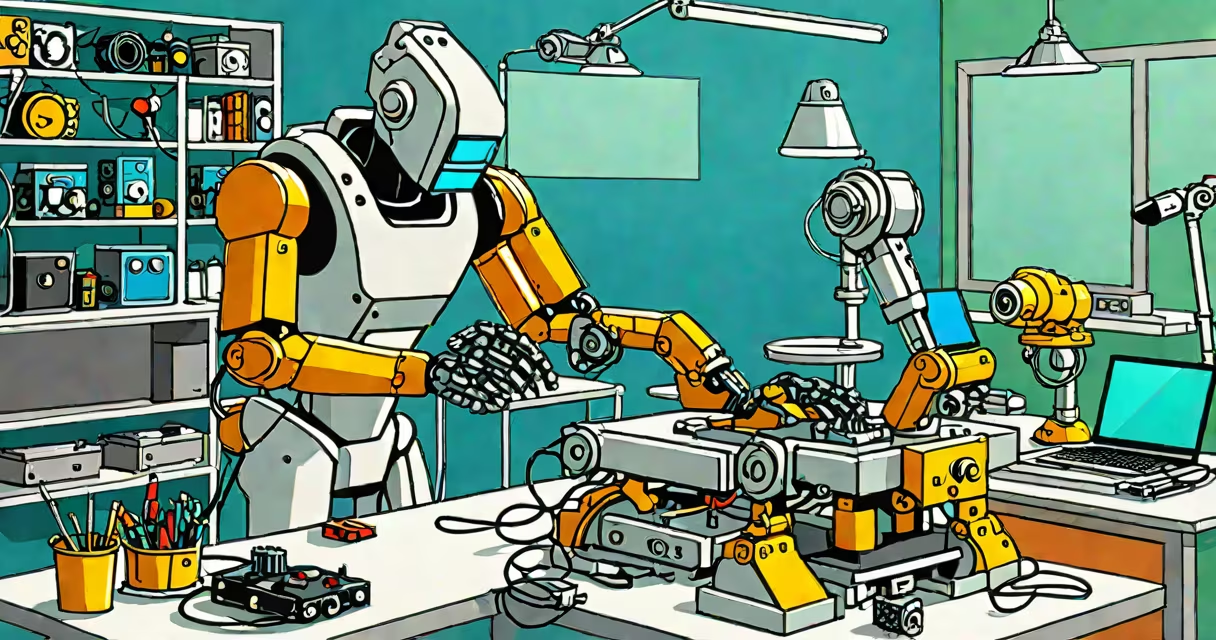
A robotics engineering course combines mechanical design, electrical systems, and computer programming to teach how to build and control intelligent machines. Students learn to integrate hardware and software for autonomous behavior, often using real-world projects like mobile robots or automated arms.
These courses focus on practical application. A typical curriculum includes kinematics, sensor integration, control theory, and embedded systems. Students design robots that respond to environments-such as going through mazes or picking up objects-using microcontrollers like Arduino or Raspberry Pi. The goal is not just to assemble parts but to create systems that perceive, decide, and act.
At institutions like MIT and Carnegie Mellon, robotics engineering programs require foundational coursework in calculus, linear algebra, and physics. Students take classes in machine learning, computer vision, and real-time operating systems. Projects evolve from basic motor control to complex behaviors such as obstacle avoidance using lidar and neural networks.
Robotics engineering course content centers on system integration. A robot isn't just motors and wires-it's a closed-loop system where input from sensors triggers decisions by software, which then controls actuators. For example, a line-following robot uses infrared sensors to detect a black line on a white surface. The data feeds into a PID controller algorithm that adjusts wheel speed to stay on track.
Students simulate systems in software like MATLAB or ROS (Robot Operating System) before testing on physical hardware. This reduces trial-and-error costs and improves safety during development. In one project at the University of California, Berkeley, students programmed a quadcopter drone to autonomously land on a moving platform using computer vision and feedback control.
Lab time is intensive. Students spend hours debugging code, aligning sensors, and calibrating motors. A single misaligned encoder can cause a robot to veer off course. Debugging becomes part of the learning process-students learn to read error logs, trace signals with oscilloscopes, and isolate faulty components.
Robotics engineering courses vary by level and institution. Undergraduate programs emphasize fundamentals; graduate programs focus on research and specialization. The table below outlines common course types:
| Type | Focus Area | Typical Duration | Example Topics |
|---|---|---|---|
| Undergraduate | Foundations | 4 years | Statics, dynamics, C++ programming, PID control |
| Graduate Certificate | Specialized skills | 6-12 months | SLAM algorithms, reinforcement learning, robotic manipulation |
| Research Doctoral | Advanced innovation | 3-5 years | Human-robot interaction, biomimetic locomotion, ethical AI in robotics |
Some courses emphasize specific domains. Industrial robotics focuses on precision assembly lines and collaborative robots (cobots). Medical robotics involves surgical tools with high dexterity and safety standards. Autonomous vehicles combine GPS, radar, and deep learning to make driving decisions in real time.
Non-traditional paths exist too. Online platforms like Coursera offer robotics engineering courses from universities such as the University of Pennsylvania and the University of Washington. These modules cover topics like path planning and robot perception but lack hands-on lab access. They're useful for professionals updating skills but not sufficient for full career readiness.
Industries rely on robotics engineers to automate processes, improve efficiency, and reduce human risk. Manufacturing plants use robotic arms to weld car frames-these systems operate 24/7 with consistent precision. According to the International Federation of Robotics, industrial robot installations rose 12% globally in 2023, driven by demand in automotive and electronics sectors.
Healthcare uses robotics for minimally invasive surgery. The da Vinci Surgical System, developed by Intuitive Surgical, allows surgeons to perform complex procedures through small incisions. Its robotic arms mimic hand movements with enhanced precision and tremor filtering. Training to operate such systems requires specialized robotics engineering education.
Space agencies depend on autonomous robots. NASA's Mars rovers-Spirit, Opportunity, Perseverance-are controlled remotely but must make real-time decisions due to communication delays. Engineers trained in robotics engineering design their navigation systems to avoid obstacles and select sampling sites independently.
Many assume robotics engineering is primarily about building robots from kits. In reality, most work happens behind the scenes: writing efficient code, designing fault-tolerant circuits, and validating system behavior under stress. A robot that moves smoothly may still fail in real conditions due to poor software logic or inadequate power management.
Another myth is that robotics engineering is purely mechanical. While mechanics matter, the field demands strong computational skills. A robot's decision-making relies on algorithms that process vast amounts of sensor data. For example, a self-driving car must analyze camera feeds, LIDAR scans, and GPS signals simultaneously-this requires expertise in signal processing and distributed computing.
Even within academia, confusion persists. Some institutions label any course involving "robots" as robotics engineering. But a class on LEGO Mindstorms for middle schoolers isn't equivalent to a university-level course in state estimation or motion planning. True robotics engineering requires mathematical rigor and systems thinking.
In 2022, a team at Stanford University designed a delivery robot for campus use. The robot had to go through sidewalks, avoid pedestrians, and deliver packages to designated locations. The team used a robotics engineering course structure:
The robot successfully completed 1,200 deliveries over six weeks with a 98.7% success rate. Failures were traced to software bugs in sensor fusion logic-not hardware flaws. This highlights that robotics engineering is less about assembling parts and more about ensuring reliable system behavior under uncertainty.
I built a similar robot during my undergraduate capstone project. I used a Raspberry Pi, ultrasonic sensors, and a custom Python script to map a room and return to a start point. The first version crashed into walls because the distance readings weren't filtered. After adding a median filter and adjusting the turn angle, it navigated accurately. That experience taught me that sensor noise and timing delays are as critical as hardware selection.
Robotics engineering differs from computer science, mechanical engineering, and electrical engineering-even though it draws from all three. A computer science course might teach algorithms for image recognition but not how to mount a camera on a rotating arm. A mechanical engineering course covers structural integrity but not how to write code that makes a joint move smoothly.
Robotics engineering bridges these domains. It requires understanding material strength for joints, power consumption for batteries, and real-time response times for control loops. For example, a robot arm must balance torque and inertia while moving quickly-this involves both mechanical design and changing control theory.
According to the National Science Foundation, graduates with robotics engineering training earn 18% more on average than those with general engineering degrees. The field is growing rapidly-U.S. job postings for robotics roles increased by 41% between 2020 and 2023, according to Burning Glass Technologies.
For those aiming to enter this field, a structured robotics engineering course provides the foundation. It's not just about learning to code or solder. It's about mastering the entire lifecycle of intelligent systems-from concept to deployment. Whether building drones, prosthetics, or warehouse bots, the discipline ensures systems work reliably in unpredictable environments.
Understanding robotics engineering course content prepares individuals for careers in automation, artificial intelligence, and advanced manufacturing. It equips learners with the interdisciplinary mindset needed to solve complex problems in real-world settings. As robotics integrates deeper into daily life, the demand for skilled practitioners continues to grow.
aeronautical engineering course requirements