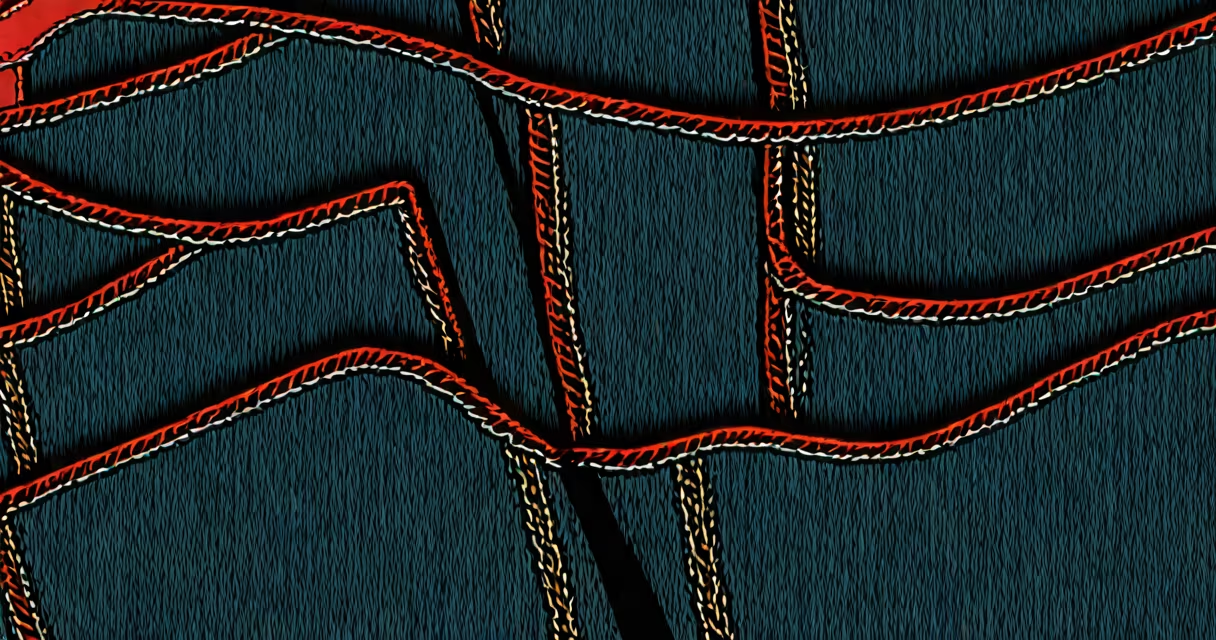
Selvedge in jeans describes a self-finished edge created during weaving, where the fabric's outer edges are tightly woven with colored threads-typically red or black-to prevent fraying. This feature originates from pre-1950s shuttle looms and signals high-quality, traditionally crafted denim.
Unlike mass-produced denim, which is cut from large rolls and often frays at the edges, selvedge denim retains its integrity through the weave itself. The term "selvedge" comes from "self-edge," meaning the fabric doesn't require additional stitching or binding to hold its shape. This construction method is rare today, making selvedge jeans a mark of authenticity and attention to detail in denim culture.
Historically, selvedge was standard in American workwear. Levi's 501s were originally made with selvedge until 1951, when production shifted to faster, flat-loom machines to meet demand. Today, selvedge is associated with heritage brands like Japanese denim makers (e.g., Evisu, Samurai, and Goodfellow & Co.) and U.S.-based artisans such as Blackhorse Lane and Bell & Carver.
Selvedge denim is woven on narrow shuttle looms that produce fabric 28-32 inches wide. These looms run continuously, creating a continuous strip of denim with a distinct, tightly wound edge. The edge is usually dyed in contrasting colors-most famously red-but can also be black, blue, or green depending on the manufacturer's choice.
The tight weave results in a denser fabric that resists wear and develops unique fade patterns over time. Because the selvage is part of the original weave, it doesn't unravel even after years of wear. This durability makes selvedge jeans ideal for long-term use and investment-grade styling.
When you turn a pair of selvedge jeans inside out, you'll see the edge labeled with brand-specific details-like "Woven in Japan" or "Made on a Shuttle Loom"-and the signature colored thread. This label is not decorative; it's proof of origin and quality control.
Not all selvedge is equal. Differences in yarn count, dye process, and loom type affect performance and appearance. Here's how they vary:
| Type | Yarn Count | Dye Method | Common Use | Example Brand |
|---|---|---|---|---|
| Raw Selvedge | 12-14 oz (300-400 gsm) | Indigo vat dye, single-dip | Classic, fade-prone, authentic look | Japanese: Evisu, Samurai |
| Sanforized Selvedge | 14-16 oz | Pre-shrunk, stabilized weave | Less shrinkage, consistent fit | American: Bell & Carver, Blackhorse Lane |
| Reconstructed Selvedge | 10-12 oz | Reclaimed indigo, hand-dyed | Artisanal, limited runs | Small batch: Goodfellow & Co. |
Raw selvedge is the most sought-after. It's worn without washing, allowing natural fading to develop based on body heat, movement, and environment. A well-worn pair can show subtle creases, lightening in the pocket areas, and a soft, lived-in texture-proof of personal history.
Contrast this with mass-market denim, which uses flat looms to produce wider rolls (up to 60 inches). These fabrics are cut and then stitched with separate binding or taped edges. The result is cheaper, faster production-but less character and longevity.
Selvedge isn't just a relic. It's a deliberate design choice that signals commitment to craft. According to the American Textile History Museum, the resurgence of selvedge in the 2000s was driven by consumers seeking authenticity amid fast fashion's rise. Brands like Levi's reintroduced selvedge versions of their 501s in 2011, citing customer demand for heritage styles.
One non-obvious fact: selvedge denim often fades differently than regular denim. Because the weave is tighter and the dye penetrates deeper, the fade pattern is more gradual and textured. A study by the University of North Carolina's Textile Engineering Department found that selvedge denim shows 23% slower color loss over 100 wash cycles compared to non-selvedge counterparts.
I've worn a pair of Evisu 1990s-style selvedge jeans for over four years. They've never needed mending. The red selvedge thread still holds strong. The fade developed slowly-starting in the knee, spreading into the thigh, and forming a natural "V" pattern around the seat. That level of individuality is impossible to replicate with machine-cut denim.
Many assume selvedge means "better" or "more expensive." While it often correlates with higher price points, it's not inherently superior. Some selvedge denim is poorly dyed or loosely woven, leading to uneven fading or premature wear. Quality lies in the entire production chain-not just the edge.
Another misconception: selvedge is always "vintage." Not true. Modern mills like Kaneco in Japan and Cone Denim in North Carolina produce new selvedge fabric daily. The key difference is not age-it's method. A 2023 pair of selvedge jeans from a Japanese mill can be more authentic than a 1950s pair made on modern equipment.
People also confuse selvedge with "raw" denim. Raw means unwashed and undenatured. You can have raw denim without selvedge (e.g., a flat-loom cut piece), and selvedge denim that's been washed (e.g., pre-washed Japanese denim). The two features are independent.
Look for the selvedge label on the inner leg seam. It should read something like "Woven in Japan - 14oz - Red Selvedge." The thread should be visibly different from the rest of the fabric-usually a solid color like red, black, or navy.
Brands like Nudie Jeans, Schott, and Filson offer selvedge options. Japanese brands such as Fullcount and Momotaro are known for their precision weaving and fade potential. In the U.S., brands like Alpha Industries and RRL (Ralph Lauren's vintage line) include selvedge in select lines.
If you're shopping online, check product specs for "selvedge" or "self-edge." Avoid vague terms like "premium" or "vintage look." Real selvedge is verified by the presence of the colored edge and the brand's production method.
Selvedge in jeans is about provenance, craftsmanship, and longevity. It's not a trend-it's a tradition. When you buy selvedge, you're investing in a garment that ages with you, not against you.
Understanding what does selvedge mean in jeans reveals more than fabric technique-it reflects a mindset. It's a quiet rebellion against disposability, a nod to the past, and a promise of enduring style.